The reading of a will is intended to formalize the distribution of a deceased person's estate in accordance with their wishes. In most cases, the beneficiaries are clearly identified and the estate is distributed as directed by the testator. However, disputes may arise where a beneficiary is excluded, where there are allegations of undue influence, or where questions are raised regarding the authenticity of the signature or the mental capacity of the testator at the time of execution.
Contesting a will in Kenya is a significant legal undertaking. The process is complex, may involve substantial costs, and requires careful consideration of the legal grounds and available evidence. Where a will is alleged to be invalid, fraudulent, or fails to provide for a dependant as required by law, the legal system provides specific remedies. This article outlines the principal grounds for contesting a will in Kenya, the procedural steps involved, the associated costs and risks, and practical considerations for parties involved in succession disputes.
1. Grounds for Contesting a Will in Kenya
1.1 Lack of Testamentary Capacity
Under Section 5 of the Law of Succession Act, a testator must be of sound mind and capable of understanding the nature and effect of the will at the time of execution. If the testator had dementia, mental illness, intoxication, or any condition that impaired their understanding, the will may be invalid. Medical records, witness testimony, and expert psychiatric evidence are critical in proving lack of capacity. The burden of proof is on the person challenging the will.
1.2 Undue Influence
A will must be the free and voluntary expression of the testator's wishes. If a beneficiary, caregiver, family member, or other person exerted pressure, coercion, or manipulation to induce the testator to make or change the will in their favour, the will may be set aside on grounds of undue influence. Undue influence is often subtle; it does not require physical force or explicit threats. It can take the form of emotional manipulation, isolation of the testator from other family members, or exploitation of a dependent relationship. Proving undue influence requires evidence of the influencer's conduct, the testator's vulnerability, and the unnatural or unfair nature of the will's provisions.
1.3 Fraud and Forgery
If the will was forged, meaning the testator's signature was forged, the will was altered without authorisation, or the testator was tricked into signing a document they did not know was a will, it is void ab initio (invalid from the beginning). Fraud can also occur if the testator was misled about the contents of the will, for example, if someone read a different document to the testator while they signed the actual will. Proving fraud or forgery typically requires handwriting analysis, forensic document examination, and witness testimony.
1.4 Failure to Comply with Formal Requirements
Section 5 of the Law of Succession Act sets out strict formal requirements for a valid will: it must be in writing; signed by the testator or by someone else in the testator's presence and by their direction; and attested by two or more competent witnesses in the presence of the testator. If any of these requirements is not met, for example, if there is only one witness, if the witnesses signed after the testator's death, or if the testator signed in the absence of the witnesses, the will is invalid. However, the court has a limited power under Section 10 to dispense with formal requirements if satisfied that the document expresses the testator's testamentary intentions.
1.5 Dependent's Provision Claims
Even if the will is technically valid, a dependant who is not adequately provided for may apply to the court for reasonable provision from the estate. Under Section 26 of the Law of Succession Act, the court may order provision for: a spouse who is not entitled under the will or intestacy rules; a child who is not entitled or who receives an inadequate share; a financially dependent former spouse; and any other person who was wholly or partially dependent on the deceased. The court considers the size of the estate, the dependant's needs, the claims of other beneficiaries, and the deceased's reasons for exclusion (if any).
1.6 Revocation by a Later Will or Marriage
A will is revoked by a later will that expressly revokes it, or by marriage (unless the will was made in contemplation of that specific marriage). If a beneficiary discovers that the deceased made a later will that was suppressed or hidden, they can challenge the earlier will and seek probate of the later will. Similarly, if the deceased married after making the will and the will did not contemplate that marriage, the will may be partially or wholly revoked.
2. The Process of Contesting a Will
Step 1: File an Objection (Within 30 Days of Publication)
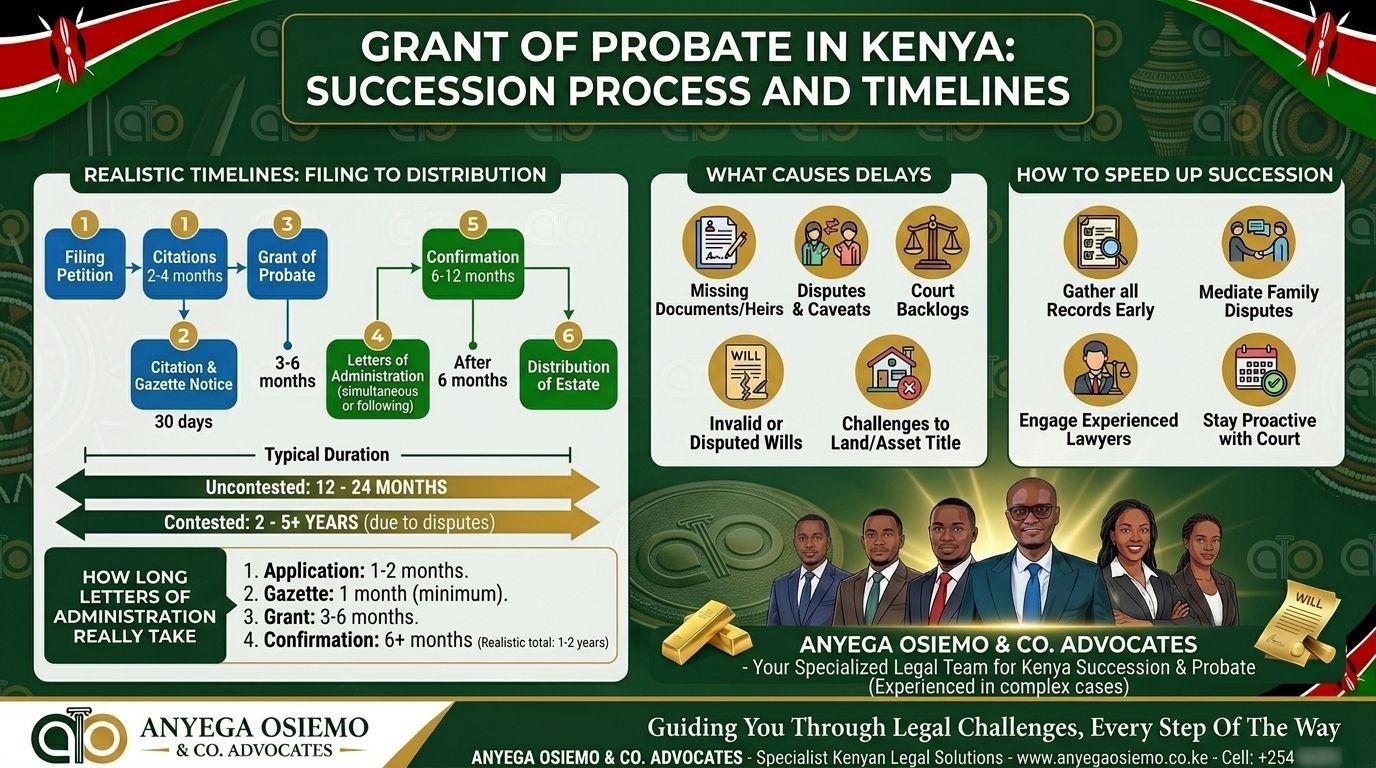
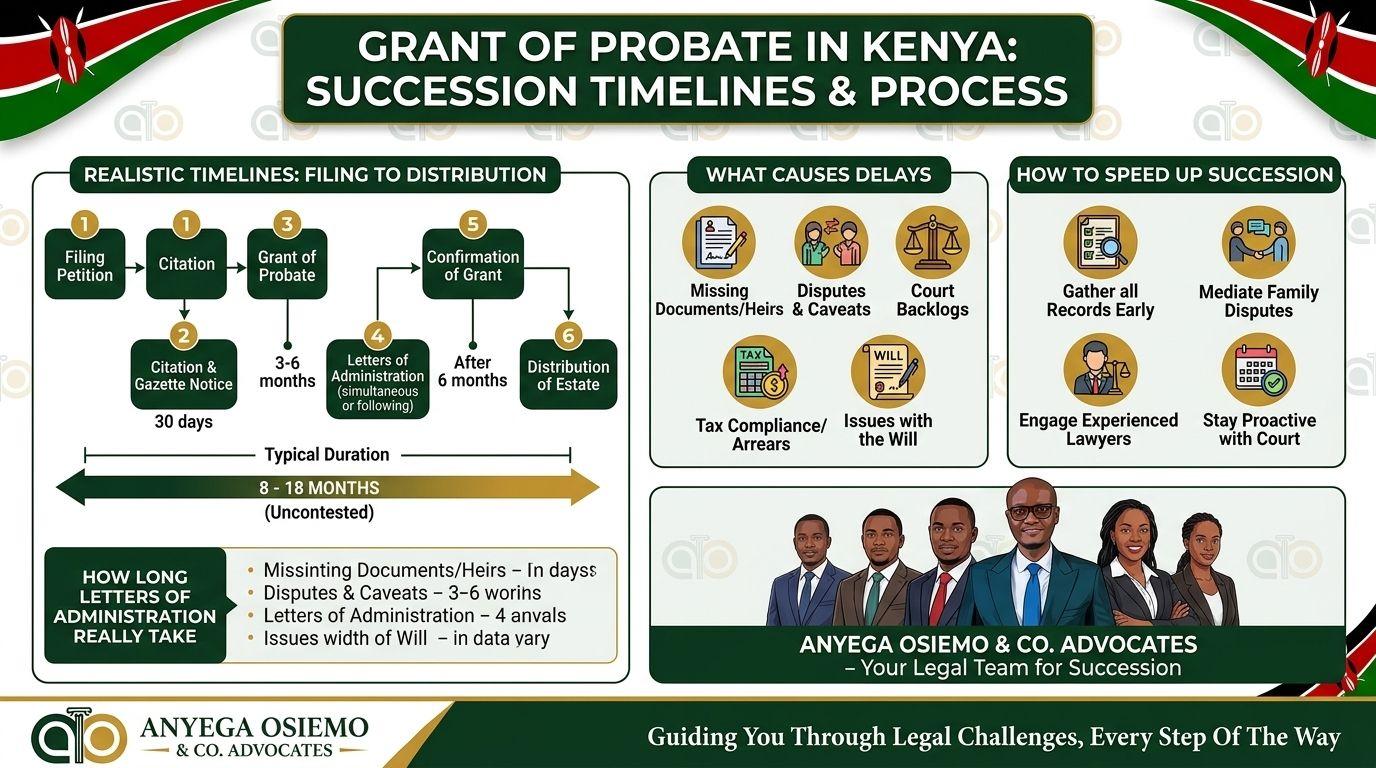
When a probate application is filed, the court publishes a notice in the Kenya Gazette and a local newspaper. Any person with an interest in the estate has 30 days to file a formal objection (a "caveat") with the court. The objection must set out the grounds for challenge and be supported by an affidavit. Failure to file within 30 days does not necessarily extinguish the right to challenge, but it makes the process significantly more difficult.
Step 2: Negotiation and Mediation
Before proceeding to full litigation, the parties should attempt to resolve the dispute through negotiation or mediation. Many disputes arise from family misunderstandings, perceived unfairness, or lack of communication rather than actual fraud. Mediation, conducted by a neutral mediator or through the court-annexed mediation program, can preserve family relationships and avoid the costs and delays of litigation. If mediation succeeds, the parties sign a settlement agreement that is filed with the court and becomes binding.
Step 3: Litigation (If Mediation Fails)
If mediation fails, the objector files a formal suit in the High Court or Magistrate Court. The suit typically seeks: a declaration that the will is invalid; an order setting aside the grant of probate (if already issued); and alternative relief (e.g., intestate distribution or dependent's provision). The litigation process includes: pleadings (petition, response, reply); discovery (exchange of documents, medical records, witness statements); expert evidence (handwriting analysis, psychiatric evaluation); trial (oral evidence, cross-examination); and judgment.
Step 4: Appeal (If Necessary)
The losing party may appeal to the Court of Appeal. Appeals in succession matters can take 1–3 years. The Court of Appeal reviews the lower court's findings of law and fact, but it does not rehear the entire case. New evidence is generally not admitted on appeal.
3. Costs and Risks of Contesting a Will
Will contests are expensive. Costs include:
- Lawyer's fees
- Court fees
- Expert fees: Handwriting analysts, forensic document examiners, and psychiatrists fees.
- Disbursements: Travel, accommodation, and witness expenses.
The losing party may be ordered to pay the winning party's costs. This is a significant risk. If you challenge a will and lose, you may not only lose your own legal fees but also be liable for the executor's and other beneficiaries' costs. Before contesting a will, obtain a realistic assessment of your chances of success. A lawyer can review the evidence, assess the strength of your case, and advise whether the potential reward justifies the risk.
4. Strategies for Success
Strategy 1: Gather evidence early. Medical records, witness statements, and financial documents must be secured before they disappear. Witnesses' memories fade. Medical records may be destroyed after a certain period. Act quickly.
Strategy 2: Engage experts. Handwriting analysis, forensic document examination, and psychiatric evaluation are often decisive in will contests. Choose reputable experts with court experience.
Strategy 3: Consider mediation. Even if you believe you have a strong case, mediation can achieve a faster, less costly, and less emotionally damaging outcome than litigation.
Strategy 4: Be realistic about outcomes. Even if the will is set aside, the estate may be distributed under intestacy rules, which may not be more favourable to you than the will. Calculate the likely outcome under both scenarios before proceeding.
Strategy 5: Protect your costs position. If you are a beneficiary under the will seeking to defend it, the estate may cover your legal costs. If you are an objector, you bear your own costs unless the court orders otherwise.
5. Frequently Asked Questions (FAQ)
Q1: On what grounds can I contest a will in Kenya?
A: The main grounds are: lack of testamentary capacity; undue influence; fraud or forgery; failure to comply with formal requirements; and inadequate provision for dependants. Each ground requires specific evidence and has a different burden of proof.
Q2: How long do I have to contest a will?
A: The best time to file an objection is within 30 days of the court's publication notice. However, challenges can be brought even after probate is granted, though the process becomes more difficult. There is no strict limitation period for challenging a will on grounds of fraud, but delay weakens the case.
Q3: Can I contest a will if I was not named as a beneficiary?
A: Yes, but only if you have a legal basis for the challenge. Being excluded is not sufficient. You must prove that the will is invalid (e.g., due to fraud, undue influence, or lack of capacity) or that you are a dependant entitled to reasonable provision under Section 26.
Q4: What evidence do I need to prove undue influence?
A: Evidence of undue influence includes: the testator's vulnerability (age, illness, dependency); the influencer's opportunity and motive; the unnatural nature of the will's provisions; and witness testimony about the influencer's conduct. Medical records showing the testator's mental state and financial records showing the influencer's control over the testator's affairs are also relevant.
Q5: What happens if the will is declared invalid?
A: If the will is declared invalid and no valid earlier will exists, the estate is distributed under the intestacy rules in the Law of Succession Act. The distribution may or may not be more favourable to the challenger than the will. It is essential to calculate the likely intestate distribution before deciding to challenge.
Q6: Can the estate pay my legal costs if I win?
A: If the court finds that the will is invalid and sets it aside, the court may order that the challenger's costs be paid from the estate. However, this is discretionary. If the court finds that the challenge was frivolous or brought in bad faith, it may order the challenger to pay all costs.
Q7: Should I mediate or litigate?
A: Mediation is usually preferable. It is faster, cheaper, less adversarial, and preserves family relationships. However, if the other party refuses to negotiate in good faith or if the fraud is clear-cut, litigation may be necessary. A lawyer can advise on the best approach for your specific case.
Q8: Can I contest a will from abroad?
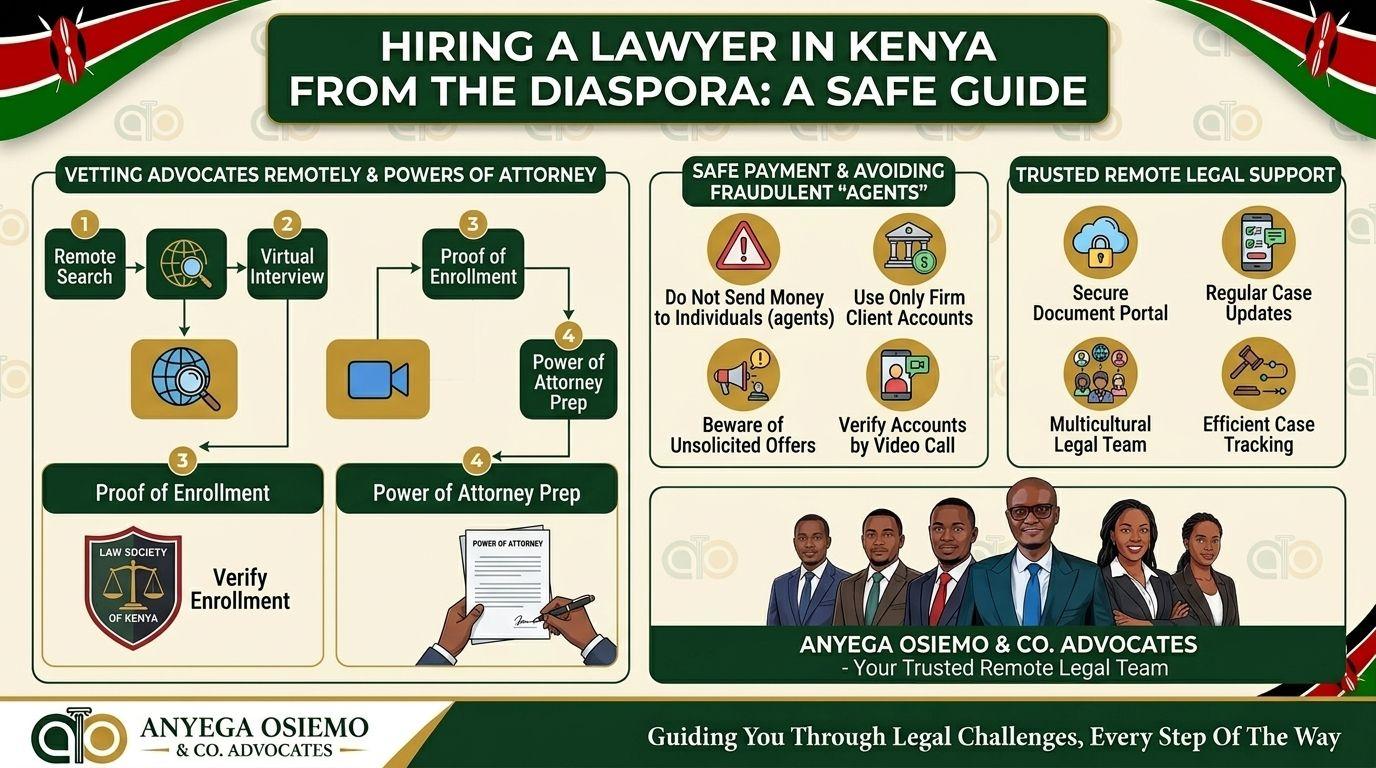
A: Yes. Diaspora beneficiaries can contest wills remotely through a Kenyan lawyer and a Power of Attorney. The process is the same as for domestic challengers, but document authentication and cross-border communication add complexity.
Q9: What if I suspect the executor is hiding assets?
A: You can apply to the court for an order compelling the executor to provide a full inventory and account. If the executor refuses or provides false information, they can be removed and held personally liable for any losses.
Q10: How can Anyega Osiemo & Co. Advocates help?
A: We provide comprehensive will contest services: initial case assessment and merit evaluation; evidence gathering and preservation; engagement of forensic experts; mediation and settlement negotiation; litigation representation at the High Court and Court of Appeal; and diaspora remote representation. We understand that will contests are not just legal disputes; they are family crises. We combine legal rigour with sensitivity to family dynamics to achieve the best possible outcome. Contact us for a confidential consultation.
Conclusion
Contesting a will is one of the most difficult legal decisions a family member can make. It pits grief against justice, love against suspicion, and loyalty against self-interest. But when a will is genuinely invalid, fraudulent, or cruelly unfair, the law provides a path to correction. The key is to act with clarity, evidence, and realistic expectations.
At Anyega Osiemo & Co. Advocates, we have represented challengers, defenders, and executors in will contests across Kenya. We know the emotional toll these cases take, and we are committed to guiding our clients through the process with professionalism, compassion, and strategic acumen. Whether you are considering a challenge, defending a will, or simply seeking clarity on your rights, we are here to help. Contact us today.
Disclaimer: This article is general legal information, not legal advice. For guidance on your specific situation, book a consultation with our advocates.