Kenyans residing in the United States, United Kingdom, United Arab Emirates, Australia, Canada, and other countries frequently face the challenge of managing the estate of a deceased relative in Kenya. Unlike those present in Kenya, diaspora beneficiaries cannot attend law offices or court hearings in person. They must address estate matters from abroad, often while managing employment and other obligations in their country of residence. Despite these constraints, estate administration requires prompt action: property must be secured, bank accounts accessed, debts settled, and decisions made regarding the estate. In some cases, family members in Kenya may begin to act without the input or consent of the diaspora beneficiary.
Administering a Kenyan estate from abroad presents significant legal and procedural challenges for members of the diaspora. The process requires compliance with Kenyan succession law, adherence to foreign document authentication protocols, execution of appropriate powers of attorney, remote court representation, property management, and tax compliance. Family disputes may also arise due to the absence of direct communication. This article provides a comprehensive guide for diaspora Kenyans on the legal steps, documentation, and strategies necessary to administer an estate in Kenya while residing abroad.
1. The Diaspora Probate Challenge: Why It Is Different
1.1 Distance and Time Zone Barriers
The most obvious challenge is distance. A diaspora beneficiary in New York cannot attend a High Court hearing in Nairobi at 9:00 AM Kenyan time (1:00 AM New York time). They cannot visit the Land Registry to check title documents. They cannot meet with family members to discuss estate matters face-to-face. Every action requires coordination across time zones, often with limited windows for real-time communication.
1.2 Documentation and Authentication
Kenyan courts require that documents filed by parties abroad be properly authenticated. This typically involves: notarization by a notary public in the country of residence; apostille certification (for countries that are signatories to the Hague Apostille Convention, including the US, UK, Australia, and most of Europe); or authentication by the Kenyan embassy or high commission (for countries not party to the Hague Convention, such as the UAE). This process can take weeks and costs hundreds of dollars. A single missing apostille can delay the entire probate application by months.
1.3 Family Dynamics and Trust
A significant challenge arises when family members in Kenya assume control of the estate in the absence of the diaspora beneficiary. Property may be occupied without authorization, bank accounts accessed, and assets sold or transferred without proper consent. The diaspora beneficiary may only become aware of these actions through indirect communication. While the legal system offers remedies for such situations, these require timely intervention, which can be complicated by the beneficiary's absence from Kenya.
1.4 Property Management Risks
Vacant property in Kenya is at risk of unauthorized occupation, non-payment of rent by tenants, and neglect of maintenance. Without a local representative holding legal authority, the diaspora beneficiary is unable to secure the property, address unauthorized occupation, or arrange necessary repairs. As a result, the property may deteriorate or be lost before the probate process concludes.
2. Legal Framework: How Diaspora Kenyans Can Administer Estates Remotely
2.1 Power of Attorney: The Foundation of Remote Representation
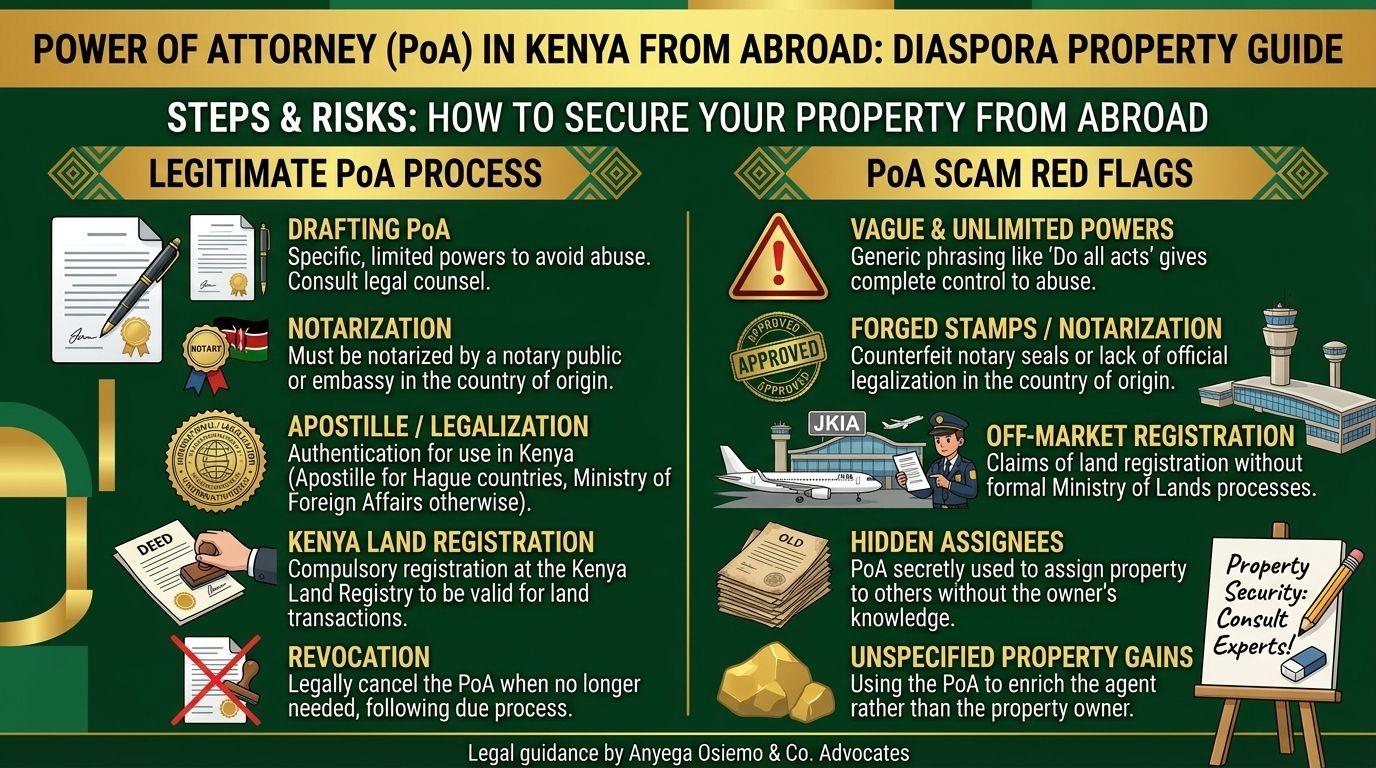
A Power of Attorney (POA) is the most critical tool for administering a diaspora estate. It is a legal document that authorizes a person (the attorney or agent) to act on behalf of the diaspora beneficiary (the principal) in specified matters. For estate administration, the POA must be: specifically drafted for succession matters (a general POA may not be sufficient); duly executed and authenticated in the country of residence; and registered in Kenya if it involves land transactions.
There are two types of POA relevant to diaspora probate: a General Power of Attorney, which grants broad authority to the attorney to act in all matters related to the estate; and a Special Power of Attorney, which limits the attorney's authority to specific actions (e.g., filing a probate application, selling a specific property, or accessing a specific bank account). A General POA is more flexible but carries greater risk if the attorney is untrustworthy. A Special POA is safer but requires the principal to anticipate every action needed, which is difficult in a complex estate.
The POA must be executed before a notary public in the diaspora country, apostilled or authenticated by the Kenyan embassy, and then registered in Kenya. The registration process involves submitting the authenticated POA to the Registrar of Documents in Nairobi, who verifies its authenticity and issues a registration certificate. Only then is the POA valid for use in Kenyan courts and government offices.
2.2 Remote Court Representation
Under the Civil Procedure Act and the Law of Succession Act, a party to court proceedings may be represented by an advocate. For diaspora beneficiaries, this means that a Kenyan lawyer can appear in court, file documents, and conduct litigation on their behalf without the beneficiary being physically present. The beneficiary needs to: engage a Kenyan lawyer and sign a retainer agreement; provide a Power of Attorney authorizing the lawyer to act; and provide instructions and evidence remotely via email, video calls, and authenticated documents.
At Anyega Osiemo & Co. Advocates, we provide dedicated legal services to the diaspora. Our clients in the US, UK, UAE, Australia, and other countries communicate with us via Zoom, WhatsApp, and email. We handle everything from probate applications to property sales to dispute resolution, keeping our clients informed at every stage. Our diaspora clients never need to travel to Kenya unless they choose to.
2.3 Embassy Authentication and Apostille
Documents executed abroad must be authenticated before they can be used in Kenya. The process depends on the country:
Hague Apostille Convention countries (USA, UK, Australia, Canada, most of Europe): Documents are notarized by a local notary public, then apostilled by the designated authority (e.g., the Secretary of State in the US, the Foreign, Commonwealth & Development Office in the UK). The apostille certifies the notary's signature and seal.
Non-Hague countries (UAE, Qatar, Saudi Arabia, most of Africa and Asia): Documents are notarized, then authenticated by the Kenyan embassy or high commission in that country. The embassy verifies the notary's credentials and affixes its own seal and signature.
The authentication process can take 2–6 weeks and cost between USD 50 and 300 per document. For a complete probate application, multiple documents may need to be authenticated: the Power of Attorney, affidavits, consent forms, and witness statements. Planning is essential.
3. Step-by-Step Guide for Diaspora Estate Administration
The process for administering a Kenyan estate from abroad follows these steps:
Step 1: Immediate Actions (Within 48 Hours of Death)
- Contact family members in Kenya to confirm the death and obtain a copy of the death certificate.
- Engage a Kenyan lawyer immediately to secure the estate's assets and prevent unauthorized access.
- Request that the lawyer conduct an urgent search at the Land Registry to confirm property ownership and check for unauthorized transfers.
- Instruct the lawyer to notify banks to freeze the deceased's accounts pending the grant of probate or letters of administration.
Step 2: Locate the Will (Within 2 Weeks)
If the deceased left a will, it may be in Kenya or abroad. Check with: family members in Kenya; the deceased's Kenyan lawyer; the deceased's bank (some banks offer will custody services); the deceased's employer; and any safe deposit boxes. If a will is found, the process is probate. If no will is found, the process is intestate succession (Letters of Administration).
Step 3: Engage a Kenyan Lawyer and Execute a Power of Attorney (Week 2–4)
Select a Kenyan lawyer with experience in diaspora succession matters. The lawyer should: have a track record of handling diaspora estates; offer remote communication and transparent reporting; understand both Kenyan law and the practical challenges of cross-border administration; and have a network of local agents for property management and court appearances. Once engaged, execute a Power of Attorney before a notary public in your country of residence. Have it apostilled or authenticated by the Kenyan embassy. Send the original to your Kenyan lawyer for registration.
Step 4: Prepare and File the Probate or Administration Application (Week 4–8)
Your lawyer will prepare the application documents, which you will sign and have authenticated abroad. The documents are then filed with the High Court or the Magistrates' Court in Kenya. The court issues a notice for publication in the Kenya Gazette and a local newspaper. The 30-day objection period begins.
Step 5: Court Hearing and Grant (Month 2–4)
If no objections are filed, the court schedules a hearing. Your lawyer attends on your behalf. The grant (Probate or Letters of Administration) is issued. Your lawyer collects the grant and begins administering the estate: accessing bank accounts, collecting rents, securing property, and settling debts.
Step 6: Confirmation of Grant and Distribution (Month 4–12)
Your lawyer prepares a distribution proposal, obtains your approval, and files it with the court. Once the Confirmation Order is issued, the estate is distributed to beneficiaries. For diaspora beneficiaries, distributions may be made via bank transfer to foreign accounts, subject to applicable foreign exchange regulations and tax compliance requirements.
4. Property Management for Diaspora Beneficiaries
One of the most valuable services a Kenyan lawyer can provide to diaspora clients is property management during the probate process. This includes: securing vacant property (changing locks, installing security systems, arranging caretakers); managing rental property (collecting rent, handling tenant issues, arranging maintenance); paying property-related expenses (rates, insurance, utilities); and preparing the property for sale if the beneficiaries decide to liquidate.
5. Tax Compliance for Diaspora Estates
Diaspora estates face complex tax obligations. The estate may be liable for: estate duty (2%–4% of net estate value); income tax on income earned during administration; capital gains tax on property sales; and withholding tax on distributions to non-resident beneficiaries. Additionally, diaspora beneficiaries may have tax obligations in their country of residence. The US, for example, taxes its citizens on worldwide income, including inheritances—the UK taxes beneficiaries on certain types of inherited assets. A coordinated tax strategy, prepared by a lawyer with cross-border expertise, is essential to avoid double taxation and penalties.
6. Frequently Asked Questions (FAQ)
Q1: Can I administer a Kenyan estate without traveling to Kenya?
A: Yes. With a properly executed Power of Attorney and a competent Kenyan lawyer, you can administer the entire estate remotely. Many of our diaspora clients never set foot in Kenya at any point during the process.
Q2: How do I authenticate documents from abroad?
A: Documents must be notarized by a local notary public, then apostilled (for Hague Convention countries) or authenticated by the Kenyan embassy (for non-Hague countries). Your lawyer will guide you on the specific requirements for your country.
Q3: How long does diaspora probate take?
A: The timeline is similar to domestic probate: 3–6 months for straightforward cases, 1–3 years for complex cases. However, document authentication and cross-border communication can add 2–4 weeks to each stage. Early engagement of a lawyer minimizes delays.
Q4: What if family members back home are mismanaging the estate?
A: Act immediately. Your lawyer can file urgent applications to secure assets, freeze accounts, and restrain unauthorized persons from dealing with the estate. If necessary, the court can remove an unfit administrator and appoint a substitute. The key is speed; the longer you wait, the harder recovery becomes.
Q5: Can I sell property from the estate while living abroad?
A: Yes, but only after the Grant of Probate or Letters of Administration and Confirmation of Grant have been issued. Your lawyer can handle the entire sale process marketing, negotiation, contract drafting, transfer, and remittance of proceeds on your behalf under a Power of Attorney.
Q6: How are proceeds from the estate sent to me abroad?
A: Proceeds can be remitted via bank wire transfer to your foreign account, subject to foreign exchange regulations and tax clearance. Your lawyer will coordinate with the bank and ensure compliance with the requirements of the Central Bank of Kenya. For large transfers, documentation of the source of funds may be required.
Q7: Do I need to pay tax in both Kenya and my country of residence?
A: Possibly. Kenya taxes the estate (estate duty, income tax, capital gains tax). Your country of residence may also tax you on inherited assets or income. Tax treaties between Kenya and certain countries (e.g., the UK and South Africa) may reduce double taxation. Consult a tax advisor in both jurisdictions.
Q8: What if the deceased left property in multiple counties?
A: The probate application is filed in one court (typically where the deceased resided or where the majority of assets are located). The Grant of Probate is valid nationwide. However, property transfers must be registered in each county's Land Registry. Your lawyer will handle all registrations.
Q9: Can I be both a beneficiary and the administrator?
A: Yes. Beneficiaries frequently apply to be administrators. However, if you are abroad, you may prefer to appoint a local co-administrator or grant a Power of Attorney to a lawyer to handle day-to-day matters.
Q10: How can Anyega Osiemo & Co. Advocates help diaspora clients?
A: We are a leading provider of diaspora legal services in Kenya. We offer: remote probate and estate administration; Power of Attorney drafting and registration; property management and security; court representation without your physical presence; cross-border tax coordination; family dispute mediation; and regular reporting via email, video calls, and WhatsApp. We understand the unique challenges of managing a Kenyan estate from abroad, and we are committed to making the process as smooth and transparent as possible. Contact us for a confidential consultation.
Conclusion
Administering a Kenyan estate from the diaspora is challenging, but it is not impossible. With the right legal representation, Administering a Kenyan estate from abroad presents challenges, but it is achievable with appropriate legal representation, accurate documentation, and timely action. Diaspora Kenyans can safeguard their inheritance and ensure compliance with legal requirements by engaging a lawyer experienced in cross-border estate matters and maintaining effective communication with family members in Kenya.cannot drop everything and fly to Nairobi every time a legal document needs to be signed. We understand that you need transparency, regular updates, and the peace of mind that comes from knowing your estate is in capable hands. Whether you are in New York, London, Dubai, Sydney, or Toronto, we are your legal link to Kenya. Contact us today.
Disclaimer: This article is general legal information, not legal advice. For guidance on your specific situation, book a consultation with our advocates.