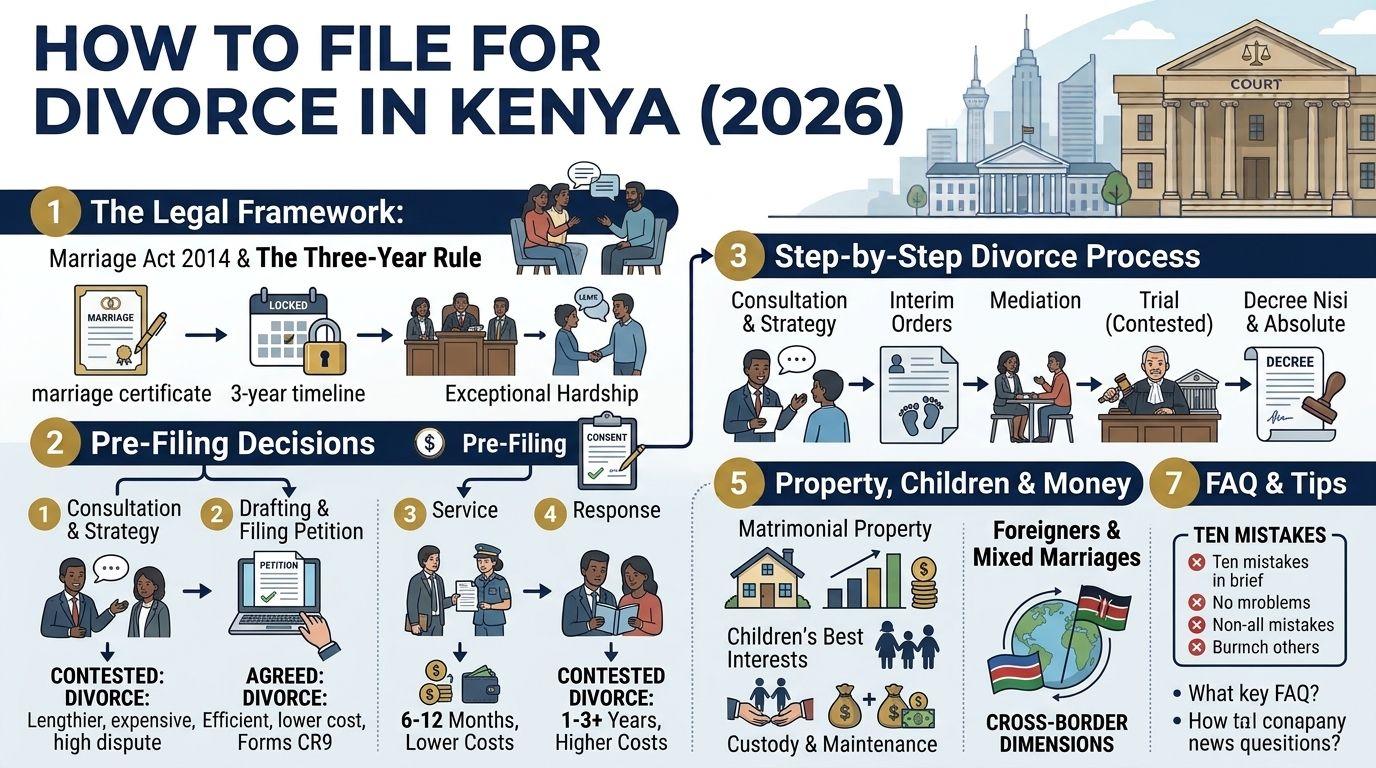
For most individuals, divorce represents their initial substantive engagement with the court system. The process is governed by statute and is more straightforward than commonly perceived. Kenya's legal framework provides clear grounds for divorce, and where parties are in agreement, the process can be concluded within a relatively short period. However, the law imposes strict procedural requirements: filing prematurely, in the incorrect forum, or without addressing property and child-related matters can result in adverse consequences. This guide is intended to ensure compliance with these requirements and to avoid unnecessary expense.
The Legal Framework: Grounds and the Three-Year Rule
Kenya's divorce law rests on the Marriage Act, 2014, which modernised the grounds for ending civil, Christian, Hindu and customary marriages, and the Matrimonial Causes Act, which governs the proceedings themselves. The central ground is irretrievable breakdown of the marriage demonstrated through facts such as adultery, cruelty, desertion, or separation periods prescribed by the Act alongside other statutory grounds. The court does not require proof of fault to the criminal standard; it requires a marriage that, on the evidence, cannot reasonably be expected to continue.
One procedural gate matters enormously and catches many petitioners by surprise: the law restricts the filing of divorce petitions within the first three years of marriage, except with the court's leave upon a showing of hardship. Young marriages in crisis have options: separation, counselling, judicial separation where applicable but not, ordinarily, an immediate divorce. Muslim marriages follow their own dissolution framework through the Kadhis' courts, a separate track covered in our Sharia and Islamic finance content.
Before You File: The Decisions That Shape Everything
Three decisions, made before the petition, determine the cost and character of the case:
Contested or agreed: Where both parties consent to the divorce and its ancillary consequences, including property, children, and maintenance, the matter proceeds by consent and is typically resolved more efficiently and at lower cost. In contrast, contested proceedings are lengthier and more expensive, and most reports of high costs arise from such litigation between parties who could have reached agreement.
Forum and representation: Divorce petitions are filed in either the Magistrates' Courts or the High Court, depending on the value and complexity of the matter. Legal representation by a family law practitioner is recommended, particularly where property or children are in dispute. Even in agreed matters, professional drafting of consent orders is advisable, as poorly drafted orders may result in future litigation.
Interim protection: Where there is a risk of asset dissipation, denial of access to children, or violence, the court may grant interim relief, including preservation orders, interim custody and access arrangements, injunctions, and protection orders, pursuant to the Protection Against Domestic Violence Act. Such orders may be sought at the commencement of proceedings or contemporaneously with the petition.
The Process, Step by Step
1. Consultation and strategy: facts, documents (marriage certificate, children's documents, asset records), and the roadmap: grounds, forum, interim needs.
2. The petition: drafted and filed with the supporting affidavits and documents, stating the marriage, the breakdown, and the orders sought: dissolution, custody, maintenance, and the property division framework.
3. Service: the petition is served on the other spouse personally, through court process servers or as the court directs; proof of service is foundational, and defective service is the most common avoidable delay.
4. The response: the respondent may contest the petition, answer the claims, and make cross-claims of their own, including their own position on property and children.
5. Interim phase: applications for custody, maintenance, access and preservation orders are typically determined on affidavit evidence, quickly.
6. Mediation and negotiation: Kenyan courts increasingly refer suitable matters to mediation; a mediated settlement on property and children, recorded as a consent order, ends most of the fight while leaving the decree for the court.
7. Trial where necessary: contested facts, the circumstances of breakdown, contribution to property, and the children's best arrangements are heard on affidavit and oral evidence, with cross-examination.
8. Decree: the court dissolves the marriage and makes final orders on children, maintenance and property. Ancillary consequences, such as name changes, single status, pension and insurance adjustments, follow administratively.
Timelines and Real Costs
Where the parties reach a genuine agreement on all issues, divorce proceedings may be concluded within six to twelve months, with costs primarily consisting of professional fees. Contesteddivorces typically require one to three years or longer, depending on the complexity and number of disputed issues, and involve higher costs due to advocates' fees and the engagement of experts such as valuers and accountants. Court fees are comparatively modest; the principal cost arises from litigation. Accordingly, a negotiated settlement is generally the most efficient resolution.
Property, Children and Money: What the Court Decides
Three ancillary issues travel with every divorce:
Matrimonial property is divided under the Matrimonial Property Act, 2013, on the principle of contribution, financial and non-financial alike: income, deposits, and payments, as well as domestic work and childcare. The matrimonial home attracts a statutory presumption of equal shares for spouses. "I paid for everything" is met, in Kenyan law, with "she built the home; everything was paid from." Detailed treatment in our matrimonial property and crypto-divorce guides.
Children's best interests are decided on: custody (sole or structured joint), access, and maintenance under the Children Act, 2022, with the child's own views gaining weight with age.
Maintenance (spousal support) may be ordered when circumstances warrant it, particularly where one spouse's economic dependence was established during the marriage.
Foreigners, Mixed Marriages and Cross-Border Dimensions
Kenyan courts divorce marriages celebrated in Kenya, including those of foreign spouses, and handle the property and children within their practical reach. Mixed-nationality divorces add the layers covered in our international custody and expatriate guides: foreign assets, recognition of the Kenyan decree abroad, and custody questions with cross-border answers. Where the marriage was celebrated abroad, recognition in Kenya follows ordinary principles, but the property and children in Kenya are governed here, which is where local counsel earns the fee.
A Worked Example: The Agreed Divorce That Stayed Agreed
Consider the following composite example: two professionals, one child, a matrimonial home, and two vehicles, following twelve years of marriage, mutually agree to dissolve the marriage. Had the parties proceeded with a contested petition, the process would have required approximately eighteen months, incurred substantial legal fees, and resulted in a court-imposed outcome. Instead, the parties engaged in structured negotiation prior to filing, prepared a comprehensive parenting plan, divided property according to contributions, with the home's equity apportioned based on the agreed valuation, and defined maintenance and pension arrangements in a settlement reflected in the petition. The decree was issued within eight months, at a fraction of the cost of a contested matter, and the parenting plan operated effectively without further court intervention. This example illustrates that, in agreed divorces, the court's function is to review and confirm the parties' arrangements rather than to construct them.
Ten Mistakes in Kenyan Divorce Cases
1. Filing inside the three-year gate: without leave, an avoidable dismissal.
2. Filing before negotiating: positions harden once pleadings fly.
3. No interim protection: where assets move, or children are withheld.
4. Treating the marriage certificate as optional: proof of the marriage is foundational.
5. Ignoring tax, pension and insurance consequences of the settlement's fine print.
6. Parenting plans drafted for the judge, not the child; unworkable schedules return as contempt applications.
7. Hiding assets: disclosure failures poison credibility across every other issue.
8. Social media as evidence: assume everything is exhibits.
9. Skipping the lawyer on "agreed" divorces: a bad consent order is a future lawsuit with your signature on it.
10. Litigating: solely for the sake of principle is rarely cost-effective, as the principle itself does not settle legal fees.
Frequently Asked Questions
Q1. What are the grounds for divorce in Kenya?
A. The grounds for divorce in Kenya are primarily the irretrievable breakdown of the marriage, which may be demonstrated by facts such as adultery, cruelty, or desertion, in addition to other statutory grounds as provided under the Marriage Act, 2014.
Q2. Can I file within the first three years of marriage?
A. A petition for divorce within the first three years of marriage may only be filed with the leave of the court, upon demonstration of exceptional hardship. In the absence of such leave, the petition must await the lapse of three years. In the interim, parties may seek alternative remedies such as judicial separation or counselling.
Q3. How long does a divorce take in Kenya?
A. Where the parties are in agreement, the divorce process typically takes between six months and one year. In contested matters, the duration may extend from one to three years or longer, depending on the complexity of the issues involved.
Q4. How much does divorce cost?
A. Court filing fees are generally modest; however, the overall cost of divorce is largely determined by the extent of legal representation and the degree of dispute between the parties. Agreed divorces are significantly less costly than contested ones, with the primary savings arising from avoiding protracted litigation between the parties. Agreed divorces are significantly less costly than contested ones, with the primary savings arising from avoiding protracted litigation.
Q5. Who gets the matrimonial home?
A. The matrimonial home is divided in accordance with the parties' respective contributions, as provided under the Matrimonial Property Act. There is a presumption of equal shares in relation to the matrimonial home, and the court will consider the housing needs of both spouses, particularly where children are involved.
Q6. How is child custody decided?
A. Child custody is determined based on the best interests of the child, with the court considering arrangements for custody, access, and maintenance in accordance with the Children Act, 2022. The views of older children are given increasing weight in such determinations.
Q7. Do I need a lawyer for an agreed divorce?
A. It is advisable to engage legal counsel even in agreed divorces, as the enforceability of the settlement depends on the proper drafting of consent orders. Poorly drafted orders often result in future litigation.
Q8. Can foreigners divorce in Kenya?
A. Yes, provided there is a sufficient connection between the marriage and Kenya. Matters relating to property and children situated in Kenya are determined by Kenyan courts, while recognition of the divorce abroad is subject to the laws of the relevant foreign jurisdiction.
Q9. What is the difference between separation and divorce?
A. Judicial separation maintains the legal existence of the marriage, allowing for orders in respect of maintenance and property, whereas divorce results in the dissolution of the marriage. Certain circumstances may warrant one remedy over the other, and the statutory three-year bar on divorce petitions makes separation the primary remedy available in the early years of marriage.
Q10. Does adultery affect property division?
A. While fault may be relevant in establishing the irretrievable breakdown of the marriage, the division of property is determined by the respective contributions of the parties. These two issues are distinct in law, notwithstanding their frequent conflation in the emotional context of divorce.
Disclaimer: This article is general legal information, not legal advice. For guidance on your specific situation, book a consultation with our advocates.