An accident occurring abroad presents multiple challenges: the injury itself, unfamiliarity with the local medical system, the need to initiate a travel insurance claim, and the reality that the responsible party may expect the foreign victim to depart without pursuing a claim. In Kenya, insurers, tour operators, and negligent drivers have often relied on the fact that foreign claimants leave the country, resulting in lost evidence and abandoned claims.
However, such claims are not extinguished unless the claimant fails to act. Kenyan law provides substantive remedies for accident victims, including tourists and expatriates who have already left the country. These remedies include direct claims against insurers, negligence claims against tour operators, and compensation that is significant by regional standards. This guide outlines the legal framework for foreign claimants: jurisdiction, identification of appropriate defendants, recoverable compensation, evidentiary requirements, and the practical steps necessary to pursue a claim from abroad.
Can a Foreigner Sue in Kenya? Yes, Jurisdiction and Your Strategic Choices
If an accident occurs in Kenya, Kenyan courts have jurisdiction to hear the matter. The claimant's nationality and residence do not affect the right to bring a claim. The primary considerations are the appropriate forum and the enforceability of any resulting judgment.
- Suing in Kenya makes sense where the defendant and their insurer are Kenyan: the insurer is reachable only where it operates, and a Kenyan judgment against a Kenyan insurer is directly enforceable.
- In some circumstances, it may be possible to bring proceedings in the claimant's home jurisdiction, particularly where the tour operator is domiciled abroad or the contract specifies a foreign forum. However, a judgment obtained in the claimant's home country may be of limited practical value if it cannot be enforced against assets located in Kenya.
- The usual answer: claims against Kenyan drivers, PSV operators, matatu SACCOs and domestic insurers are best brought in Kenya, through Kenyan counsel, while you recover at home. Where a foreign-domiciled tour company is involved, its home jurisdiction may be the better forum for that defendant, and the two tracks can run in parallel with coordination.
In practical terms, a claimant need not remain in Kenya to pursue a claim. However, it is essential to preserve evidence at an early stage, instruct Kenyan legal counsel, and have a clear plan in place before departing the country.
Road Accidents: Your Real Opponent Is the Insurer, Not the Driver
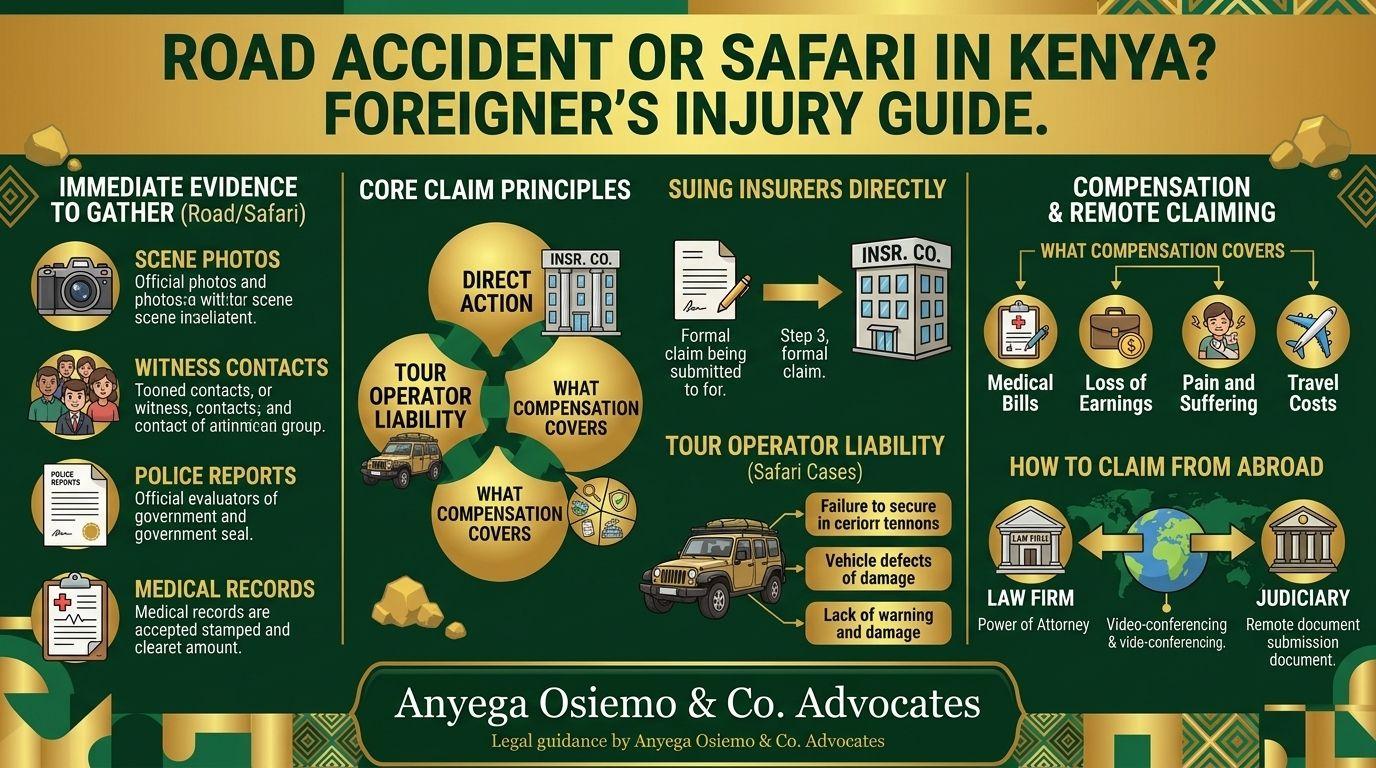
Kenyan law mandates that all motor vehicles operating on public roads must carry third-party insurance under the Insurance (Motor Vehicles Third Party Risks) Act. This legislation grants injured third parties a direct right of action against the insurer, allowing claimants to pursue the insurance company rather than relying solely on the driver. This provision ensures that a financially viable defendant is available from the outset of the claim.
The road-accident file, assembled properly:
- Police abstract obtained from the police post that handled the accident or through the National Police Service channels; it is the foundational document for every road claim and should be obtained promptly while the report is fresh.
- Medical evidence: attend a hospital immediately, even for minor injuries; the contemporaneous record is the backbone of general damages, and insurers exploit gaps in treatment.
- Vehicle and driver particulars: registration, insurer (demanded at the scene or via the police), driver identity. Witnesses contact the scene in the moment; they scatter within days.
- Scene evidence photographs of vehicles, road conditions, skid marks, and the location itself.
Where the vehicle involved is a public service vehicle (such as a matatu, boda, or taxi), claims may be brought against the operator, the relevant SACCO, and the insurer. Passengers in such vehicles benefit from additional statutory protections, which should be reviewed with legal counsel. In cases involving commercial ride-hailing vehicles, the platform, vehicle owner, and the driver may all be relevant defendants, particularly when insurance coverage is in dispute.
Safari and Tour Operator Injuries: Contract and Negligence
Tourism injuries ,vehicle rollovers on safari, boating and activity accidents, lodge incidents, animal-related injuries, hot-air balloon and excursion mishaps generate claims on two overlapping tracks:
- Negligence: the operator owed a duty of care and breached it through unroadworthy vehicles, unqualified drivers, ignored weather warnings, unmaintained equipment, inadequate supervision. The standard is what a reasonably competent operator would have done; Kenyan courts apply it without deference to the tourism industry.
- Contractual claims arise from the terms of the tour package, which set out the expected standard of service. The contract may also contain exclusion clauses and forum selection provisions. Exclusion clauses are interpreted narrowly and generally do not protect against liability for gross negligence. It is important to address these clauses directly in any claim.
Travel insurance interplay: your travel insurer may pay medical costs and then hold subrogation rights against the negligent party, meaning your claim and your insurer's claim are connected. Notify your travel insurer promptly, preserve their file, and let the two tracks coordinate; double recovery is not available, but your insurer's payment does not extinguish the claim against the negligent operator for what it did not cover: pain and suffering, future losses, and uninsured heads.
Activity waivers are commonly required before participating in certain activities. While such waivers do not automatically bar a claim, they may complicate the legal analysis. It is important to retain a copy of any waiver and seek legal advice regarding its effect in light of the circumstances of the injury.
What You Can Claim: Heads of Compensation
Kenyan personal injury awards are built from distinct heads, and understanding them disciplines both the evidence gathering and the settlement evaluation:
- Special damages: every shilling actually spent or lost, receipted: medical bills (Kenya and home country), travel and repatriation costs, damaged property, lost earnings during recovery, care costs. Receipts decide this head; keep everything.
- General damages compensation for pain, suffering, loss of amenity and diminished quality of life, assessed against Kenyan precedent awards for comparable injuries. This is where serious, permanent injuries carry real value, and where medical reports describing long-term prognosis do the decisive work.
- Future losses: ongoing care, future surgery, reduced earning capacity, supported by medical and expert evidence.
- Dependency and fatal claims: where the accident is fatal, the Fatal Accidents Act and the Law Reform Act allow claims for the family's loss of financial dependency and loss of expectation of life, brought by the estate and defendants, including those abroad, a common configuration in tourist and expatriate fatalities.
Initial settlement offers from insurers are often based on the assumption that claimants are unfamiliar with the various heads of compensation. A properly calculated claim, supported by receipts for special damages, general damages referenced to precedent, and evidence of future losses, is likely to settle for a significantly higher amount than an unsubstantiated demand.
The Claims Process, Step by Step
- The first priority should be to obtain medical attention, followed by documenting all relevant evidence.
- 2. Preserve the evidence chain: police abstract, photographs, witness statements, vehicle and insurer particulars, the tour contract and waiver, booking records, medical file.
- 3.Notify: your travel insurer per its policy timelines; the prospective defendants' insurers through counsel where appropriate.
- 4.Demand and negotiate: a computed, evidence-based demand letter from advocates opens most files; the majority of well-prepared claims settle here.
- 5.Sue if necessary: negligence suits in the Magistrates' Courts or the High Court, depending on the value; direct action against the insurer under the Motor Insurance Act for road claims. Kenya's court timelines are real, but so are interest and costs award that discipline delay.
- 6.Personal injury claims in Kenya are generally subject to a three-year limitation period from the date of the accident. Fatal accident claims may be governed by different limitation rules. It is essential to ensure that claims are brought within the applicable time limits.
If You Have Already Left Kenya
While it is possible to manage a claim from abroad by instructing Kenyan counsel, providing evidence by affidavit, and obtaining medical records, certain aspects of evidence collection cannot be replicated once the claimant has left Kenya. These include photographs of the scene, witness contact information, vehicle condition, and the police abstract. Claimants who are still in Kenya following an accident should ensure that all relevant evidence is collected and preserved before departure. Those who have already left should immediately gather all available documentation, such as hospital records, booking documents, and photographs, as the claim can still proceed but time is of the essence.
Insurer Tactics and the Counters
Claimants should anticipate certain common tactics from insurers, including delayed correspondence, disputed liability, low initial settlement offers, assertions of improper jurisdiction, and attempts to minimize the extent of injury. These tactics can be addressed through proper procedure and evidence: direct action against the insurer eliminates reliance on the driver's cooperation; the police abstract and witness statements establish liability; well-documented claims supported by precedent counter low offers; and Kenyan jurisdiction is mandatory for Kenyan-insured defendants. A thoroughly prepared file andan engaged claimantd are the most effective responses to these strategies.
A Worked Example: The Safari Transfer Accident
A composite case. A tourist couple's safari-transfer van, operated by a subcontracted local company engaged through their international tour operator, collides with a PSV outside the park gates. The wife suffers a fractured wrist and concussion; treatment in Nairobi is sound; they complete a shortened safari and fly home as planned.
The file, built in the first two weeks: a police abstract identifying both drivers; photographs at the scene taken by their guide; the transfer operator's and the PSV's insurer details; Nairobi hospital records; and the booking chain showing that the international operator subcontracted the transfer. The claims strategy, run in parallel: the travel insurer notified and paying medical costs (with subrogation preserved); Kenyan counsel demanding against the transfer operator's insurer under the direct-action provision, and against the PSV's insurer for apportioned liability; the international operator engaged on its contractual responsibility for subcontractor selection. The transfer insurer offers a quick "full and final" sum weeks in, declined against the computed claim, which includes the receipted medical costs, general damages anchored to wrist-fracture precedents, the ruined portion of the safari, and repatriation costs. The claim settles months later at several times the opening offer, with the wife never returning to Kenya for a single hearing. The variables that decided it: evidence preserved in week one, defendants chosen for their insurance, and a demand computed before the first offer arrived.
Ten Mistakes Foreign Claimants Make After an Accident in Kenya
- 1.Flying home before preserving evidence; the scene cannot be recreated from abroad.
- 2 . Treating the driver as the defendant when the insurer is the real target of the direct action.
- 3.No police abstract the foundational document, and it is hardest to fix late.
- 4.Gaps in medical treatment: insurers read every gap as recovery or exaggeration.
- 5. Discarding receipts: special damages are won on paper, not memory.
- 6.Signing insurer discharge forms for quick payments, extinguishing serious claims.
- 7.Missing the travel-insurer notification deadlines in the policy's fine print.
- 8.Ignoring the tour operator's contractual liability in cases involving activities and transfers.
- 9.Accepting jurisdiction confusion; Kenyan insureds answer in Kenyan courts.
- 10.Letting the three-year limitation lapse while waiting for an insurer to be reasonable.
Frequently Asked Questions
Q1. Can I claim compensation if I've already left Kenya?
A. Yes. Evidence preserved early does the work; the claim proceeds on affidavit and through counsel, with medical reports obtained from your treating facilities.
Q2. Who actually pays the driver or the insurance company?
A. For road accidents, the claim runs directly against the third-party insurer under the Motor Vehicles Third Party Risks Act; the driver and owner remain relevant to liability and any uninsured shortfall.
Q3. How long do I have to claim?
A. Generally, three years from the accident for personal injury; fatal claims have their own rules. Urgency matters for evidence, whatever the legal deadline.
Q4. What if I were a pedestrian or a passenger?
A. Third-party insurance covers pedestrians and passengers; PSV passengers have additional statutory protections. Your status changes the defendant mix, not your right to claim.
Q5. Does my travel insurance affect the claim against the negligent party?
A. It coordinates with it: your insurer may pay medical costs and hold subrogation rights, but its payments do not extinguish your independent claim for pain and suffering and uninsured heads.
Q6. The tour company is foreign. Where do I sue it?
A. Potentially at home or in Kenya, depending on the contract's forum clause and its corporate structure; often both tracks are available and coordinated; take advice before choosing.
Q7. What compensation can I realistically expect?
A. Receipted special damages in full, plus general damages anchored to Kenyan precedent for comparable injuries, plus evidenced future losses. Serious permanent injuries carry significant awards; computed claims settle well above insurers’ opening offers.
Q8. What if the accident was fatal?
A. The estate and defendants, including those living abroad, may claim under the Fatal Accidents Act and Law Reform Act for loss of dependency and related heads against the same insurer-defendants.
Q9. Do I needa police abstract if the police came to the scene?
A. Yes, the attendance report and the abstract are different documents; the claim runs on the abstract, so obtain it promptly.
Q10.Will I have to return to Kenya for court?
A. Most well-prepared claims settle without trial; if trial becomes necessary, evidence can often be given by affidavit and, where permitted, via video link. Plan logistics with counsel from the outset.
How We Can Help
At Anyega Osiemo & Company Advocates, we act for injured foreigners and their families: assembling the evidence chain, running direct claims against motor insurers, pursuing tour operators and subcontractors on negligence and contract, coordinating with travel insurers on subrogation, computing claims against Kenyan precedent, and conducting proceedings for clients who are already back home. We also act for insurers and operators, so we know exactly what the other side's file looks like and how to beat it.
Disclaimer: This article is general legal information, not legal advice. For guidance on your specific situation, book a consultation with our advocates.