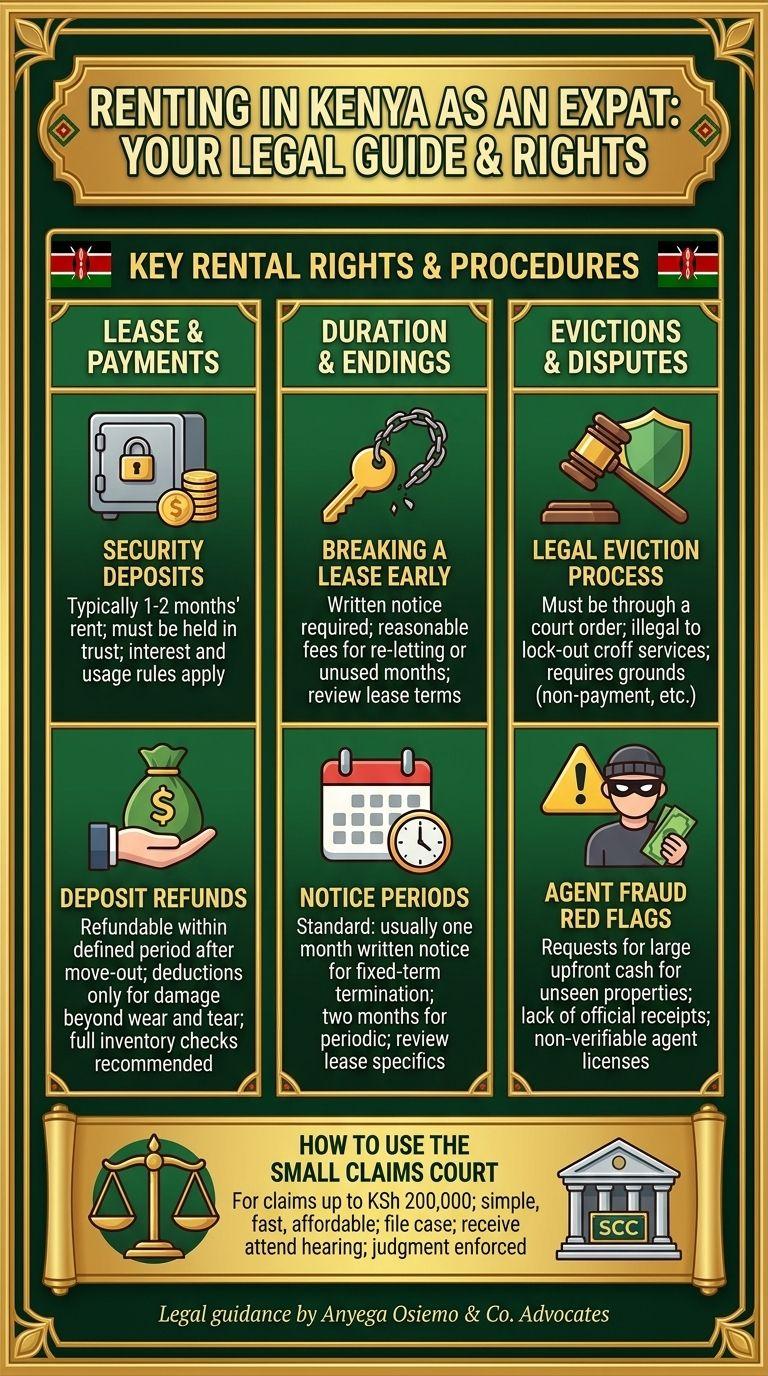
For expatriates in Kenya, housing is often the first and most significant legal issue encountered. The Nairobi rental market is characterized by informal practices, including cash deposits paid to agents, standard-form leases favoring landlords, escalation clauses that increase rent over time, and disputes over deposit refunds at the end of the tenancy. Many foreign tenants mistakenly believe that they either have no legal rights in Kenya or that the protections available in their home countries will apply. In reality, Kenyan law does provide tenants with enforceable rights, but these rights are determined primarily by the terms of the lease and the specific tenancy regime that governs the arrangement.
This guide sets out the legal framework applicable to expatriate tenants in Kenya. It addresses the classification of tenancy types, the legal position regarding security deposits, the limitations on landlord conduct, procedures for early lease termination, measures to prevent agent fraud, and appropriate forums for dispute resolution when negotiations are unsuccessful.
What Kind of Tenancy Do You Have? The Regime Decides Your Rights
Kenyan tenancy law is split by statute, and the split matters more than most tenants realize:
- Controlled tenancies under the Rent Restriction Act apply to residential dwelling-houses subject to a statutory rent threshold (historically very low, at KShs 2,500 per month). Almost no expatriate-priced housing falls here, so the Act's strong protections (standard rents, controlled termination) rarely help you, and landlords know it.
- The Landlord and Tenant (Shops, Hotels and Catering Establishments) Act governs *commercial* premises; the tribunal it creates, the Business Premises Rent Tribunal (BPRT), handles controlled commercial tenancies with strict termination rules: notice of at least two months, specified statutory grounds, and security-of-tenure flavour <REF>cite✦tools://web_search:71#3:~:text=cannot take effect earlier than two months from receipt and must specify termination grounds</REF>. Relevant if your lease is a home-office or commercial arrangement, not your apartment.
- Contractual, or uncontrolled, tenancies, which are the default for expatriate tenants, are governed by the express terms of the lease, the general principles of contract law, and equitable doctrines. In such arrangements, the rights and obligations of the parties are largely determined by the negotiated terms of the lease, underscoring the importance of careful review and negotiation prior to signing.
Expatriate tenants need to read and negotiate the lease thoroughly before execution. In the event of a dispute, the lease will serve as the primary basis for any court's legal determination.
The Lease: Clauses Expats Should Negotiate Before Signing
Most expatriates sign whatever the landlord's agent presents. The clauses that decide 90% of later disputes:
- Deposit amount and refund procedures should be clearly stipulated. The prevailing market practice is a deposit equivalent to one or two months’ rent. It is advisable to negotiate a written timeline for refund (typically within 30 days of handover), specify permissible deductions (limited to arrears and documented damage exceeding fair wear and tear), and address any interest or penalties for delayed refund.
- Break clause. Given the potential for changes in expatriate assignments, it is prudent to negotiate a right to terminate the lease early, typically upon providing two- or three-months’ written notice or upon the occurrence of specified events such as job loss or redeployment. In the absence of such a clause, the tenant remains bound for the full term of the lease.
- Diplomatic clause. A variation of the break clause common in expat markets: early termination without penalty on evidence of employment transfer or exit from the country.
- Escalation. The standard market rate for rent escalation is approximately 10% per annum. Tenants should negotiate the escalation rate and ensure that any increases are contingent upon the landlord's compliance with agreed rates and service charges.
- Service charge and utilities. The lease should clearly define which charges are included in the rent. Where a service charge is applicable, tenants should require an itemized account or a cap on such charges.
- Inventory and condition report. A dated and photographed inventory, signed by both parties at the commencement of the tenancy, provides the strongest protection for the tenant's deposit.
- Subletting and assignment. Assignment rights (finding a replacement tenant) rescue Brook. The deposit serves as security for the landlord and is neither a gift nor an admission fee. The enforceable legal position, derived from contract law and established practice, is as follows’
The deposit is a security deposit, not a gift or an admission fee. The enforceable position, distilled from contract law and general practice:
- Permissible deductions must be substantiated and documented. These may include rent arrears, unpaid utilities attributable to the tenant, and damage exceeding fair wear and tear, as evidenced by the move-in inventory. Deductions for routine repainting, unspecified cleaning fees, or agent fees are generally not permitted and are often disallowed in legal proceedings.
- Fair wear and tear is a tenant's right. Normal aging, minor scuffs, and ordinary depreciation are considered part of the landlord's responsibilities and are not deductible from the deposit.
- The timing of the deposit refund should be expressly stated in the lease. Where the lease is silent, a reasonable period applies. A landlord who retains the deposit for an extended period after lawful handover, particularly while the property is re-let, may be liable for the deposit amount and associated costs.
- Documentary evidence is critical. Move-in photographs, a signed inventory, meter readings, and a formal handover record at the end of the tenancy are essential. Tenants who maintain proper documentation are more likely to recover their deposit in full, while those without such evidence are at a disadvantage in any dispute.
If negotiation is unsuccessful, the Small Claims Court—which has jurisdiction over civil claims up to KShs 1,000,000 and is designed for expedited resolution—is the appropriate forum for deposit disputes. Landlords are generally aware of this remedy.
Evictions: What Landlords May and May Not Do
Kenyan law prohibits landlords from effecting eviction by force. The lawful procedure for removing a tenant in breach or holding over after termination requires issuing notice, followed by court proceedings. Acts of self-help eviction, such as changing locks, removing doors, disconnecting utilities, disposing of possessions, or using intimidation, are unlawful and actionable. A tenant who is unlawfully locked out may seek restoration of possession and damages. Landlords who engage in unlawful eviction often incur losses greater than the disputed rent.
In practical terms, a landlord who threatens an immediate lockout is typically not acting within the law, and any actual lockout gives the tenant a legal claim. However, tenants should not interpret these protections as a license to remain in occupation without paying rent. Valid notice and court process, when properly executed, will terminate the tenancy, and contesting such proceedings without merit can result in unnecessary costs.
Breaking Your Lease Early and Notice Periods
In the absence of a break or diplomatic clause, early termination of a lease constitutes a breach of contract, but there are practical options available to manage the situation. The preferred approaches are as follows:
- Surrender by agreement. Many landlords will accept a documented surrender of the lease and re-letting of the premises in preference to pursuing a claim for damages. It is advisable to negotiate a written surrender, which may involve a modest payment.
- Assignment. Securing an acceptable replacement tenant to assume the lease—where assignment rights are provided or can be negotiated—offers a practical solution to early termination.
- Mitigation-based exit. A tenant may choose to vacate, provide proper written notice, and accept liability for the landlord's actual loss. Legally, the landlord is obligated to mitigate losses by re-letting the premises and accounting for any resulting income. The tenant's exposure is limited to the period the property remains vacant and any documented re-letting costs, rather than the entire unexpired term of the lease. This principle often facilitates reasonable ex The mechanics of notice are important. Periodic tenancies generally require one month's written notice, aligned with the rent payment period or as specified in the lease. Fixed-term tenancies conclude by effluxion of time or by negotiated agreement. Informal communications, such as WhatsApp messages or verbal agreements, are insufficient; written notice with proof of service is essential. Proof of service.
Agent Fraud and Fake Listings
A considerable proportion of tenancy disputes involving expatriates arise prior to the execution of the lease. These include fraudulent listings, agents collecting deposits for properties they do not manage, double-letting of the same unit, and agents absconding with deposit funds. The following measures, while unremarkable, are effective in preventing such issues:
- Engage directly with the landlord or a verifiable agency. Confirm the agency's physical office, licensing, and track record. For individual agents, verify their identification and, most importantly, confirm that they are authorized to let the property by requesting the title deed or management mandate and, where possible, confirming with the property owner.
- Never pay cash into personal accounts for deposits or rent; pay to the landlord or agency account against a receipt, and, for the deposit specifically, negotiate payment into escrow or against a formal deposit receipt referencing the lease.
- Arrange to visit the property in person before committing, and exercise caution if the rent is significantly below market rates or if there is undue pressure to act quickly, as these are common indicators of fraudulent activity.
- Ensure that the lease is signed before any payments are made. Funds paid before execution of a formal lease are at risk and may not be recoverable.
Dispute Routes: Negotiation, the BPRT and the Small Claims Court
Escalation ladder for tenancy disputes:
- 1.Written engagement: a demand letter from advocates, referencing the lease, the inventory and the amounts; the majority of deposit disputes settle here.
- 2. Small Claims Court for monetary claims up to KShs 1,000,000: informal procedure, no advocates strictly required (though they help), and a statutory design aimed at resolution within weeks. Deposit refunds, refunds of unearned rent, and utility disputes fit naturally here.
- 3.The Business Premises Rent Tribunal for *commercial* controlled tenancies: rent determination and termination disputes under the Shops Act, with its own procedure and timelines.
- 4. The Magistrates' Courts for claims above the Small Claims threshold, possession matters, and injunctions (including restraining unlawful eviction or compelling access).
For expatriates who have already left the country, the Small Claims Court's documentary, fast-track character makes remote conduct far easier than ordinary litigation; another reason good paper wins these disputes.
A Worked Example: The Disappearing Deposit
A composite case. An expatriate's two-year assignment ends; she gives three months' written notice per her lease, conducts a photographed handover against the move-in inventory, and leaves for her next posting. The landlord, having already re-let the unit within three weeks, declines to refund the two-month deposit, citing "repainting, deep cleaning and general wear."
Her advocates' response to the documents: the lease's refund clause (30 days from handover) was ignored; the deductions are either fair wear and tear (ordinary repainting after two years) or undocumented; the landlord's own re-letting shows no loss; and the deposit, with costs, is squarely within the Small Claims Court's jurisdiction. A demand letter with the inventory photographs attached results in a full refund within 11 days. The landlord's own agent advises that the filed claim is unwinnable, with a total professional costs amounting to a fraction of one month's rent. The difference between this outcome and the common alternative (months of WhatsApp arguments, then abandonment) was nothing more than a signed inventory and written notice.
Ten Mistakes Expatriate Tenants Make in Kenya
- Signing the landlord's lease unamended: the negotiation you skip becomes the dispute you inherit.
- 2. Paying deposits to individuals in cash before signing.
- 3.No move-in inventory or photographs: the evidentiary foundation of every later dispute.
- 4. Verbal or WhatsApp-only notice is unenforceable when challenged.
- 5. Assuming Rent Restriction Act protections apply, they rarely do at expat price points.
- 6.Walking away from the deposit too cheaply makes it recoverable cheaply with paper.
- 7.Believing lockout threats self-help eviction is unlawful; know it, say it, mean it.
- 8.No break or diplomatic clause in an assignment-length lease.
- 9. Fighting arrears wars emotionally, arrears genuinely expose you; engage, document, negotiate before positions harden.
- 10. Leaving Kenya before resolving the deposit remote claims is winnable but slower; settle the paper before you fly.
Frequently Asked Questions
Q1. How much deposit can a landlord ask for in Kenya?
A. Market practice is one to two months' rent; there is no statutory cap for uncontrolled tenancies, but anything above the market is negotiable and should be secured by a proper receipt and refund clause.
Q2. Can my landlord evict me without a court order?
A. No. Eviction requires notice and court process; lockouts, utility cuts, and possession dumping are unlawful and actionable.
Q3. My landlord won't refund my deposit. What do I do?
A. Written demand referencing the lease, inventory, and refund clause; then the Small Claims Court for claims up to KShs 1,000,000 fast, documentary, and effective.
Q4. An agent took my deposit and disappeared. Is it gone?
A. Not necessarily pursue the agency and, where fraud is evident, the police; and in future, verify agency and pay only against signed leases and proper receipts.
Q5. My lease has no break clause, and my assignment is ending. Am I stuck?
A. No, negotiate surrender or assignment; even a walk-away exposure is limited by the landlord's duty to mitigate, not the full remaining term.
Q6. How much notice must I give to end my tenancy?
A. What the lease says; otherwise, typically a month in writing aligning with the rent period for periodic tenancies. Fixed terms end by expiry or agreement.
Q7. What is fair wear and tear?
A. Ordinary aging and use: minor scuffs, faded paint, worn fittings. It is the landlord's cost; only damage beyond it is deductible, and only with evidence.
Q8. Can the landlord raise rent whenever they want?
A. Only as the lease permits escalation clauses to govern; unilateral mid-term increases breach the lease. Periodic tenancies can be repriced on renewal with proper notice.
Q9. What is a diplomatic clause?
A. A break clause allowing early termination without penalty on evidence of employment transfer or departure from Kenya, standard in expat markets, worth demanding in Nairobi.
Q10. Do I need a lawyer for the Small Claims Court?
A. Not strictly; the procedure is designed for lay parties, but a properly documented claim settles faster and wins more; advocates are worth their fee even there.
How We Can Help
At Anyega Osiemo & Company Advocates, we act for expatriate tenants at every stage: lease review and negotiation before you sign, deposit recovery and tenancy disputes through negotiation and the Small Claims Court, defence of unlawful-eviction conduct and arrears claims, and coordination with your employer's relocation team so housing exits don't become disputes
Disclaimer: This article is general legal information, not legal advice. For guidance on your specific situation, book a consultation with our advocates.