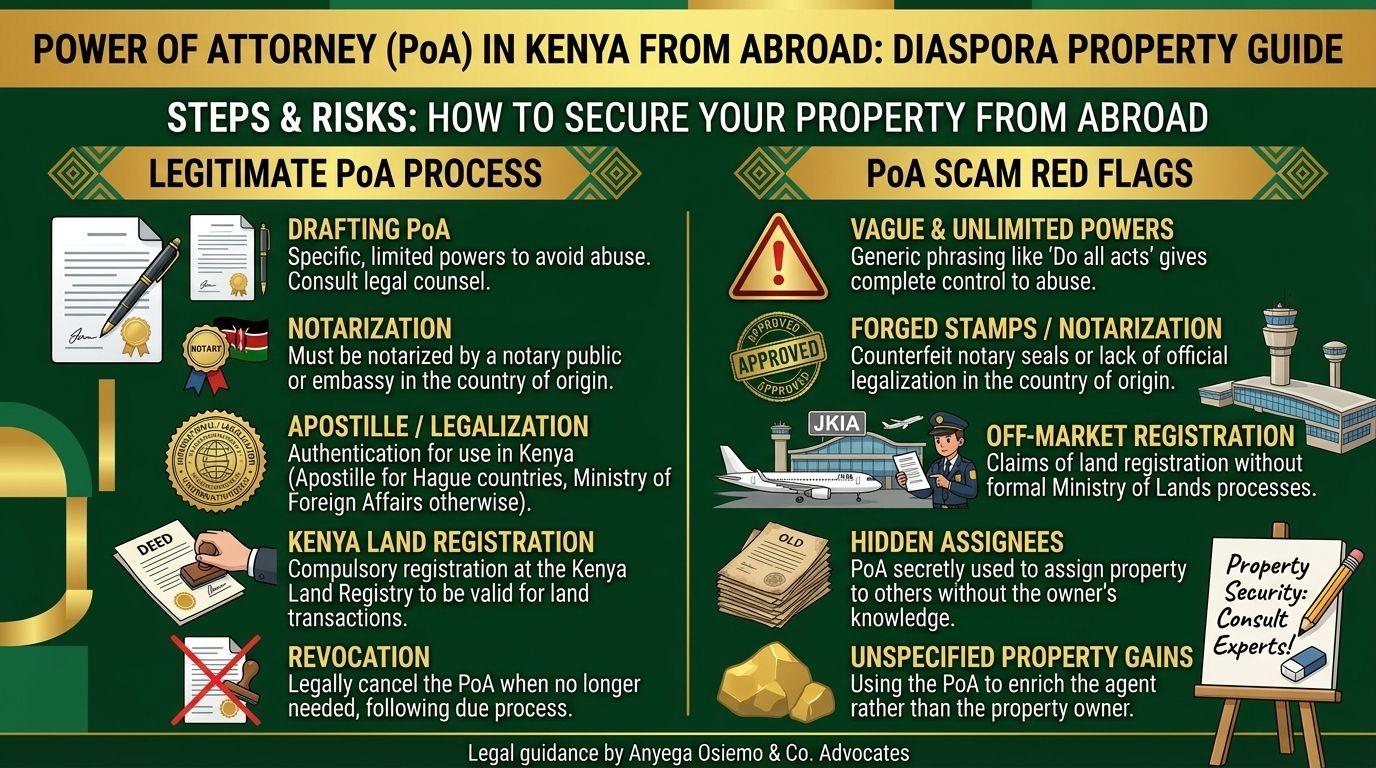
For many Kenyans’ living abroad, the power of attorney serves as the essential legal link to their affairs at home. It is the document that allows a mother to complete a land sale in Kisumu, a brother to register a title in Nairobi, or a daughter to manage her late father's estate. However, the power of attorney is also frequently misused in Kenya. There are numerous cases where attorneys-in-fact have sold family land to themselves, where diaspora investors have lost access to their own assets, or where documents have been signed without the principal's knowledge or consent.
When used correctly, a power of attorney is an efficient, flexible, and secure legal tool. This guide explains the correct process for granting a power of attorney from abroad, how to protect yourself and your family, when it may be appropriate to refuse to grant one, and the steps to take if abuse has already occurred.
What a Power of Attorney Is and Is Not Under Kenyan Law
A power of attorney (POA) is governed by the Powers of Attorney Act (Cap 257) together with the general law of agency. In essence: a written authorization by which one person (the donor or principal) appoints another (the attorney or agent) to act on their behalf.
Three things it is not, which donors routinely misunderstand:
- It does not transfer ownership. The attorney is authorized to administer the property or affairs, but does not become the owner. However, a significant risk arises because an attorney holding a registered land power of attorney can execute transactions that transfer the property to third parties, including themselves or their companies. The distinction between acting on your behalf and acting in your place is narrower than many donors realize. For this reason, it is critical to define the scope of authority and to maintain proper supervision.
- It does not survive all events. The donor's death automatically terminates the power of attorney. In addition, ordinary powers of attorney become ineffective if the donor loses mental capacity, which often occurs at a time when the family most needs continuity.
- It is not revocable by wishing. Revocation must be executed properly, in writing, and critically communicated to everyone who relied on the power: the attorney, the Lands Registry, banks, and counterparties to pending transactions.
The Main Types Used in Kenya
- A general power of attorney grants broad authority over the donor's affairs, including property, banking, contracts, and litigation. Because of its wide scope, it is a powerful and potentially risky instrument. It is suitable only for carefully structured long-term management, and is almost never appropriate for a single transaction or for use by a person whose actions cannot be fully monitored.
- A special (or limited) power of attorney restricts authority to a specific transaction or task, for example, to complete the sale of a particular plot to a named purchaser for not less than a stated price within a defined period. For most diaspora transactions, this is the appropriate instrument, as it expires upon completion of the task and cannot be used for other purposes.
- An irrevocable power of attorney survives ordinary revocation, usually where the power is coupled with an interest held by the attorney, such as securing an obligation owed to them. The term 'irrevocable' should be treated with caution unless it has been drafted by your own advocates for a specific and legitimate commercial purpose.
- Company powers of attorney are typically granted by board resolutions authorizing officers or agents to act on behalf of the company. These are standard in commercial transactions and are often required by banks, registries, and counterparties as a condition for proceeding with business.
- Enduring powers: Kenya's enduring-power landscape has historically been thin. The Mental Health (Amendment) Act, 2022 introduced enduring power of attorney provisions, principally directed at health and personal welfare matters, and the area is still developing. If incapacity planning is your real concern, take specific advice; a standard POA alone does not solve it.
Granting a POA from Abroad: Execution and Legalization, Step by Step
The document must be executed correctly, or Kenyan registries and institutions will reject it, often when a transaction is already in progress. The proper sequence is as follows:
- 1.Draft under Kenyan law, preferably by Kenyan advocates, describing powers with precision in the language the Lands Registry, banks and courts expect.
- 2.Sign before a notary public in your country of residence; many institutions additionally want a second attesting witness. Confirm the wording of the execution clause with your Kenyan advocates before signing, not after.
- 3.Legalize the document for use in Kenya. Kenya is now a party to the Hague Apostille Convention, so most donors obtain an apostille from the competent authority in the country where the document is executed. This process usually takes less than a week in most developed countries and replaces the previous requirement for consular legalization. If the country of execution is not a party to the Convention, the traditional process applies: notarization followed by legalization at the Kenyan mission or other designated authorities.
- 4.Courier the original to your Kenyan advocates by tracked delivery. Certified copies support the file; originals support the registry.
- 5.Register where the power will be used. For land dealings, the POA and, often, the instruments executed under it must be registered with the relevant Lands Registry. Verify the power of attorney before it is needed. Your advocates should confirm with the relevant bank, registry, or counterparty that the legalized instrument meets their requirements. A power of attorney that is rejected at the point of use is ineffective. satisfies their requirements. A POA that fails at the counter is not a power at all.
Foreign investors who grant Kenyan powers of attorney to local agents must follow the same process. In addition, their home-country counterparties may require notarized and legalized corporate authorizations supporting the power of attorney. Both sets of requirements should be incorporated into the transaction timetable.
A Worked Example: Granting a POA from London or Dubai
The process is best illustrated by example. Consider a Kenyan professional living in London who needs her brother in Nakuru to complete the sale of her plot while she is working abroad for two years. Her advisers would proceed as follows:
- 1.Draft in Kenyan law. Advocates in Nairobi prepare a special power of attorney: the plot is described by title number; the brother is authorized to complete the sale to a named purchaser for not less than a stated price within nine months; the authority covers signing the transfer and directing the net proceeds to her specified account, and nothing else: no general powers, no blanks, a fixed expiry.
- 2.Execution in London. She signs before a notary public with a second witness, using the execution clause her advocates confirmed.
- 3.Apostille. As both the UK and Kenya are Convention parties, she obtains an apostille from the competent UK authority within days.
- 4.Tracked courier sends the original document to her Nairobi advocates. Copies are not used in the transaction.
- 5.Registration in Kenya. The advocates register the POA at the Lands Registry and confirm its acceptance with the registry and the purchaser's advocates before any instruments are signed.
- 6.Completion under supervision. Her advocates prepare transfer documents; the brother signs only what the POA authorizes; proceeds go to her account, not through his.
- 7.After completion, the power of attorney is formally revoked by deed, with notice given to the brother and confirmation of deregistration. This ensures that an outdated instrument does not remain in circulation among family records.
The total time required is typically a few weeks. The total cost includes a modest professional fee, as well as charges for notarization, apostille, and registry fees. These costs are minimal compared to the potential loss of property that can result from misuse of a general power of attorney.
Registration, Stamping and the Institutional Reality
Compliance with formal legal requirements is only part of the process. Institutions apply their own verification procedures, and a power of attorney that does not meet their standards will not be effective.
- Land registries apply the relevant statutes strictly. An unregistered power of attorney cannot support registered dispositions, and a registered power will be interpreted narrowly, often to the disadvantage of the attorney. Powers of attorney should be drafted with this in mind.
- Banks usually require their own standard forms or will vet external forms, request specimen signatures, require board resolutions for corporate attorneys, and may demand periodic re-confirmation. A power of attorney that is more than one or two years old often triggers additional verification, regardless of its stated validity.
- Companies and counterparties increasingly require certified corporate authorizations. For significant transactions, they may also require evidence that the donor is alive, has capacity, and has not revoked the power at the time of signing.
If your power must work with a specific bank, registry or counterparty, test it against their requirements before the day it is needed.
Revocation, Death and the Incapacity Gap
- A written deed must be revoked in writing and becomes effective only when notice is given to all relevant parties, including the attorney, the Lands Registry, banks, and counterparties. A revocation that is not communicated provides no protection. Where land is concerned, it is advisable to register a caveat or restriction to prevent transactions while the revocation is being processed.
- Death terminates the power of attorney. The donor's death ends the attorney's authority, and any transaction completed after death under a now-invalid power of attorney is voidable. Heirs who discover sales made after the donor's death have legal remedies, but these must be pursued promptly before the assets are transferred to innocent purchasers.
- Incapacity creates a significant gap. An ordinary power of attorney becomes ineffective if the donor loses capacity, which is often when the family most needs continuity. The 2022 enduring power of attorney provisions address some welfare matters, but comprehensive financial incapacity planning still requires the use of trusts, joint arrangements, or carefully drafted enduring instruments. This is a specialist area and should be treated as such.
The Abuse Problem and the Safeguards That Actually Work
The typical fraud is not sophisticated: a relative holding a general POA sells the donor's land to an accomplice at half value, and the donor abroad discovers it a year later when the rent stops. The safeguards that work, in combination:
- Use special, not general, POAs for defined transactions; name parties, property, price floors and time limits.
- Require joint action for major dealings: two attorneys acting together.
- Cap the duration at six to twelve months, renewable only by a fresh instrument.
- Register a caveat or select your attorney with the same care as you would when hiring an employee. The attorney should have a verifiable background, a fixed address, and assets that provide accountability. Avoid appointing someone simply because they are familiar with documents. traceable life, fixed address, assets to answer with; not the cousin who is "good with documents."
- Impose clear accountability on the attorney, including a duty to provide accounts, to surrender title documents upon request, and to report all transactions to your advocates.
- Do not sign blank or undated documents, and do not sign any document that you have not read and fully understood in a language you are fluent in.
- Always verify before purchasing property through an attorney. If you are the purchaser, request the registered power of attorney, confirm that the donor is alive and that the power has not been revoked, and instruct your advocates to conduct registry checks. Buyers who neglect these steps have lost property to forged or post-death transactions.
When a POA is a tool for delegation, it does not address every legal issue that may arise. It does not solve every problem people bring to it:
- Long-term asset management for a diaspora owner: a trust or management structure with enforceable duties and accounts beats an indefinitely renewable POA dependent on one person's honesty.
- Incapacity planning: ordinary POAs fail exactly when needed; explore the enduring provisions under the Mental Health (Amendment) Act, 2022 and structured alternatives with specialist advice.
- Single defined transactions: sometimes a direct escrow or completion through your own advocates is cleaner than granting anyone power over your assets at all.
- Company matters: a shareholder resolution appointing a local director may carry more weight in corporate transactions. The appropriate question is not simply whether to sign a power of attorney, but rather to identify the specific problem you are seeking to solve and to determine whether delegation is the safest and most effective solution. Is delegation the safest solution to it?"
Ten Mistakes to Avoid
- 1.A general POA where a special one would do.
- 2.No expiry date, scope limits or joint control.
- 3.Kenya-hostile form: foreign wording, no notarization, no apostille or legalization.
- 4.Believing a POA transfers ownership and learning too late what the attorney actually did.
- 5.No registration at the Lands Registry for land dealings.
- 6.Revoking in your head but never serving notice or registering the revocation.
- 7.Appointing an attorney with no accountability and nothing to lose.
- 8.Blank spaces, undated signatures, spare blank originals.
- 9.Assuming a POA survives incapacity or death.
- 10.Buyers accepting POAs without verifying the donor's life, capacity and revocation status.
Frequently Asked Questions
Q1. How much does a power of attorney cost in Kenya?
A. Advocates' drafting fees vary commonly from a few thousand shillings for a simple special POA to considerably more for complex instruments; add notarization, apostille or legalization abroad, courier costs, and registry fees in Kenya.
Q2. Does a Kenyan POA need to be registered?
A. For land dealings, yes, registration at the Lands Registry is required for the instruments to take effect. Banks and registries apply their own verification even where formal registration is not mandatory.
Q3. Can I make a POA from the diaspora without travelling to Kenya?
A. Yes, signed and notarized where you live, apostilled or legalized, couriered to Kenya and registered where needed. You never need to travel for the document itself.
Q4. How do I stop someone from using my POA after I revoke it?
A. By deed of revocation served on the attorney, the Lands Registry, banks and counterparties and, where land is at stake, by registering a restriction or caveat to block transactions while revocation takes effect.
Q5. Can the attorney sell the property to themselves?
A. Self-dealing by fiduciaries is treated harshly, and such transactions are challengeable, but challenge is expensive and uncertain. Prevention through limited drafting beats litigation after the fact.
Q6. Is a foreign POA valid in Kenya?
A. Yes, if properly executed, notarized, apostilled or legalized for Kenyan use, and acceptable in form to the Kenyan institution involved, which is why foreign donors should generally start from a Kenyan-law draft.
7Q. What happens to my POA if I die or lose capacity?
A. Death terminates it automatically. Ordinary powers falter on incapacity; the 2022 enduring-power provisions cover welfare matters to a degree, but financial incapacity planning needs dedicated structures.
Q8. Can I appoint a POA to run my company?
A. Yes, company powers of attorney are standard, but corporate governance tools (resolutions, directorships) often serve better and should be considered first.
Q7. How do I check a POA someone has presented to me?
A. Demand the original or registered copy, verify with the purported donor directly, confirm no death or revocation, and have your advocates run registry checks. Forged and stale POAs are common in land fraud.
How We Can Help
At Anyega Osiemo & Company Advocates, we draft powers of attorney for diaspora clients and foreign investors, special and general, land and corporate, with protective architecture built in to handle notarization and apostille logistics, register instruments at the Lands Registry and banks, advise donors on revocation and incapacity planning, and act for victims of attorney abuse, including recovering property disposed of in breach of duty
Disclaimer: This article is general legal information, not legal advice. For guidance on your specific situation, book a consultation with our advocates.