The core obligations
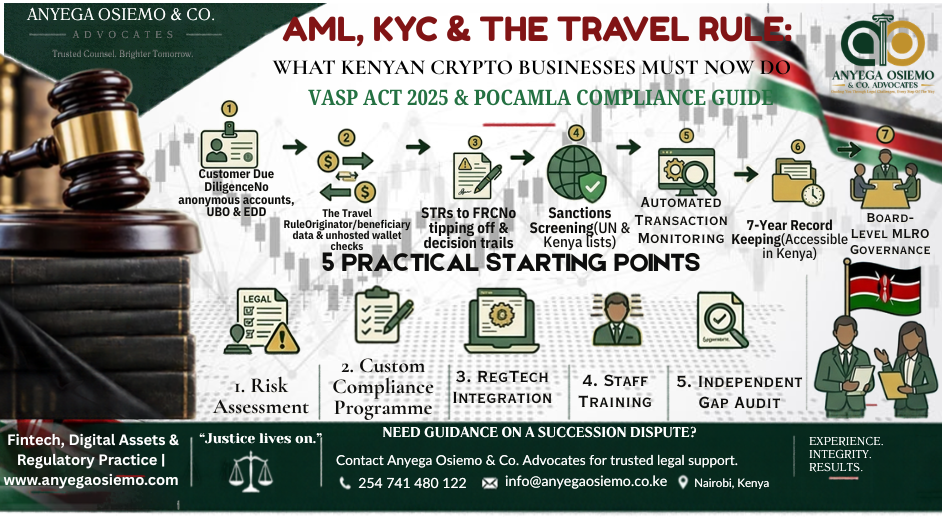
1. Customer due diligence (CDD)
- Verify customer identity before providing services no anonymous accounts, no “verify later” tiers for real-money activity;
- For business customers, identify the beneficial owners behind the entity the humans who ultimately own or control it;
- Apply enhanced due diligence to high-risk customers: politically exposed persons, complex ownership structures, unusual transaction volumes or values, high-risk geographies;
- Refresh the CDD on an ongoing basis as customer risk changes, and remember that onboarding is the beginning of the relationship, not the end of your obligations.
2. The travel rule
- Virtual asset transfers exceeding prescribed thresholds must include originator and beneficiary information transmitted between virtual asset service providers, consistent with the requirements applicable to wire transfers by banks. In practice, this means:
- Your systems must be able to send and receive travel-rule data with counterparty VASPs, which means choosing and integrating a technical solution, because there is no manual workaround at scale;
- Transfers involving unhosted (self-custody) wallets need documented risk handling: verify, record, and apply heightened scrutiny where appropriate;
- Counterparty VASP due diligence matters: sending customer data to an unvetted counterparty is its own risk.
3. Suspicious transaction reporting (STRs)
Suspicious transactions, including attempted suspicious transactions, must be reported to the Financial Reporting Centre (FRC). Two key practices distinguish compliant institutions from those at risk of non-compliance:
- No tipping off. Alerting the customer that a report was made or is contemplated is itself an offence. Train every customer-facing employee on this;
- Document the reasoning. Whether you report or decline to report, the file should show a considered decision by a competent person. Inspectors read decision trails, not just filings.
4. Sanctions screening
Customers and transactions must be screened against United Nations, Kenyan, and other applicable sanctions lists at onboarding and on an ongoing basis, as these lists are updated frequently. Exposure to sanctions risk in the crypto sector is a practical concern; wallets, mixing services, and counterparties may appear on sanctions lists. A credible compliance programme requires a robust screening system.
5. Transaction monitoring
Automated transaction monitoring must be calibrated to the institution’s risk profile, including detection of structuring patterns, rapid movement of funds, unusual geographic activity, exposure to mixing services, and behaviour inconsistent with the customer’s profile. Institutions should avoid adopting generic thresholds that do not reflect actual risk, and must ensure that alerts generated by the monitoring system are reviewed and acted upon. Failure to review alerts may be considered evidence of non-compliance.
6. Record keeping
Customer due diligence records, transaction data, and internal reports must be retained for a minimum of seven years following the termination of the business relationship. These records must be accessible within Kenya for regulatory inspection. Institutions utilising cloud or offshore systems must ensure compliance with this access requirement.
7. Governance and the MLRO
A competent and empowered Money Laundering Reporting Officer (MLRO) must be appointed and have direct access to the board of directors. Regulatory authorities assess anti-money laundering compliance at the board level, including reviews of minutes, oversight mechanisms, resource allocation, and evidence of challenge. Directors may be held personally liable for knowing non-compliance. An MLRO must report to a board that actively addresses anti-money laundering matters.
The regulators’ reach
The Central Bank of Kenya (CBK) and the Capital Markets Authority (CMA) are empowered to conduct on-site inspections, require real-time read-only access to transaction data, and impose enforcement measures including directions, fines, suspension, and revocation of licences. A compliance function that is not operational in practice will be identified during inspection, as the inspection regime is structured to detect such deficiencies.
Practical starting points
1. Conduct a comprehensive risk assessment, including products, customer types, geographies, channels, and delivery mechanisms. The risk assessment forms the basis for all subsequent compliance documentation.
2. Develop the compliance programme based on the institution’s own risk assessment, rather than relying on templates from other jurisdictions.
3. Invest in appropriate compliance tools at an early stage, as implementation of screening, monitoring, and travel rule solutions may require several months.
4. Provide comprehensive training to staff and regularly assess their understanding, as frontline employees are responsible for suspicious transaction reporting decisions. Inadequate training may result in institutional liability.
5. Obtain an independent review of the compliance programme prior to regulatory inspection. Conducting a gap assessment is more cost-effective than addressing deficiencies identified by regulators.
Frequently asked questions
Q1. Do these rules apply to foreign platforms with Kenyan users?
A. Yes, the regime’s extraterritorial scope means platforms targeting Kenya can be required to comply (and to be licensed) regardless of where they are based.
Q2. Are P2P platforms caught?
A. Businesses facilitating virtual asset exchange or transfer services for others fall within regulated activities. Purely personal, occasional trades between individuals are different, but a business model built on facilitation is squarely covered.
Q3. What is the biggest inspection failure?
A. Programmes that exist only as documents: no evidence of monitoring actually running, no STR decision records, no board oversight trail. Inspectors test operation, not paperwork.
Q4. We are a startup; can we really afford all this?
A. Compliance costs are now an inherent part of market entry and must be considered in the licensing decision. The available options are to allocate budget for compliance, partner with a licensed entity, or refrain from operating. Operating without a licence is neither viable nor low-cost.
Disclaimer: This article is general legal information, not legal advice. For guidance on your specific situation, book a consultation with our advocates.