Victims of gold fraud frequently experience a sense of personal failure after the loss. However, these schemes are operated by highly organized, professional networks that invest significant resources to appear legitimate. Delay in taking action, often due to embarrassment, enables fraudsters to dissipate further and conceal assets, making recovery more difficult.
Recovery of funds lost to a gold scam with a Kenyan connection is possible, though not assured, and the process is often lengthy and costly. Kenyan law provides a framework for victims to pursue recovery, and the relevant authorities and institutions address such cases with due seriousness. This guide outlines the available legal mechanisms, including criminal and civil proceedings, asset tracing, cross-border considerations, and the practical aspects of each approach.
First, Understand What You Are Recovering From
Recovery strategy depends on the fraud's architecture, and most gold scams share one:
- A front company registered, presentable, often with genuine-looking premises and documents. Registered does not mean legitimate; incorporation is cheap, and the fraudsters know it.
- A payment ladder: your money did not go to "the gold." It went to receiving accounts, then split onward to M-Pesa numbers, cash agents, vehicles, land, and runners. Each hop is a traceable event and a potential defendant.
- A dissolution plan: the moment pressure arrives, the office closes, phones go dead, and the principals are either gone or replaced by nominees.
The legal tools discussed below are designed to disrupt the fraud's structure by freezing assets before they are dissipated, tracing funds to existing assets, and converting financial losses into enforceable claims against identifiable individuals and property.
The First 72 Hours: What You Do Now Decides Everything
Before the commencement of any court proceedings, four urgent steps are within the victim's control:
1. Preserve every piece of evidence. Every email, WhatsApp and Telegram thread, contract, invoice, receipt, assay certificate, flight booking, hotel record, and photograph. Export chat logs with dates visible; back up email correspondence with headers; make at least two copies in different locations. Do not edit, annotate, or delete anything. If the matter proceeds, this material is the case, and its integrity will be tested.
2. Contact your bank immediately. If you paid by international wire, instruct your bank to attempt a recall and, more importantly, to open a formal fraud record and correspond with the receiving Kenyan bank. Funds sitting in a receiving account for hours or days can occasionally be intercepted; even when moved, they remain traceable, and the bank record anchors the tracing exercise either way. Ask for written confirmation of everything.
3. Map the payment trail while it is fresh. List every payment: date, amount, channel (wire, card, crypto, MoneyGram, cash), sender account and receiving account or wallet. If any portion was moved in cryptocurrency, record the transaction hashes now; they cannot be reconstructed from memory later.
4. Do not contact or alert the fraudsters. Avoid any communication that may indicate awareness of the fraud or the intention to pursue recovery. The effectiveness of subsequent legal strategies depends on the fraudsters remaining unaware of investigative or recovery efforts, as premature confrontation may prompt them to dissipate assets.
The Criminal Route: Police, DCI, and the Proceeds of Crime Machinery
Gold fraud is a crime in Kenya on multiple fronts: cheating and related offenses under the Penal Code, and, where the scheme ran through email, phones, websites, or electronic transfers, offenses under the Computer Misuse and Cybercrimes Act, 2018. The practical sequence:
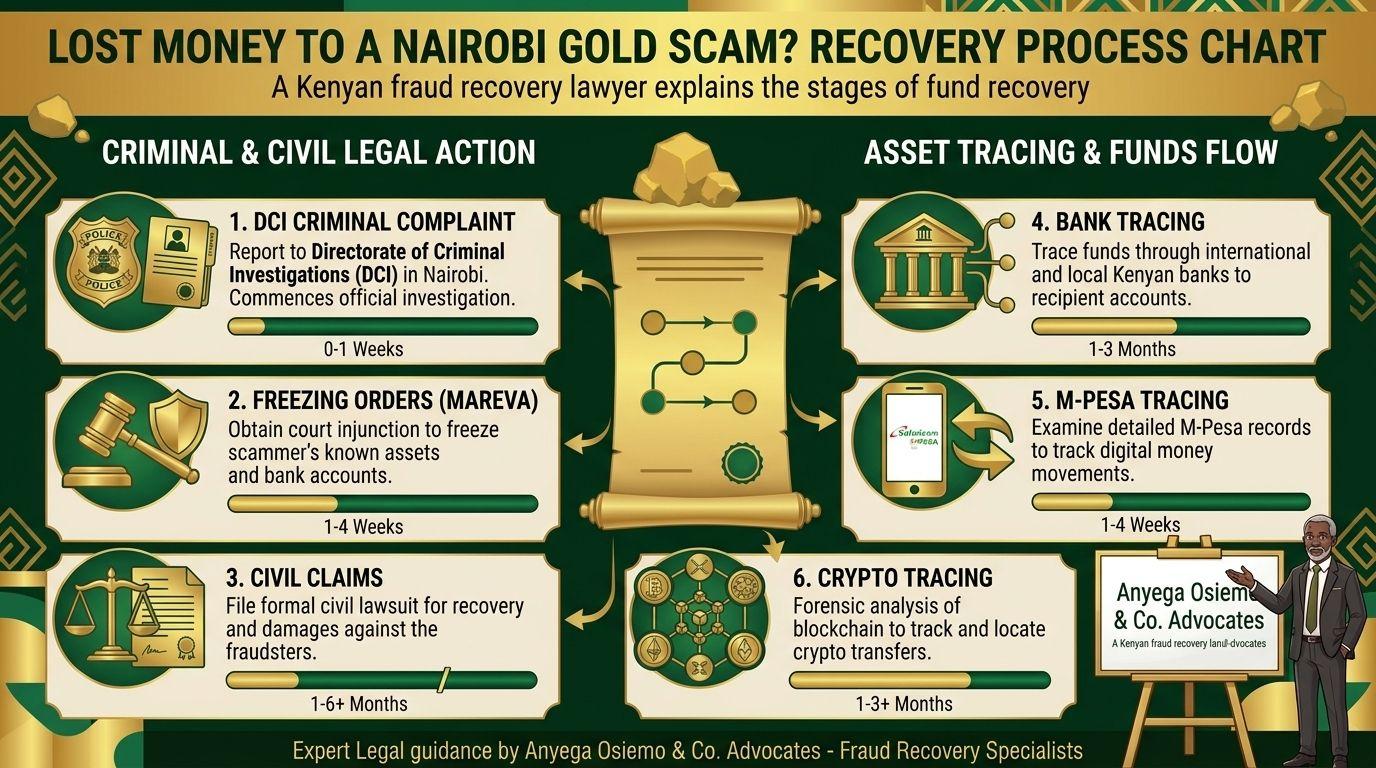
1. File the complaint properly. A written complaint should be submitted to the Directorate of Criminal Investigations or the nearest police station. It should be complete: chronology, amounts, parties, account details, evidence index. A complaint that arrives as an organized bundle moves; a complaint that arrives as a story waits. Obtain the OB (Occurrence Book) number or a written acknowledgment immediately; you will cite it to banks, platforms, and the court.
2. The investigation. DCI's specialized units can lawfully obtain bank records, M-Pesa subscriber and transaction data, phone records, and CCTV footage. Kenyan law enforcement has an active and public record; gold fraud arrests are regularly announced, including those of foreign nationals running fake export operations, and courts have dealt with these schemes substantively. Cooperation with investigators, through counsel, materially improves outcomes.
3. Restraint before conviction. Under the Proceeds of Crime and Anti-Money Laundering Act, 2009 (POCAMLA), assets suspected of being criminal proceeds can be restrained, frozen before trial, and ultimately forfeited. The Financial Reporting Center receives and analyses suspicious transaction reports. For victims, the point is practical: restraint orders can freeze the very accounts and properties your money bought if the criminal case moves fast enough. This is where the criminal and civil tracks must coordinate.
4. Compensation at sentencing. Courts can order compensation to victims as part of sentencing. But compensation orders are only as good as the assets the fraudster holds when the case concludes, often years away, after dissipation. Treat criminal compensation as upside, never as the plan.
It is important to note that a criminal complaint alone seldom results in the recovery of funds. Its primary value is in applying pressure, obtaining restraint orders, gathering information, and creating leverage. Actual recovery of money typically occurs through civil proceedings.
The Civil Route: Where Money Is Actually Recovered
Civil proceedings in the Kenyan courts may proceed concurrently with criminal cases; it is not necessary to await the outcome of the criminal process. Civil recovery is the mechanism through which funds are actually returned to victims.
Causes of action. The workhorse claims are fraud and deceit (the misrepresentations: the fake stockpile, the forged assay, the fictitious export requirements) and unjust enrichment (they have your money; they have no lawful basis to keep it). Each element must be pleaded against the evidence you preserved; this is why the 72-hour evidence discipline matters.
Who to sue? The fraudsters, obviously. But also, the knowing assistants: the introducer who vouched for them, the "advocate" who witnessed the fake documents, the company whose account received your funds knowing their character, the relative who registered the land your money bought. Kenyan law does not require the person who pitched the lie to be the person who caught the money; liability follows participation and knowledge.
The freezing order is the decisive weapon. Kenyan courts grant Mareva-type injunctions restraining defendants from dealing with or dissipating assets pending judgment under the court's general equitable jurisdiction, the Civil Procedure Act's injunctive provisions, and, where arbitration is contemplated or in progress, the Arbitration Act. Two features make freezing orders powerful here: they can be sought before a suit is filed, and they can target the specific accounts and properties identified by the tracing. They are commonly paired with disclosure orders requiring the defendant to swear an affidavit of assets. A false assets affidavit is a fresh offense and a gift to your case.
Search orders and preservation. Where there is a real risk that documents, devices, or property will be destroyed, courts can grant search-and-preservation orders (the Kenyan relative of the Anton Piller order) to be executed with counsel and, where directed, the police or a court process server.
Third-party disclosure. Courts order banks, Safaricom, platforms and government registries to produce records: onward transfer trails, subscriber details, registration documents. This is how "Mr. Director" turns out to be a hired name, and how the upcountry plot bought with your second payment surfaces on your defendant list.
Garnishee and execution. A judgment or a frozen balance supports garnishee proceedings to attach funds directly from the fraudster's accounts and execution against land, vehicles, and goods. Kenya's execution machinery is slow but real; existing assets can be reached.
Following the Money: Banks, M-Pesa and the Blockchain
Kenya's payment rails are documentation-rich, which works relentlessly in a victim's favor once court processes engage:
- Bank records and production orders yield onward transfers, cash withdrawals, standing orders, and linked accounts, including the moment your funds bought a vehicle or a plot.
- M-Pesa records: Safaricom produces transaction histories under court order; large agent withdrawals capture ID details. Most Nairobi fraud networks touch M-Pesa somewhere, and the records are unforgiving.
- Cryptocurrency trails: if any leg was paid in USDT or Bitcoin, the public ledger supports professional tracing to off-ramps and exchange accounts, where court orders or law-enforcement channels identify the person who cashed out. Blockchain evidence requires an expert affidavit to be admissible and a persuasive budget when crypto is involved.
- Land and company registries: the assets themselves: searches reveal what was bought, when, and in whose name, with transfers made after your payments drawing their own inferences.
Cross-Border Realities
Most victims are outside Kenya, and the system accommodates that: you instruct Kenyan advocates, depose to affidavits remotely, and appear in person only where a court genuinely requires it. Foreign-sourced evidence, such as your bank records and the laboratory report on the fake bars, must arrive in a Kenyan-admissible form: notarized and apostilled where both countries are parties to the Hague Convention, or legalized through the consular chain. Your home jurisdiction adds parallel leverage: your own bank's fraud team and, in some countries, law-enforcement interest in the outbound wire can produce records and apply pressure faster than any Kenyan application. Finally, where the operators themselves are foreign, the Mutual Legal Assistance framework allows Kenyan and foreign authorities to cooperate on evidence and restraint, slow, but occasionally decisive. Coordinate the fronts; do not duplicate them.
Inside a Recovery Case: How the Pieces Fit Together
A representative composite (not a client file): an investor wires USD 250,000 in staged payments over four months: purchase price, then "export clearance," then "airport release" fees. He flies home; the boxes never arrive; his home-country laboratory reports copper and zinc.
Week one: advocates file the DCI complaint with an indexed evidence bundle; his bank opens its fraud record; the civil file quietly assembles, with no contact with the fraudsters.
Weeks two to five: investigation confirms the receiving account was operated on a borrowed identity; funds split four ways: two M-Pesa numbers, a vehicle dealer, and an agent withdrawal. The civil team files suit and, the same day, an urgent freezing application against the identified recipients, supported by evidence of the transfers. The court freezes two residual bank balances and orders disclosure of assets.
Months two to six: disclosure exposes what the network actually owns: a plot upcountry registered in a sister's name weeks after the second payment, the vehicle, M-Pesa float. One defendant settles early for a documented partial repayment; the others fight.
Months six to eighteen: the civil matter runs toward hearing while the criminal case proceeds in parallel; an arrest on the DCI file improves the settlement posture materially. The outcome in a case of this shape is partial-to-substantial recovery of the traceable residue, with the size of the gap determined almost entirely by how the first month was handled.
In summary, the general approach involves filing a criminal complaint to apply pressure and obtain restraint orders, initiating civil proceedings to recover funds, utilizing tracing to identify assets and defendants, and acting with urgency at every stage.
Honest Economics: Timelines, Costs, Chances
- Limitation period. Fraud and contract claims are subject to a three-year limitation period under the Limitation of Actions Act. Do not sit on the file; seek interim relief within weeks where dissipation is evident.
- Timeline: Urgent applications to freeze orders may be decided within days to weeks if supported by strong evidence. The period from trial to judgment typically ranges from one to three years. Recovery should be viewed as a process rather than a single event.
- Costs. Court fees, counsel fees, tracing experts, blockchain forensics (where relevant), notarization, and apostilles. Costs: Expenses include court fees, legal fees, fees for tracing experts and blockchain forensics where applicable, and costs for notarization and apostilles. It is advisable to agree on a staged budget linked to specific milestones, such as investigation and merits assessment, interim relief, and pleadings, to allow for informed decisions at each stage. (Real property and operating businesses, or lifestyle and runners?). You control the first; your counsel investigates the second fast. Where the assessment says the money is gone, a good firm will tell you not to spend more.
Working With Kenyan Counsel: What to Ask
Victims located outside Kenya sometimes engage representatives without adequate due diligence, resulting in further losses. Before instructing counsel, consider the following:
- Are you an advocate of the High Court of Kenya? Verify on the Law Society of Kenya's register. "Recovery agents" and "consultants" are not advocates and cannot conduct litigation.
- What is your specific experience with fraud recovery and freezing orders? Ask about past matters in shape, not testimonials.
- Will you provide a written assessment of the merits and prospects of recovery? Reputable firms will advise against filing if recovery is unlikely. Recommendations should be based on analysis, not mere optimism.
- How are fees structured? Staged budgets tied to milestones are the norm; any contingency-style arrangement should be documented with precision about what "success" means.
- Who will be responsible for the day-to-day management of the matter? It is important to have a designated advocate handling your case.
Evidence Standards: What a Kenyan Court Will Expect
The success of recovery litigation depends on the quality and admissibility of evidence, particularly where it originates from outside Kenya. Bank records and correspondence from foreign jurisdictions should be notarized and apostilled where required. Laboratory analysis of the purported gold should be supported by an expert affidavit detailing the methodology, as the defense will scrutinize such evidence. Digital evidence must be preserved in its original form with metadata intact; avoid using screenshots of screenshots. Translations must be certified. Courts expect thorough preparation and will penalize evidentiary gaps.
Ten Mistakes Victims Make
- 1.Delaying action due to embarrassment: limitation periods continue to run, and assets may be dissipated.
- 2.Confronting the fraudsters prematurely: this removes the element of surprise and may prompt asset dissipation.
- 3.Paying unregulated "recovery agents" in advance: this exposes victims to further fraud. Only engage registered advocates
- 4.Relying only on the police is necessary and insufficient; civil. Destroying evidence during confrontation: hostile communications may be used by the defense. Failing to trace assets before initiating proceedings: a judgment against an insolvent defendant does not result in recovery. It is a trophy, not a recovery.
- 5. Suing only the principal fraudster: individuals who knowingly assisted and hold assets may be more effective defendants.
- 6. Overlooking the receiving financial institution: banks or platforms that received the funds and had, or should have had, knowledge of the fraud may be liable, subject to time-sensitive and fact-specific considerations.
- 7. Waiting for the conclusion of the criminal case: civil and criminal proceedings may proceed in parallel; unnecessary delay may result in lost recovery opportunities.
- 8. Proceeding without a written fee agreement or staged budget: legal expenditure should be proportionate to the realistic prospects of recovery.
Frequently Asked Questions
Q1. Can I recover money lost to a gold scam in Kenya?
A. Yes, most reliably through civil proceedings supported by freezing orders, with a DCI complaint running in parallel. Outcomes turn on speed and on whether the fraudsters hold traceable assets.
Q2. How long do I have to file a claim in Kenya?
A. Generally, three years from when the cause of action arose under the Limitation of Actions Act, but freezing applications should be sought within weeks where dissipation is evident.
Q3. Do I need to travel to Kenya to pursue a claim?
A. No. You instruct counsel, give evidence by affidavit, and appear remotely for most steps; physical attendance is rarely required.
Q4. Will the police get my money back?
A. Not by themselves. Police investigate and prosecute; money returns through POCAMLA restraint, court-ordered compensation, or,r most effectively,y your own civil claim.
Q5. What does a freezing order cost, and how fast can it be obtained?
A. With solid evidence, an urgent application can be lodged within days to weeks. Costs vary with complexity; expect a staged budget from the outset.
Q6. Can I sue the bank or M-Pesa that received my money?
A. Sometimes, the institution knowingly facilitated the fraud or breached its own controls. These claims are fact-sensitive and time-critical; take advice before assuming either way.
Q7. What if the fraudsters are in another country?
A. Kenyan courts can act against Kenyan assets and receivers of funds; mutual legal assistance covers cross-border evidence and restraint; and your home jurisdiction may offer parallel leverage. Strategy follows the money, not the passport.
Q8. Can crypto payments be traced and recovered?
A. Yes, the public ledger preserves the trail, professional tracing identifies off-ramps, and court orders or exchange law-enforcement channels identify recipients. You need the transaction hashes preserved early.
Q9. What if the "gold" was actually delivered but turned out to be fake?
A. You still have claims for fraud and breach, and the delivered goods are admitted as exhibits. The analysis belongs in an expert affidavit.
Q10. How do I avoid recovery scams?
A. Registered advocates only; verify on the LSK register; no upfront "release fees"; a written merits assessment before any money is spent on litigation.
How We Can Help
At Anyega Osiemo & Company Advocates, we represent both local and international clients in matters involving gold and investment fraud. Our services include evidence preservation; preparation and filing of DCI complaints; obtaining freezing and search orders; conducting civil recovery and asset tracing; coordinating with foreign counsel; and providing written assessments of recovery prospects before the commencement of litigation. Timely action is critical; contact us for a confidential consultation.
Disclaimer: This article is general legal information, not legal advice. For guidance on your specific situation, book a consultation with our advocates.