Kenya is one of Africa's most active cryptocurrency markets. Chainalysis has repeatedly ranked the country among global leaders in peer-to-peer digital asset trading, and the Virtual Asset Service Providers Act, 2025, which has been in force since 4 November 2025, has brought crypto squarely within Kenya's legal and regulatory system. Yet the overwhelming majority of Kenyan holders have made no legally valid plan for what happens to their Bitcoin, Ethereum, USDT, or other digital assets upon their death.
This omission is not a routine estate-planning oversight. Unlike traditional assets, there is no institution to notify, no branch to visit, and no mechanism for password recovery. If your executor or beneficiaries cannot locate and use your private keys, the cryptocurrency is permanently lost. It does not become part of a probate dispute or remain accessible to heirs; it is irretrievable as a matter of mathematical certainty.
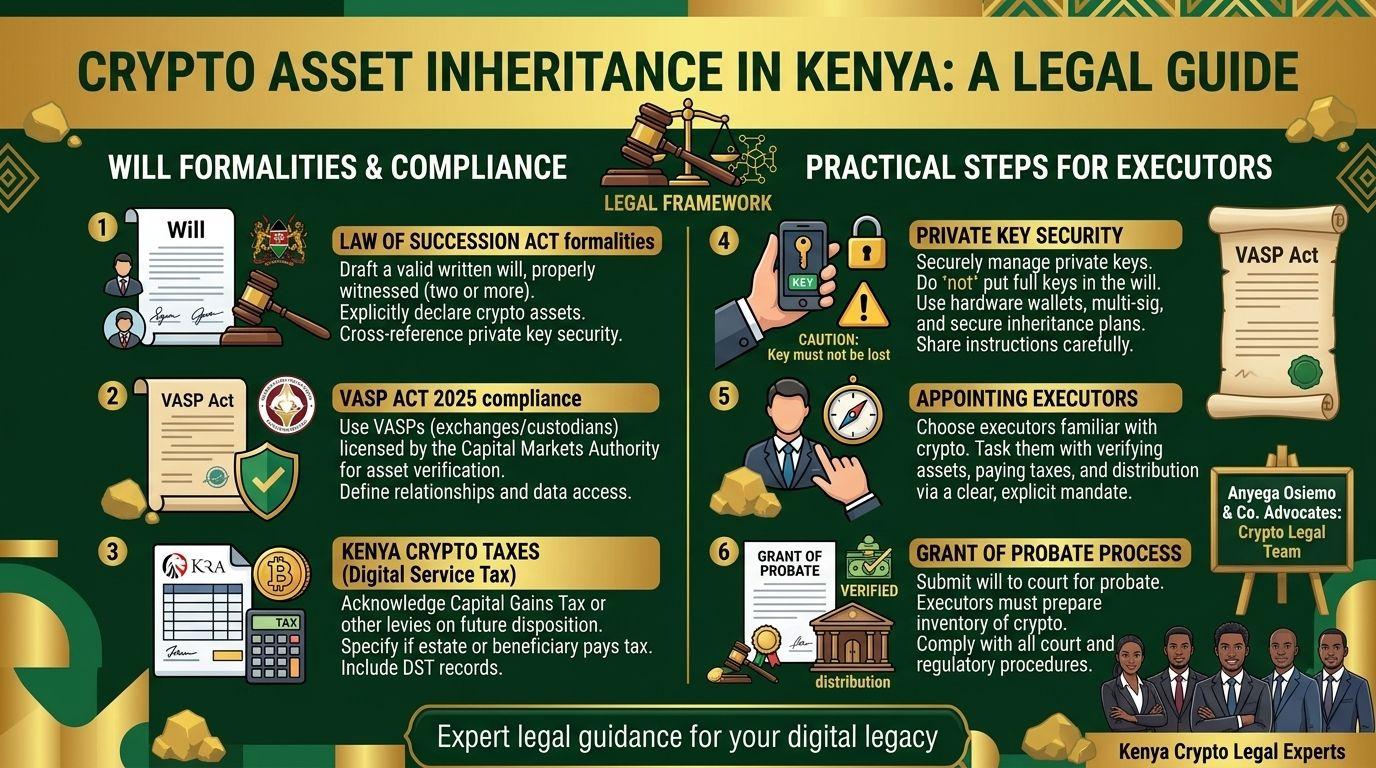
This guide sets out the process for including cryptocurrency in your will in Kenya. It addresses the legal framework under the Law of Succession Act, the applicable tax considerations, the probate process for estates containing digital assets, and, crucially, the practical arrangements required to ensure that the legal documentation is effective in practice.
Is Cryptocurrency Property You Can Leave in a Will in Kenya?
Yes. Cryptocurrency is not legal tender in Kenya; the Central Bank of Kenya has maintained that position since its first public cautions in 2015, but it is unquestionably property, and the Law of Succession Act (Cap 160) governs the distribution of a deceased person's property of every description. Kenyan courts have already engaged with digital tokens as assets within existing legal categories. In the litigation arising from the ill-fated "KeniCoin" offering, the High Court treated the token as a security falling under the Capital Markets Act.
The regulatory position has also firmed up considerably:
- The VASP Act, 2025 (Act No. 20 of 2025) was assented to on 15 October 2025 and came into force on 4 November 2025. It establishes a licensing regime for virtual asset service providers, exchanges, custodians and transfer services administered principally by the Central Bank of Kenya, with the Capital Markets Authority regulating token offerings.
- The VASP Regulations, 2026 (Legal Notice No. 134 of 2026) operationalise the Act, including the licensing of platforms operating in or from Kenya.
For estate planning purposes, the distinction is significant. Cryptocurrency held on a licensed, Kenya-regulated platform is substantially easier for an executor to identify, verify, and recover. In contrast, assets held on unlicensed offshore platforms may be subject to uncertain terms of service, jurisdictional complications, and solvency risks upon death. Platform risk is now a material consideration in structuring your estate.
The Tax Position for Crypto in a Kenyan Estate
Tax compliance is the point at which many crypto estate plans fail, often due to inadequate record-keeping over time. The current legal position is as follows:
- The repealed Digital Asset Tax. The Finance Act 2023 introduced a 3% Digital Asset Tax on crypto transactions, effective September 2023. The Finance Act 2025 repealed it and replaced it with a 10% excise duty on fees charged by virtual asset service providers: a tax on the platform's commission, not on your holdings.
- Income tax on disposal. Realized gains are subject to ordinary income tax, and digital assets are likely to be treated as "property" for capital gains tax purposes upon disposal. Beneficiaries will require cost-basis records to determine their tax liability when assets are eventually sold. If acquisitions occurred over several years in different currencies, reconstructing this history without proper records may be impossible. Maintaining a contemporaneous ledger is essential.
- No estate duty. At present, Kenya does not impose estate duty or inheritance tax. However, proposals to reintroduce estate duty have appeared in recent Finance Bills, including the Finance Bill 2025, but have not been enacted. This issue recurs in each budget cycle. It is prudent to review the tax position annually.
The Legal Framework: The Law of Succession Act (Cap 160)
Kenya's succession law applies to "property" broadly defined, and digital assets fit comfortably within it. The provisions that matter for your will:
- Testamentary capacity (Section 5). Any person of sound mind aged eighteen years or above may make a will. Because crypto is novel, disputes about capacity are foreseeable; if there is any history of illness, a contemporaneous medical confirmation of capacity at the time of execution is cheap insurance.
- Freedom of testation: with one limit. You can leave your crypto to whomever you wish. Still, under the defendants’ provision of the Act, the court can order reasonable provision from your net estate for defendants you have not adequately provided for. Digital assets are not exempt from such orders.
- Execution formalities (Section 11). The will must be in writing, signed by you (or by someone at your direction in your presence), and attested by two or more competent witnesses, each of whom must see you sign and must sign in your presence. Best practice is to have both witnesses present together; practitioners commonly use the drafting advocate and an independent professional.
- The beneficiary-witness trap (Section 13). A bequest to an attesting witness or to the witness's spouse is void unless at least two additional competent witnesses also attest the will. Use independent witnesses; never let a beneficiary witness your will.
- Incorporation by reference (Section 12). A will may validly incorporate an existing, clearly identified document without reproducing it. This is the single most useful provision in Kenyan law for crypto estate planning because it allows your will to incorporate a separate letter of wishes and access memorandum, which can be updated as your estate plan evolves. Oral wills are not appropriate for digital assets. The Act allows oral wills only in narrowly defined circumstances, such as imminent death within three months before two or more witnesses. An oral instruction regarding a seed phrase does not constitute an estate plan. If cryptocurrency forms part of your estate, it must be addressed in a written will. If your crypto matters, include it in your will.
Muslim testators should note: the Law of Succession Act does not govern the estates of Muslims, who are instead governed by Islamic law. Under that framework, a wasiyya (testamentary bequest) to a non-heir is generally capped at one-third of the estate. Crypto can absolutely be included, but the one-third ceiling and the rules on heirs mean the drafting must be accompanied by advice informed by Islamic law; a generic will template will get this wrong on both fronts.
How Crypto Moves Through the Kenyan Probate Process
Understanding the machinery helps you draft for it. Upon death, your executor (under a will) or administrators (where there is no will) must obtain a grant from the court: a grant of probate in the former case, letters of administration in the latter. In practice:
- The petition. An application is lodged with the supporting documents, including an affidavit of means listing the estate's assets and their values in Kenya Shillings. Your crypto must appear here, listed by exchange and wallet, with approximate holdings and a date-of-death valuation derived from exchange statements or market prices.
- 2. Public notice. The petition must be advertised, and the grant cannot be issued until at least thirty days have elapsed, the window during which objections can be filed.
- 3. The grant issues, after which the executor has legal authority to deal with third parties, banks, the Land Registry, and crypto exchanges.
- 4.Confirmation of the grant follows, authorizing distribution to the beneficiaries.
Smaller estates fall within the jurisdiction of the Magistrates' Courts, subject to statutory thresholds. Larger or more complex estates, especially those involving foreign platforms or cross-border assets, are heard by the High Court. An uncontested grant typically takes six to twelve months; contested proceedings may extend for years. During this period, digital assets may require active management, including the handling of staking lock-ups, volatile positions, and evolving platform terms. The will must therefore confer express and flexible powers on the executor, as discussed below.
Where a Kenyan resident dies holding crypto abroad, say, on a US exchange, the foreign grant or the Kenyan grant may need to be resealed in the other jurisdiction before the platform will act. If your estate has this shape, state it in the will and the letter of wishes, and consider the platform's known estate procedures when deciding where to hold it.
Exchange-Held vs Self-Custodied Crypto: Why the Drafting Differs
How you hold determines what your executor must do.
Exchange-held assets. Your coins sit with a platform, a licensed Kenyan VASP, or a foreign exchange such as Binance or Coinbase, which controls the private keys. Access requires your account, registered email, KYC identity, and two-factor authentication. For the estate, the asset is claimable through the platform's death process, typically requiring a death certificate, the grant of probate or letters of administration, the executor's identity documents, and sometimes notarization or an in-app heir nomination. Two vulnerabilities deserve emphasis: platforms freeze or restrict accounts on notice of death (proper, but it means your executor must move quickly with documents), and SIM-swap and email-takeover fraud spikes when a death becomes public; a deceased person's verified exchange account is a prime target. Your inventory must therefore record the exchange, the account email, and approximate holdings so that the executor can notify the platform immediately.
Self-custodied assets. In this case, you retain the private keys, whether on a hardware wallet, a phone wallet, or as a seed phrase recorded physically. Legal documentation is secondary to the practical reality: possession of the seed phrase equates to control of the assets. The estate plan must precisely specify the locations of the device and the seed backup, as well as the individuals authorized to access both. The secure arrangements for this are addressed in Step 5 below.
Most Kenyan holders, particularly those who accumulated through M-Pesa-funded P2P trades on global platforms, have both types. Your plan must cover each separately and completely.
The Cardinal Rule: Never Write Seed Phrases or Private Keys in the Will
This rule cannot be overstated; it is the one most often broken by do-it-yourself drafters who use online templates.
Once a grant is applied for, the will becomes a public document at the court registry and is open to inspection. If your seed phrase or private keys appear in the will, a codicil, or the probate papers themselves, you have published the combination to your vault in a public office. The assets can be swept by anyone who reads the file, weeks or months before your executor is even in a position to act, and a blockchain transaction is irreversible. The same danger applies to bank safe-deposit instructions, PINs, and account passwords written into the will.
The will should identify your digital assets and specify the location of the access information. It must never include the access credentials themselves.
How to Add Cryptocurrency to Your Will in Kenya: The Nine Steps
Step 1: Build a complete crypto asset register
List every digital asset you own, and for each record: the asset and approximate quantity; the platform or wallet where it is held (exchange name and your registered account email, or wallet type and device location); how it is secured (hardware device, phone wallet, paper or metal seed backup); and anything in motion, such as staked positions with unbonding periods, liquidity in DeFi protocols, pending airdrops. Date the register, sign it, and keep it with your will papers. This register doubles as the raw material for the affidavit of means, sparing your family a forensic exercise at the worst moment of their lives.
Step 2: Update your will. Determine whether to make
A specific bequest (for example, "I give my Bitcoin holdings to X") or a bequest of the residue of the estate (for example, "all the rest of my property, including all digital assets, to Y"). Given the volatility of cryptocurrency, percentage allocations generally reflect testamentary intention more accurately than fixed unit amounts. A bequest of "1 BTC" may have widely varying value over time and could distort the intended distribution. Assets should be described with sufficient precision to identify them without disclosing sensitive information, and the drafting should encompass future acquisitions, staking rewards, and airdrops.
A clause in the modern Kenyan style will look something like this (your advocate will adapt it to your circumstances):
"I give all my right, title and interest in my digital assets including all cryptocurrency and tokens held on my account with [exchange], all balances held in the self-custody wallets described in the Letter of Wishes dated [date] which I have incorporated into this my will, and all staking rewards, airdrops and other digital assets of whatever kind owned by me at my death to [beneficiary], and I direct my Executors to deal with such assets in accordance with the said Letter of Wishes and the express powers conferred on them by this my will."
Step 3: Incorporate a letter of wishes by reference
Section 12 of the Law of Succession Act permits a will to incorporate an existing, clearly identified document. A letter of wishes and an access memorandum should be used to provide operational details, including the locations of devices and backups, security arrangements for exchange accounts, notification instructions, the identities of technical advisers, and guidance on managing volatile assets. The memorandum should be updated as circumstances change, while the will remains unchanged. Store the memorandum securely, for example, in a sealed envelope with your advocate or in a safe-deposit box, and record its location in the will.
Step 4: Appoint the right executor and grant express digital asset powers
An executor without experience in handling digital assets may encounter significant difficulties, and exchange compliance teams are unlikely to make exceptions to their procedures. Consider appointing a co-executor with technical expertise or a professional executor with express authority to engage digital asset specialists. At a minimum, the letter of wishes should identify a technical adviser for the executor. The will should expressly authorize the executor to access devices and accounts, recover and transfer digital assets, communicate with platforms both in Kenya and abroad, convert cryptocurrency to shillings where appropriate, hold volatile assets pending distribution, and engage forensic or custodial experts. Failure to address these matters can result in prolonged administration.
Step 5: Secure the access layer
This is the step that determines whether the plan works at all.
- For small-to-medium holdings: a sealed, dated envelope containing the access memorandum, held by your advocate, with a note in the will acknowledging its existence.
- For larger holdings: split knowledge; one trusted person knows where the hardware device is; a sealed envelope containing the seed backup sits with your advocate; no single person can act alone. Consider a multi-signature wallet that requires two of three keys, or splitting a seed phrase using a scheme such as Shamir’s secret sharing.
- Whatever the structure, rehearse it once with your executor: a dry run moving a small test amount is the only real proof the plan works.
Step 6: Prepare for valuation and the affidavit of means
The affidavit of means must state asset values in Kenyan shillings as at the date of death. Exchange statements and wallet balances should be preserved promptly after death, as prices fluctuate and the court requires a defensible valuation. The executor should be granted discretion to sell or distribute assets in specie, depending on prevailing conditions. Compelling a sale during a market downturn or distributing illiquid tokens to beneficiaries who cannot realize their value is not advisable.
Step 7: Hand over the tax records
Compile a comprehensive cost-basis ledger, platform statements, and any records from the period when the Digital Asset Tax applied. Beneficiaries inherit not only the assets but also the obligation to substantiate the cost basis upon eventual disposal. Maintaining organized tax records is of significant value to your heirs.
Step 8: If you are Muslim, A Muslim testator may generally bequeath up to one-third of the estate to non-heirs.
Cryptocurrency may be included within this portion or, in certain family circumstances, addressed through lifetime gifts or with the agreement of heirs. Drafting in this context requires expertise in both the VASP Act and Islamic succession law. A generic will template is inadequate for these requirements. A document that fails on both fronts.
Step 9: Stress-test and review annually
Exchanges may exit the market, experience security breaches, or alter their terms of service. Wallets may be replaced, seed backups relocated, and portfolios rebalanced. The regulatory environment under the 2025 Act and 2026 Regulations continues to evolve. It is essential to review the will, asset register, and memorandum at least annually and after any significant change. A will that references obsolete wallets or omits current holdings is less effective than one that does not.
A Worked Example: A Nairobi Holder's Estate Plan
David, aged 41, a consultant based in Nairobi, holds 1.2 BTC on a hardware wallet, 8 ETH and USDT on a global exchange, and a staked position subject to a ninety-day unbonding period. His estate plan provides that his entire digital asset portfolio be divided in equal percentages between his two children and held in trust for their education. The will incorporates a letter of wishes specifying the exchange account, the device’s location, and a sealed seed backup held by his advocate. His brother, who is familiar with cryptocurrency, is appointed co-executor alongside the drafting firm. The will authorizes conversion to shillings to fund educational expenses, and the asset register records the staked position, enabling the executor to manage the unbonding period. The professional cost is minimal relative to the estate. The alternative: children discovering the Bitcoin years after probate, without keys or records, is precisely what this guide seeks to prevent.
Ten Mistakes That Break Crypto Estates in Kenya
- 1.Writing the seed phrase in the will. The will becomes public on probate. You have published your keys.
- 2.Telling no one. If no one knows the crypto exists, it is unrecoverable. There is no bank to send a statement.
- 3.Assuming an exchange will release the account. Platforms freeze on notice of death and demand the grant, death certificate, and identification, sometimes notarized, sometimes with extra steps for foreign executors.
- 4.Letting a beneficiary witness the will. Under Section 13 of the Law of Succession Act, their gift is void unless two additional independent witnesses attest to it. Use independent adults.
- 5.Vague descriptions. "My Bitcoin," with no exchange names, wallet types, or locations, invites litigation among heirs.
- 6.No express digital asset powers. Without them, your executor's authority to access devices, keys, and foreign platforms will be contested by the platforms and sometimes by family members.
- 7.Forgetting 2FA and the phone. The exchange account secured by the deceased's phone and authenticator app is a classic deadlock; the letter of wishes must address access to devices.
- 8.Ignoring platform risk. Assets held on an unlicensed offshore exchange may be unrecoverable for reasons unrelated to your will. Prefer licensed VASPs where practical.
- 9. A n outdated plan. Wallets change, exchanges change, you change. Review annually.
- 10.Assuming beneficiaries understand crypto. If one heir is fluent in wallets and the others are not, expect disputes over valuation, timing and conversion. Settle these questions in the will and letter of wishes in advance.
Frequently Asked Questions
Q1. Is Bitcoin legal in Kenya?
A. Bitcoin is not legal tender, but owning, buying, selling and bequeathing it is lawful. Crypto is treated as property; platforms are now regulated under the VASP Act, 2025, and the tax treatment is set out in the finance legislation summarized above.
Q2. How much does it cost to write a will in Kenya?
A. For a straightforward will, advocates quote from around KSh 10,000 to KSh 30,000; estates with trusts, foreign assets or detailed digital-asset provisions cost more. Whatever the fee, it is trivial against the value of a crypto portfolio and far cheaper than the letters of administration process your family faces without a will.
Q3. How long does probate take in Kenya?
A. By law, the grant cannot issue until at least thirty days after the petition is advertised, and uncontested estates commonly take six to twelve months end to end. Contested estates take considerably longer, another reason to draft carefully and witness properly.
Q4. Can I leave my crypto exchange account in my will?
A. You bequeath the assets, not the account. The platform's terms govern the account itself, and most will transfer holdings to an executor upon proof of death and the grant. Name the exchange and account in your register and letter of wishes so your executor can start that process on day one.
Q5. What happens to my crypto if I die without a will in Kenya?
A. It passes under the Act's intestacy rules to your spouse, children, and other relatives in fixed shares, but only if anyone can access it. Your family must first obtain letters of administration, with all the delay and cost that entails, and self-custodied assets without known seed phrases are almost certainly lost. A will plus an access memorandum is dramatically cheaper.
Q6. Do my heirs pay tax on inherited cryptocurrency in Kenya?
A. There is currently no estate duty or inheritance tax. Gains are taxed when your beneficiaries eventually dispose of them, with income tax and potentially capital gains tax, which is why your cost-basis records matter. The 10% excise duty on VASP fees is a platform-level charge, not an inheritance tax.
Q7. Is it safe to tell my lawyer my seed phrase?
A. No, not even your lawyer needs it in the ordinary course. The professional arrangement is a sealed envelope held by the advocate, whose existence and location are noted in the will. The seed phrase is accessed only by your executor under the letter of wishes.
Q8. Can a Muslim include Bitcoin in a wasiyya?
A. Yes, subject to the one-third limit on bequests to non-heirs and the Islamic rules on heirs. The drafting must come from someone who understands both the VASP Act framework and Islamic succession law.
Q9. Should I put my crypto in a trust instead of a will?
A. For substantial holdings, a trust with a professional trustee gives continuity, custody and smoother succession. Trust structures for digital assets are still developing alongside the VASP Regulations, so take advice before settling on one.
Q10. How do I update my will when I buy or move crypto?
A. Usually, you do not need to re-execute the will at all: update the crypto asset register and the incorporated letter of wishes. Re-execute the will itself only if beneficiaries, executors, or the core structure change, and never by hand-editing the signed original.
How We Can Help
At Anyega Osiemo & Company Advocates, we prepare wills and estate plans that actually work for modern portfolios, including cryptocurrency held on Kenyan and foreign platforms, self-custody wallets, NFTs, and other digital assets. We draft the will and the letter of wishes, structure executor appointments and express powers for digital assets, advise on trust structures for larger holdings, and guide executors through the probate and platform claims process when the time comes.
A will that ignores your digital assets is half an estate plan; a will that puts your seed phrase on the public record is worse than none. Contact us for a confidential consultation.
Disclaimer: This article is general legal information, not legal advice. For guidance on your specific situation, book a consultation with our advocates.