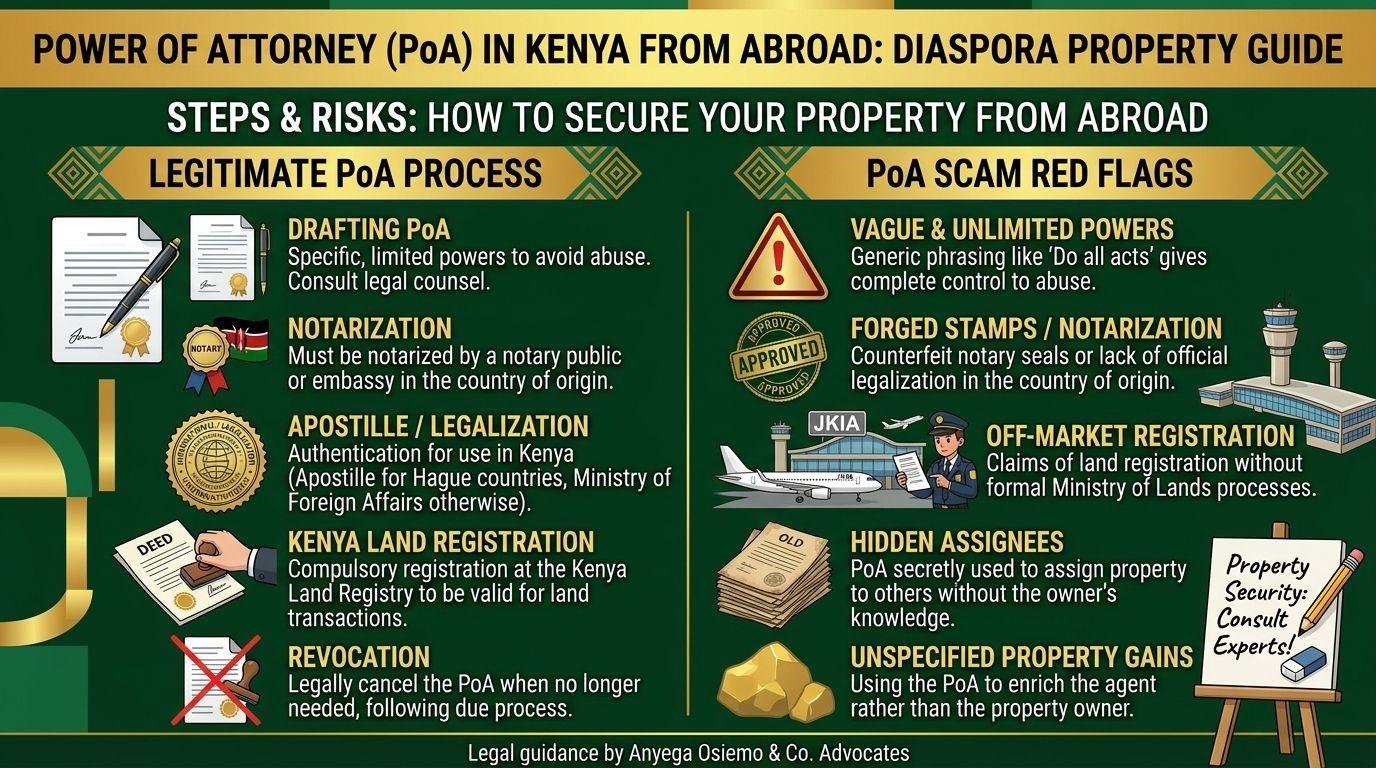
Land remains the principal asset sought by members of the diaspora, yet it is also the transaction most susceptible to fraud. The recurring schemes are familiar to practitioners: parcels purportedly sold to multiple buyers, authentic titles transferred without the proprietor's knowledge, land designated as road reserve misrepresented as available for sale, and relatives presenting opportunities that exist solely in their representations. The risks inherent in these transactions are exacerbated by physical distance, which precludes personal inspection of the property, direct assessment of the seller, or verification of boundary markers.
Nevertheless, it is entirely possible for members of the diaspora to acquire land in Kenya securely, provided that the transaction is approached as a procedural matter. The process consists of a defined sequence of verifiable steps, each designed to address and eliminate a particular category of fraud. Adherence to this sequence is essential; omission of any step exposes the purchaser to significant risk. The following guide sets out this procedural framework.
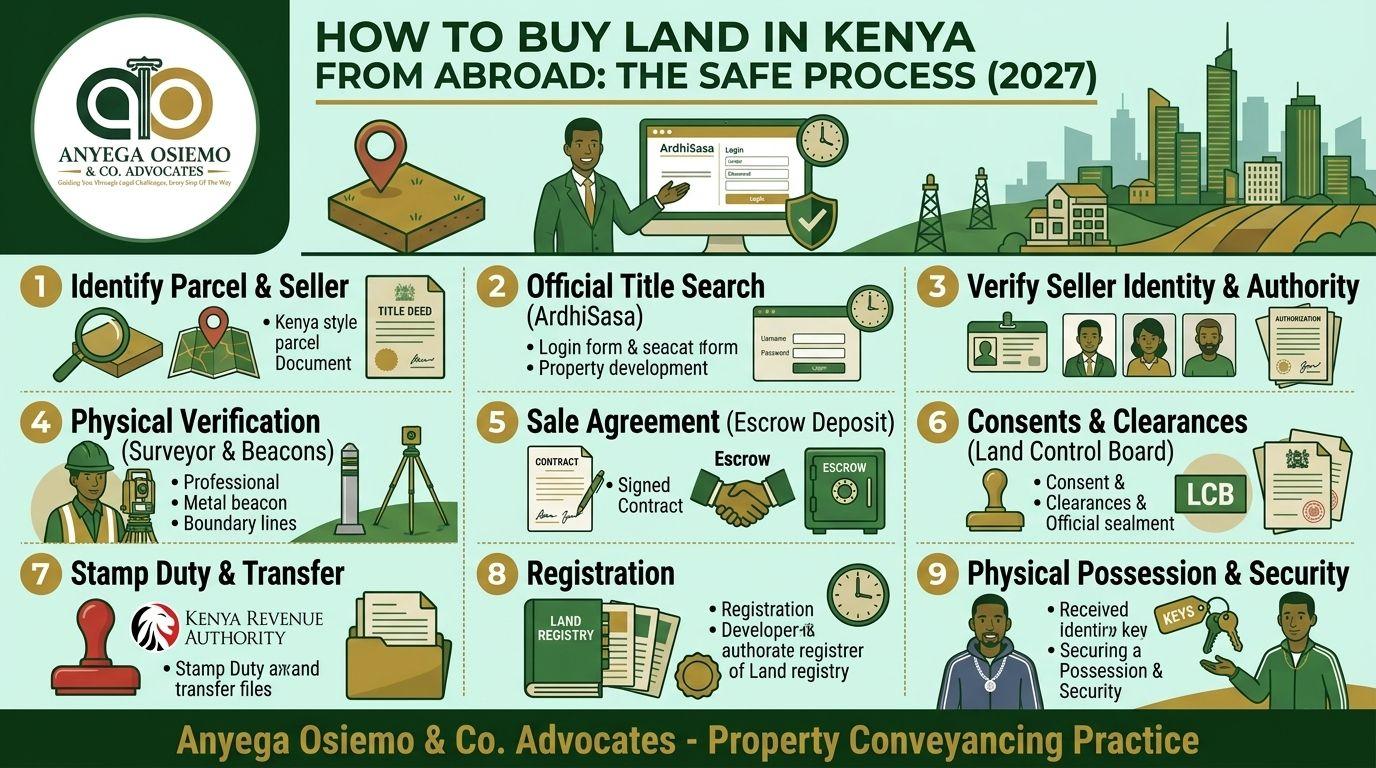
The Safe Sequence at a Glance
1. Identify the parcel and the seller
2. Search the title officially
3. Verify the seller's identity and authority
4. Physically verify the land
5. Negotiate and sign a sale agreement
6. Handle consents and clearances
7. Pay stamp duty
8. Execute the transfer and register
9. Take possession and secure the plot
Each of these steps is mandatory. Their inclusion in the process is necessitated by the specific forms of fraud that arise when any are omitted.
Step 1: Identify the Parcel and the Seller
Fraud begins at identification. The "agent" with the hot listing; the relative who found "an opportunity"; the online advert below market — each is a channel, not a verification. Before anything else: who is the registered proprietor? The seller's claim to be the owner, the manager, or the "son handling father's plot" must resolve to a name on a title — or to documented authority (a registered power of attorney, letters of administration, a company resolution) from that name.
Step 2: Search the Title Officially
The official search is the transaction's foundation and is conducted through the government's land information platforms (the ArdhiSasa portal) or at the relevant land registry. The search confirms the registered proprietor, the land's particulars, and critically the encumbrances: mortgages, charges, cautions, restrictions and court orders attaching to the parcel. Each encumbrance is a conversation before it is a problem: a mortgaged plot requires the chargee's involvement in any discharge; a caution means someone has staked a claim the seller must clear.
It is imperative to reconcile the results of the official search with the property's physical characteristics. The parcel number, acreage, and location as indicated on the title must correspond precisely to the land intended for purchase. A common form of fraud affecting diaspora buyers involves substitution, where a legitimate title is presented for a parcel that is not the one actually being offered.
Step 3: Verify the Seller's Identity and Authority
The person signing must be the person on the title, or properly authorised:
- Individuals: national ID verified against the registry record; where the seller is married, and the land is matrimonial property, spousal consent is required by law for the sale; in its absence, it is a ground to unwind the transaction.
- Companies: registry search confirming the company, its directors and signatories, plus the board resolution authorising the sale.
- Estates: the grant of representation and the administrator's authority; heirs selling "family land" without administration are selling a lawsuit.
- Attorneys: A trusted individual, such as an agent of your advocate, a licensed surveyor, or a relative without any financial interest in the transaction, must conduct a physical inspection of the property. The inspection should confirm the presence and accuracy of boundary beacons as per the registry diagram, determine whether a new mutation survey is warranted in cases of recent subdivision, verify that there is no occupation by third parties whose presence cannot be explained by the seller, and ensure that the land is not subject to road, wayleave, or riparian reservations. Additionally, neighbouring proprietors should be able to confirm the seller's ownership. Failure to conduct such verification renders the transaction speculative rather than legitimate. Riparian reservation slicing through the "plot"; neighbours who recognise the seller's ownership. A plot that has never been physically verified is not a parcel; it is a rumour with a price.
Step 5: The Sale Agreement
The written sale agreement formalises the parties' negotiations into a legally binding obligation. Essential elements include verification of the parties as previously described, precise identification of the parcel by title number, specification of the purchase price and payment structure, and proper handling of the deposit, which should be held in escrow by advocates and released only upon completion or satisfaction of defined milestones. The agreement must also set out conditions precedent, such as obtaining necessary consents and discharging encumbrances, establish completion timelines, stipulate consequences for default, and require that the balance of the purchase price is paid only upon delivery of registrable transfer documents. Reversing this sequence, such as paying a deposit prior to executing an agreement, undermines the legal protections afforded to the purchaser.
Step 6: Consents and Clearances
Depending on the land's class and the parties: land control board consent for transactions in controlled (private agricultural) land; consent of a charge where the land is encumbered; and the clearances: land rates from the county and land rent where the title is leasehold from the state, without which the registrar will not move. Each is a defined procedure with defined timelines; your advocates run them in parallel, because sequence errors here are how completion dates die.
Step 7: Stamp Duty and Transfer
The transfer documents are executed, assessed for stamp duty ad valorem at differentiated rates, commonly four per cent of value for urban land and two per cent for rural land, and stamped. Valuation can be contested where the authority's assessment departs from the transaction's reality; professional handling keeps the duty right and the file moving.
Step 8: Registration Where Ownership Actually Moves
The duly stamped transfer instrument is lodged at the relevant land registry. Upon registration, a new title is issued in the name of the purchaser (or transferee), effecting the transfer of legal interest. The duration of this process varies depending on the registry and its workload. It is essential to maintain proper documentation, including receipts and lodgment records, and to rely on the advocate's oversight rather than informal follow-up. Legal ownership does not pass until registration is complete, underscoring the importance of deposit protection and staged payments throughout the transaction.
Step 9: Possession and Security
Completion is not registration alone: take physical possession fenced, beaconed, occupied, or visited as soon as practicable. Unoccupied and unvisited land is the diaspora's recurring loss: sold again by the same seller, subdivided by neighbours, occupied by strangers whose eviction costs more than the plot. Title without possession is a theory; secure the theory.
The Red Flags That Should Stop Everything
- Price materially below comparable parcels; urgency and discounts are bait, not luck
- Pressure to skip searches, consents or agreements "to save time"
- A seller who cannot produce ID matching the title, or whose "authority" is a story
- Requests for deposits to personal accounts before any signed agreement
- A plot you have never seen, whose beacons no one will confirm
- Relatives or agents who resist involving your own advocate
- Titles with recent, rapid transfers churned instruments deserve fresh scrutiny
A Worked Example: The Plot That Passed Every Test
Consider the following composite example: a diaspora purchaser identifies a half-acre parcel near a developing county town through an agent whose reliability is not yet established. The procedural sequence is followed from abroad: an official search confirms the registered proprietor and absence of encumbrances; identification and spousal consent are verified; an independent surveyor confirms the beacons, registry diagrams, and consults neighbouring proprietors who corroborate the seller's ownership; a sale agreement is prepared by the purchaser's advocates, with the deposit held in escrow and released only upon delivery of registrable documents; land control board consent is obtained (as the land is agricultural); clearances for rates and rent are secured; stamp duty is assessed and paid; the transfer is lodged; and, after several weeks, a new title is issued in the purchaser's name. Physical possession is taken immediately through fencing, a caretaker's agreement, and scheduled visits. The entire process is completed in under four months, with no unexpected issues arising. This outcome is the direct result of adherence to the procedural sequence. In contrast, files abound with cases where omitted steps resulted in significant losses, despite initial time or cost savings.
Ten Mistakes Diaspora Land Buyers Make
- Skipping the official search the single non-negotiable step, and the most commonly skipped.
- Trusting agents and relatives over procedures channels to identify land; only procedures verify it.
- Paying deposits before agreements; money moves on paper, or it does not move.
- No physical verification: an unwalked plot is a rumour with a price.
- Ignoring encumbrances, charges, and cautions are conversations, not footnotes.
- The absence of spousal consent can render an otherwise valid purchase void. Where spousal consent is required by law and is not obtained, the transaction may be set aside.
- It is essential to verify that the person purporting to sell the property has the legal authority to do so. Any claimed authority must be supported by proper documentation.
- Registration of the transfer does not occur automatically. It is necessary to lodge the documents, obtain receipts, and ensure that all steps are completed to finalise the process.
- Holding title without taking possession of the land exposes the property to risks, including resale, subdivision, or occupation by third parties. It is important to physically inspect the land and take possession of it after purchase.
- Each party should engage their own advocate in a land transaction. The seller's advocate acts in the interests of the seller, not the buyer.
Frequently Asked Questions
Q1. How do I search a land title from abroad?
A. You may conduct a land title search from abroad through the government's official land information platforms, such as ArdhiSasa, or by instructing your advocate to carry out the search at the land registry. It is important to rely on an official search result, not a photocopy provided by an agent.
Q2. What is the first thing to check when buying land in Kenya without travelling?
A.All steps can be managed through your advocates and appointed agents, with proper procedures in place to safeguard your interests. Title and the physical parcel.
Q3. Can I buy land in Kenya without travelling?
A. Yes every step runs through your advocates and appointed agents; distance is managed with procedures, not trust.
Q4. How much is stamp duty on land in Kenya?
A. Stamp duty is assessed on an ad valorem basis, typically at four per cent for urban land and two per cent for rural land, calculated on the value of the property. Your advocates will handle the assessment and address any disputes regarding the amount.
Q6. What is land control board consent?
A. Land control board consent is a statutory requirement for transactions involving private agricultural land. This consent must be obtained from the local land control board prior to registration of the transfer.
Q7. Do I need spousal consent to buy?
A. Spousal consent is legally required for the sale of matrimonial property. If the seller does not obtain this consent, the transfer may be rendered invalid.
Q8. How do I protect my deposit?
A. A land transfer in Kenya typically takes several weeks to a few months, depending on the time required to obtain consents and clearances, and on the workload at the registry. Diligent follow-up with documentation, rather than applying pressure, is the key to expediting the process.
Q9. How long does a transfer take in Kenya?
A. Weeks to a few months depending on consents, clearances and registry workload; documentary follow-through, not pressure, is the accelerator.
Q10. What are the biggest red flags of land fraud?
A. Major red flags for land fraud include prices that are significantly below market value, pressure to bypass standard procedures, sellers who cannot be verified against the title, requests for deposits to be paid into personal accounts, and plots that no one is willing to physically confirm.
Q11. Should I involve a lawyer when buying land in Kenya?
A. It is essential to involve a lawyer when buying land in Kenya. Each step in the process is a legal procedure, and the cost of proper legal representation is minimal compared to the potential losses from failing to follow the correct procedures.
Disclaimer: This article is general legal information, not legal advice. For guidance on your specific situation, book a consultation with our advocates.