For Kenyans residing outside the country, whether in Texas, London, Dubai, Toronto, or elsewhere, engaging a lawyer in Kenya presents a particular concern: establishing the advocate’s authenticity, competence, and integrity in the absence of in-person interaction.
This concern is justified. Fraudulent agents often target Kenyans in the diaspora, exploiting the challenges of remote verification. However, distance does not preclude effective legal representation. Many Kenyans abroad successfully handle land transactions, succession matters, family law issues, and business affairs in Kenya without having to return in person. The essential factor is a hiring process specifically structured for remote engagement. The following outlines such a process.
Step 1: Verify the advocate is genuine, licensed, and in good standing
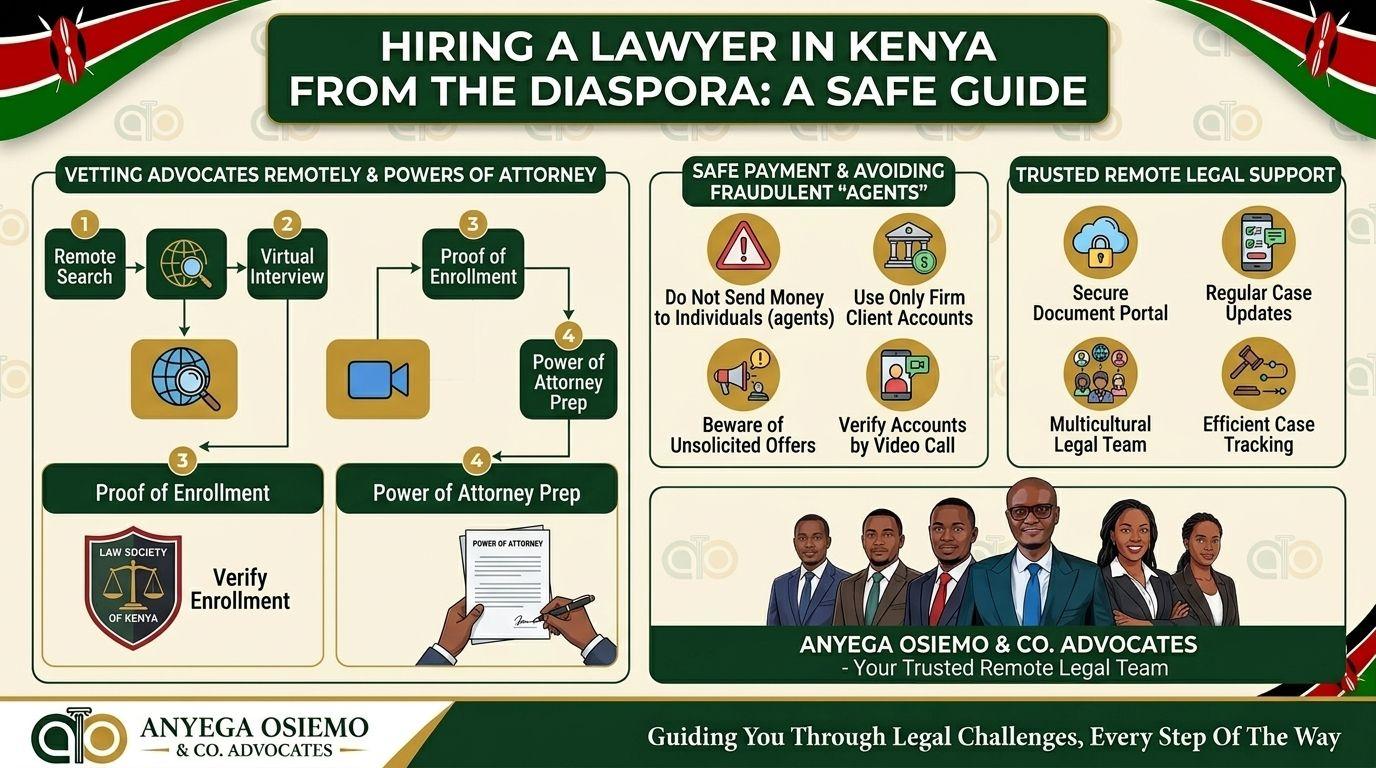
In Kenya, only advocates, lawyers admitted to the Roll of Advocates and holding a current practicing certificate from the Law Society of Kenya (LSK) may give legal advice, draft legal documents, and represent you. This matters because the diaspora fraud ecosystem is full of “legal consultants,” “property agents,” and “paralegals” who perform activities that resemble legal work without any of the accountability that comes with it.
Your verification, in order:
- Ask for the advocate’s full name and LSK membership number. A genuine advocate provides this without hesitation; it is printed on their letterhead.
- Verify the name against the LSK’s records (the Society maintains a member register and can confirm whether a named person is an advocate and whether their practicing certificate is current).
- Confirm the firm is real: a verifiable physical address, a landline or official email domain (not just a Gmail and a WhatsApp number), and a traceable registration.
- Check the firm’s digital footprint, website, published articles, and professional profiles. A firm that publishes substantive legal content under its advocates’ names is leaving a public, accountable trail.
Step 2: Assess competence in your specific matter, not law in general
Kenyan law is broad; excellence is narrow. Ask directly: How many matters like mine have you handled in the last year, and what were the outcomes?
- For a land matter: how many conveyancing transactions per month? Will they run the official search themselves, or accept the seller’s documents?
- For a succession matter: how many grants of probate or letters of administration obtained recently, and in which registries?
- For diaspora clients, it is essential to inquire about how the firm manages matters for clients residing abroad. An experienced firm will be able to explain procedures such as the use of registered powers of attorney, remote identity verification, regular, documented reporting, and handling funds through a client account. If the advocate cannot provide a clear response, they likely lack experience with diaspora clients.
Request references where appropriate. Established firms should be able to connect prospective clients with previous diaspora clients, subject to consent. The willingness to provide such references is an indicator of reliability.
Step 3: Agree on scope, fees, and reporting in writing before any payment
Your engagement letter should cover four things, and each matters more at a distance:
- Scope: exactly what the advocate will and will not do. “Handle my land matter” is not in scope; “conduct due diligence, draft the sale agreement, complete transfer and registration, and report at each stage” is in scope.
- Fees: written, itemized, separating professional fees from disbursements (search fees, stamp duty, registry fees). Agree on the basis: fixed fee, percentage, or staged, and when each payment falls due. See our guide to lawyer fees in Kenya for the regulatory floor and realistic market ranges.
- Reporting cadence: in writing, at every material step, with copies of documents filed or received. WhatsApp is fine for quick questions; anything material should also arrive by email, creating a permanent record you can review from abroad.
- Termination: how either side ends the engagement and what happens to your file and documents if it does. Your documents belong to you.
Step 4: Set up the power of attorney correctly if you need one
For most remote matters, especially property transactions, your advocate (or another trusted person in Kenya) acts under a power of attorney. The POA is where diaspora clients most often get hurt, so treat it with real care:
- Limited scope: the POA should authorize exactly the acts needed (e.g., “complete the purchase of LR No. X from Y for Z shillings”), not a general power over everything you own. General POAs are how people lose property to the very agents they trusted.
- Expiry: include a fixed expiry date tied to the transaction.
- Registration: for land matters, the POA must be registered at the Lands Registry to be effective against third parties.
- Safeguards: reporting obligations, the requirement that funds move only through the advocate’s client acco• Do not sign a power of attorney that has not been reviewed by a qualified advocate, including those drafted by the intended agent or a relative. The power of attorney is a critical legal instrument conferring authority over your property. Paperwork: it is the key to your property.
Step 5: Handle money safely
- Pay professional fees to the firm’s bank account, never to a personal M-Pesa number or personal account. Ask for the firm’s bank details on letterhead and verify them by a second channel.
- For transaction funds (purchase money, estate proceeds), insist on the advocate’s client account: funds held on your behalf, released only against registered documents or court process. This is the single most important structural protection in any remote transaction.
- Get a receipt for every payment, referencing your matter number every time, no exceptions.
- Exercise caution with requests for full upfront payment. It is standard practice to structure fees in stages aligned to specific milestones, which provides protection for the client.
The red flags: when to walk away immediately
- The “lawyer” contacts you first, via social media DMs, about an opportunity, an unclaimed inheritance, or an urgent property deal
- No LSK number, or a number that does not verify
- Fees dramatically below market, or full payment demanded in cash or to a personal account
- Pressure to sign a POA quickly, “before the deal goes”
- Guaranteed outcomes: “I will win,” “I can get the grant in a month”; no honest advocate guarantees results
- No verifiable office address; meetings only in hotels, cafés, or “the car park at Sheria Hou If you have instructed an advocate and encounter issues such as lack of reporting, missing documents, or unaccounted funds, you are not without recourse. The engagement may be terminated at any time. Your files and documents remain your property, and the Law Society of Kenya provides disciplinary mechanisms to address professional misconduct. Prompt action increases the likelihood of a satisfactory resolution. A new advocate can review the file, determine the status of the matter, and assume conduct of the case. It is not uncommon for reputable firms to take over and resolve stalled matters. In summary, hiring a lawyer in Kenya from abroad is a manageable process when proper safeguards are observed. Verification of the advocate’s license, assessment of diaspora experience, clear written agreements on scope and reporting, registration of a secure power of attorney, and ensuring all funds are routed through the client account are essential. With these measures, distance ceases to be a vulnerability. Client account. Distance stops being a vulnerability the moment your process no longer depends on trust alone.
At Anyega Osiemo & Co. Advocates, diaspora clients are a core part of our practice, with documented reporting at every stage, written quotations before any payment, and matters handled fully remotely under registered powers of attorney. [WhatsApp us — whatever your time zone, we respond fast.]
FAQs (FAQ Page schema):
Q1. Can a lawyer in Kenya act on my behalf without me ever traveling home?
A. Yes, in most civil matters. A registered power of attorney, combined with remote identity verification, allows your advocate to handle the matter end-to-end, including property, succession, contracts, and most disputes, with documented reporting at every stage.
Q2. How do I pay a Kenyan lawyer from abroad?
A. International bank transfer to the firm’s account is standard, and receipts should reference your matter number. Many diaspora clients also use regulated remittance channels. Never pay into a personal account.
Q3. What if I lose trust in my lawyer midway through a matter?
A. You may terminate at any time. Your file and documents belong to you; a new advocate can take over, and serious professional misconduct can be reported to the Law Society of Kenya.
Q4. How do I know if a title or document my relative sent me is genuine?
A. Have it independently verified: an official search at the Land Registry for titles and verification with the issuing authority for other documents. Never rely solely on documents provided by the counterparty or their agents.
Disclaimer: This article is general legal information, not legal advice. For guidance on your specific situation, book a consultation with our advocates.