The Tob Cohen case is notable for the legal issues surrounding it: a Dutch businessman, a Kenyan spouse, a contested estate valued at several hundred million shillings, two conflicting wills, and, seven years after his death, an unresolved estate dispute before the Kenyan courts.
For expatriates married to Kenyans, or foreigners with assets in Kenya, this case shows the risks of poor or unclear estate planning. This article reviews only public information, including court rulings and mainstream reporting, and identifies the main planning lessons. It does not address the criminal allegations, which remain before the court and are denied by the accused.
The Case in Brief: What Is on the Public Record
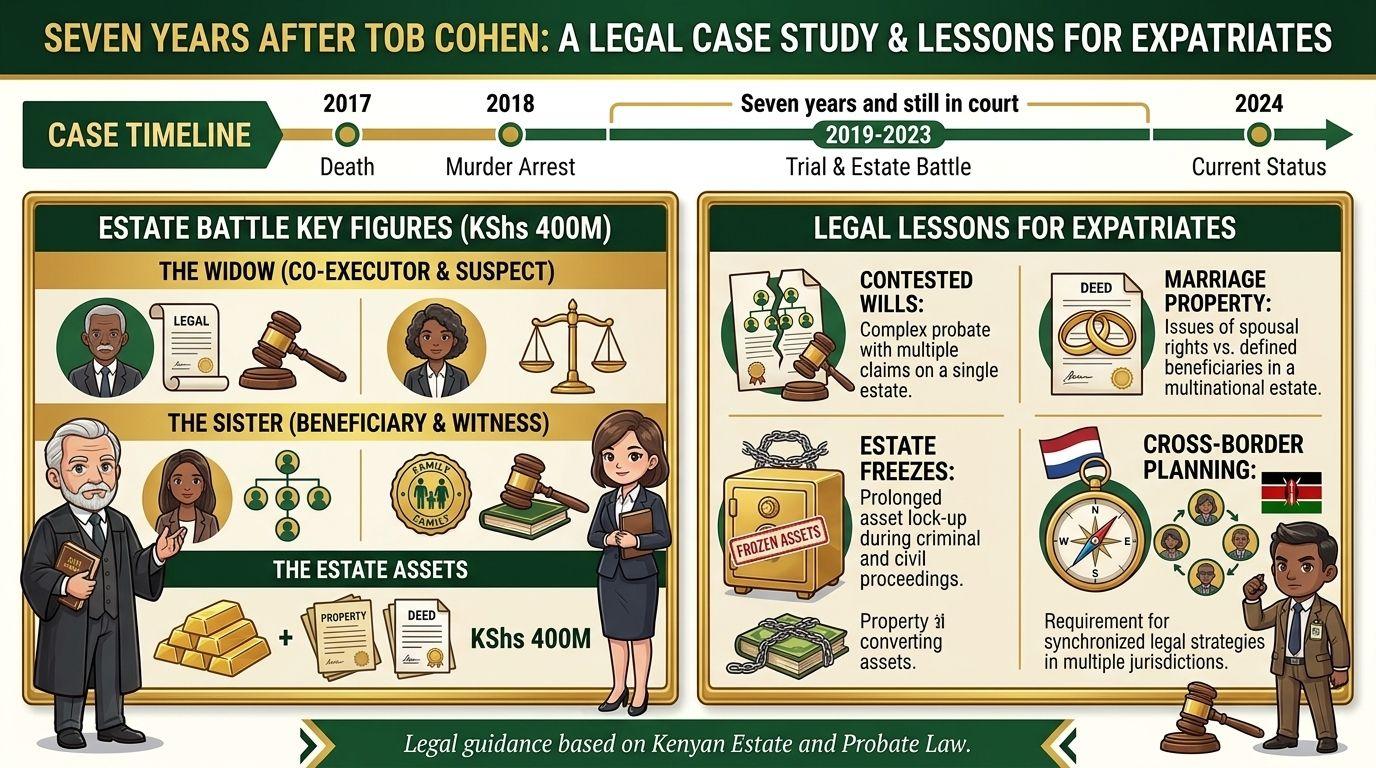
Tob Cohen, a Dutch national and Nairobi-based businessman, was reported missing in July 2019. On 13 September 2019, investigators found his body inside a sealed underground water tank at the couple's Kitisuru home. His wife, Sarah Wairimu Cohen, was arrested and charged with his murder. The case has moved through several stages in court, including changes to the charges, bail decisions, and an ongoing trial before the High Court at Kibera. The accused denies the allegations and remains presumed innocent.
In addition to the criminal proceedings, a separate dispute over Cohen's estate, estimated at KShs 400 million in media reports, has continued for seven years.
The Estate Battle Running in Parallel
The succession aspect of this case, as reflected in court records and mainstream reporting, highlights issues that succession law is meant to address and prevent:
- A will that excluded the widow. Shortly after the discovery of Cohen's body, his siblings were reportedly presented with a will that appeared to leave nothing to his wife. This document was immediately contested.
- Two competing wills. By 2022, the High Court was considering two contested wills and ordered that the estate be preserved until the wills’ validity was determined.
- A suspended administration grant. In late 2021, the High Court suspended an estate administration grant issued to Cohen's brother-in-law, leaving the estate without a lawful administrator.
- Property is at the center of a marital dispute. As of September 2026, court proceedings continued to address property matters and disputes arising from the marriage. Questions about succession and matrimonial property remained unresolved and intertwined.
- Seven years of paralysis. While the estate remains in dispute, property cannot be sold, accounts cannot be closed, and beneficiaries cannot receive distributions. The legal costs, loss of asset use, and family conflict have far exceeded the cost of proper estate planning.
The criminal proceedings will conclude according to the court's timetable. The succession law lessons, however, are already clear.
Lesson 1: The Will You Don't Write or Write Badly Writes Your Estate for You
Cohen reportedly left a will. But Cohen reportedly left a will. But its timing and content created confusion, because it appeared at a difficult moment and excluded the individual Kenyan law treats as a protected beneficiary. The core lesson is clear: if a will surprises the spouse, it is more likely to trigger litigation than to deliver orderly estate planning. re One System; Plan Them Together
The Cohen estate dispute is closely linked to the state of the marriage. Public reports and court evidence reference assault complaints, pending divorce proceedings, and property disputes during the final months of the marriage. The lesson is that property and marriage planning must be treated together. Under the Matrimonial Property Act, 2013, property acquired during marriage is divided based on each party's contribution, including domestic contributions, and there is a statutory presumption of equal shares in the matrimonial home. A will that treats property as solely belonging to one spouse may be inconsistent with the court's findings in divorce or succession proceedings. It is important to note that foreign spouses may assume their home country's law governs their marriage, while Kenyan law applies to property located in Kenya. Both assumptions are only partially correct, and failure to address the interaction between the two legal systems can result in estate disputes.
Lesson 3: Two Wills Mean No Will, for Years
The presence of two competing wills did not provide additional options; instead, it froze the estate. The lesson is that one valid will is better than two disputed ones. Kenyan courts resolve will disputes by examining execution formalities, testamentary capacity, knowledge and approval, and the circumstances of each will's creation. If a later will is valid, it revokes the earlier one; if its validity is in question, the estate remains in limbo. Each month of delay increases legal costs and family conflict. The solution is to have a single, professionally drafted will that is reviewed regularly, with previous versions collected and destroyed, and to ensure the executor and family are informed of its contents.
The suspension of the administration grant in the Cohen estate demonstrates that grants are conditional and that administrators act as fiduciaries under court supervision. The lesson is that an estate without lawful administration cannot move forward. Intermeddling, contested appointments, and disputed documents can leave an estate without lawful administration, preventing the sale, transfer, or distribution of assets until the court appoints a new administrator. Selecting an appropriate executor in the correct jurisdiction and communicating clearly with the family are essential to ensure timely estate administration.
With a Dutch national, a Kenyan spouse, property in Nairobi, and family in Europe, the Cohen estate required administration across two legal systems. The lesson is that cross-border estates need two-country architecture. Cross-border estates require legal instruments that are effective in each relevant jurisdiction, clarity regarding which assets are governed by which law, and a plan for transferring grants between countries through resealing or parallel proceedings. Families who establish this structure during the testator's lifetime can complete administration in months, while those who do not may face years of litigation over jurisdiction.
- One current will, professionally drafted under Kenyan law for your Kenyan assets, executed with proper formalities and reviewed on every material change: marriage, separation, children, acquisitions.
- Collect and destroy any previous wills. The lesson is that having more than one will on file creates the risk of future disputes. Understand what your spouse is entitled to under Kenyan law. If you intend a different arrangement, be aware that Kenyan courts may still protect dependent spouses. Unexpected provisions often result in litigation.
- Separate matrimonial-property questions from testamentary ones. The lesson is to resolve the question of "what is mine, what is ours" during the marriage. Select administrators carefully and inform them in advance. Ensure that family members are aware of the estate planning documents. An estate plan that is transparent to all parties is less likely to be contested.
A Note on the Ongoing Proceedings
The criminal trial arising from Tob Cohen's death remains before the Kenyan courts, and the accused is presumed innocent until proven otherwise. This article draws exclusively on matters of public record, court rulings, and mainstream reporting and addresses the civil and succession dimensions of a public case. It is written to inform, not to influence any proceeding.
Ten Lessons from the Cohen Case
- A will that excludes a spouse is likely to result in court intervention. Estate planning should comply with the law.
- The existence of two wills can prevent the administration of an estate. A single, regularly reviewed will allows the estate to be administered efficiently.
- Matrimonial property rights are considered part of the estate administration process.
- Administrators are fiduciaries; contested appointments paralyze estates.
- Cross-border estates require legal documents that are effective in both relevant jurisdictions.
- Disclose plans before divorce. Divorce proceedings and estate planning are interconnected and should be updated concurrently; the plans interact and are updated together.
- Prolonged estate disputes are significantly more costly than proper estate planning.
The presumption of innocence governs the criminal case; the documents do not. The most cost-effective estate planning occurs when it is completed during the testator's lifetime and before disputes arise. Complete it while the testator is alive and calm.
Frequently Asked Questions
Q1. What is the current status of the Tob Cohen murder case?
A. As of late 2026, the trial is ongoing before the High Court at Kibera, and the accused remains in custody following the Court of Appeal's refusal of bail in August 2026. She denies the allegations.
Q2. What happened to Tob Cohen's estate?
A. The estate, estimated at around KShs 400 million, has been in dispute since 2019: two contested wills, a suspended administration grant, and court orders preserving the estate pending resolution remain in the public record.
Q3. Can a will in Kenya leave nothing to a spouse?
A. A will can attempt to do so, but Kenyan courts may order reasonable provision for a dependent spouse who is not adequately provided for. Attempting to disinherit a spouse typically results in litigation rather than the intended outcome.
Q4. What happens when two wills are found in Kenya?
A. The court examines the validity of each will's execution formalities, capacity, knowledge, and approval. Until validity is resolved, the estate is effectively frozen.
Q5. Can an estate administration grant be canceled?
A. Yes, grants can be revoked or suspended where obtained improperly or where disputes require it, leaving the estate without lawful administration until the disputes are resolved.
Q6. Does my foreign will cover my Kenyan property?
A. Not reliably. Kenyan law best covers Kenyan assets or a foreign grant resealed in Kenya, and the two should be coordinated rather than contradictory.
Q7. What does divorce have to do with estate planning?
A. Everything. Matrimonial property is divisible under the Matrimonial Property Act, and a will that ignores a spouse's property claims invites the court to overlay a matrimonial-property analysis onto succession.
Q8. How long can an estate dispute take in Kenya?
A. Uncontested estates close in months; contested wills and grants run in years. Public cases like Cohen's illustrate the outer reaches, which is precisely why prevention is so cheap by comparison.
Q9. What should a mixed-nationality couple in Kenya do differently?
A. Plan across both legal systems: wills effective in each jurisdiction, clarity on which assets pass under which law, and professional advice in both countries before signing documents.
Q10. Is it too late to plan if my marriage is already in difficulty?
A. No, but the planning must be honest about the matrimonial-property overlay and done with advice, since documents executed on the eve of disputes receive particular judicial scrutiny.
How We Can Help
At Anyega Osiemo & Company Advocates, we draft wills and estate plans that prevent Cohen-style disputes: Kenyan-law wills for foreign residents and investors; cross-border estate architecture; matrimonial property and succession advice for mixed-nationality couples; and, where prevention has failed, representation in contested will and administration proceedings. We would rather write your will than have your will disputed.
Disclaimer: This article is general legal information, not legal advice. For guidance on your specific situation, book a consultation with our advocates.