The passing of a family member initiates not only a period of mourning but also the formal process of administering the deceased's estate. In the Kenyan context, this process is structured around the requirement to obtain a Grant of Probate. This legal instrument provides the executor with the authority to manage and distribute the estate in accordance with the will. Access to assets such as bank accounts, property transfers, and debt settlement is contingent upon the issuance of this grant. However, the probate process in Kenya remains insufficiently understood and is often not comprehensively documented.
This guide is intended to provide executors, administrators, and beneficiaries with a clear and detailed overview of the probate process in Kenya as at 2026. It addresses the procedural steps required from the time of death to the final distribution of the estate, including applicable timelines, costs, common errors, and the circumstances under which legal representation is advisable. Whether you are named as an executor, a beneficiary seeking to understand your rights, or a family member managing an estate without clear instructions, this guide sets out the essential information required to navigate the process.
1. What Is a Grant of Probate and Why Do You Need It?
1.1 Definition and Legal Basis
A Grant of Probate is a legal document issued by the High Court of Kenya (or a Magistrate's Court for estates below KES 20 million) that confirms the validity of a will and authorizes the named executor to administer the deceased's estate. The legal basis is the Law of Succession Act, Cap 160, which governs all succession matters in Kenya. Section 51 of the Act provides that a grant of probate shall be made to the executor named in the will.
In the absence of a Grant of Probate, the executor lacks legal authority to administer the estate's assets. Financial institutions will not release funds, the Land Registry will not process property transfers, and the Kenya Revenue Authority will not issue tax clearances. Prospective purchasers will also be unable to acquire property from the estate. The Grant of Probate is therefore essential for the administration of the estate.
1.2 Who Can Apply for a Grant of Probate?
Only the executor named in the will can apply for a Grant of Probate. If the named executor is deceased, unwilling, or unable to act, the court may grant administration with the will annexed to a substitute administrator, typically a beneficiary or a person with a legitimate interest in the estate. If there is no will, the process is different: the applicant must seek Letters of Administration rather than a Grant of Probate. See our companion guide on Letters of Administration for details.
1.3 The Difference Between Probate and Letters of Administration
This distinction is critical. A Grant of Probate is issued where the deceased left a valid will. Letters of Administration are issued where the deceased died intestate (without a will). The procedures, requirements, and timelines differ significantly. This guide focuses exclusively on a Grant of Probate. If your loved one died without a will, refer to our guide on Letters of Administration in Kenya.
2. Step-by-Step Process for Obtaining a Grant of Probate in Kenya
The probate process in Kenya is organised into a series of procedural steps that remain consistent across jurisdictions. Although the duration of each stage may differ depending on the complexity of the estate and the workload of the court, the overall structure is uniform.
Step 1: Locate and Verify the Will (Days 1–7)
The first step is to locate the deceased's will. This may be in a safe deposit box, with a lawyer, in a home safe, or lodged with a trusted family member. Once located, verify that it is the last will; check for dates, codicils (amendments), and any indication that a later will exists. If multiple wills are found, the most recent one that meets the formal requirements of the Law of Succession Act prevails.
Under Section 5 of the Law of Succession Act, a valid will must be: in writing; signed by the testator or by someone else in the testator's presence and by their direction; and attested by two or more competent witnesses who sign in the presence of the testator. If the will does not meet these requirements, it may be invalid, and the estate may need to be administered as intestate.
Step 2: Engage a Succession Lawyer (Days 3–14)
Although an applicant may seek probate without legal representation, the process is complex and requires strict compliance with procedural and documentary requirements. Errors such as omitting an affidavit, submitting an inaccurate inventory, or failing to notify beneficiaries can result in significant delays. For estates involving property, business interests, or disputes among beneficiaries, it is advisable to engage a lawyer.
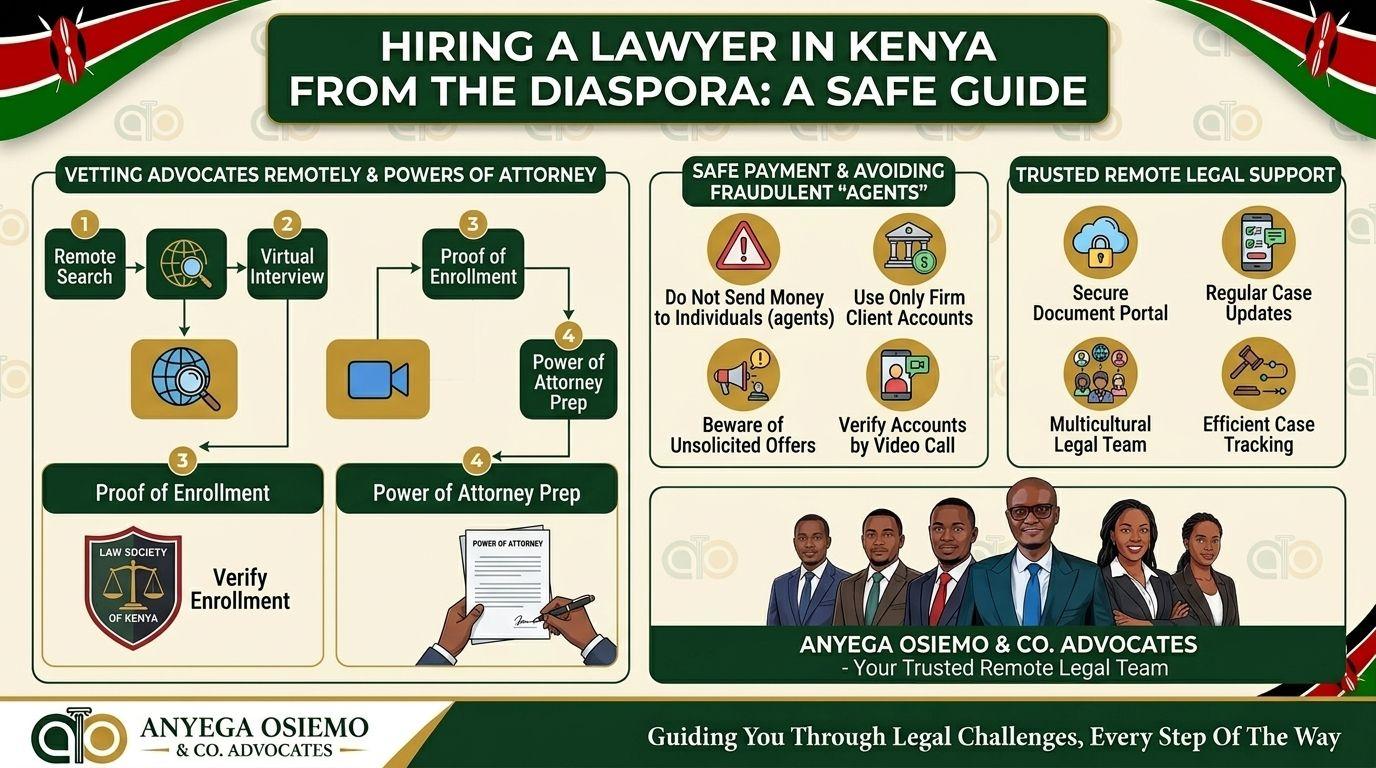
At Anyega Osiemo & Co. Advocates, we provide end-to-end probate services: will verification, application preparation, court filing, representation at hearings, and estate administration. For diaspora executors, we offer remote services including power of attorney arrangements, embassy-authenticated documentation, and virtual consultations.
Step 3: Prepare the Probate Application (Days 7–21)
The probate application consists of several mandatory documents:
(a) Petition for Grant of Probate: The formal application to the court, setting out the deceased's details, the will's details, the executor's details, and the estimated value of the estate.
(b) Death Certificate: The official death certificate issued by the Registrar of Births and Deaths.
(c) The Original Will: The original will must be filed with the court. A copy is not sufficient.
(d) Affidavit of Executor: A sworn statement by the executor confirming their identity, their relationship to the deceased, and their willingness to act.
(e) Inventory of Estate: A detailed list of all assets (property, bank accounts, investments, vehicles, personal effects) and liabilities (debts, mortgages, loans).
(f) Affidavit of Witnesses: If the will's witnesses are available, they may be required to swear affidavits confirming the circumstances of execution.
(g) Bank Certificate: A certificate from the deceased's bank confirming the account balances.
(h) Land Search: A search of the Land Registry confirming ownership of any property.
Step 4: File the Application at Court (Days 14–21)
The probate application must be filed at the appropriate court, determined by the value of the estate: the High Court for estates exceeding KES 20 million, and the Magistrate's Court for those below this threshold. Jurisdiction is typically based on the deceased's residence or the location of the property.
Step 5: Publication of Notice (Days 21–35)
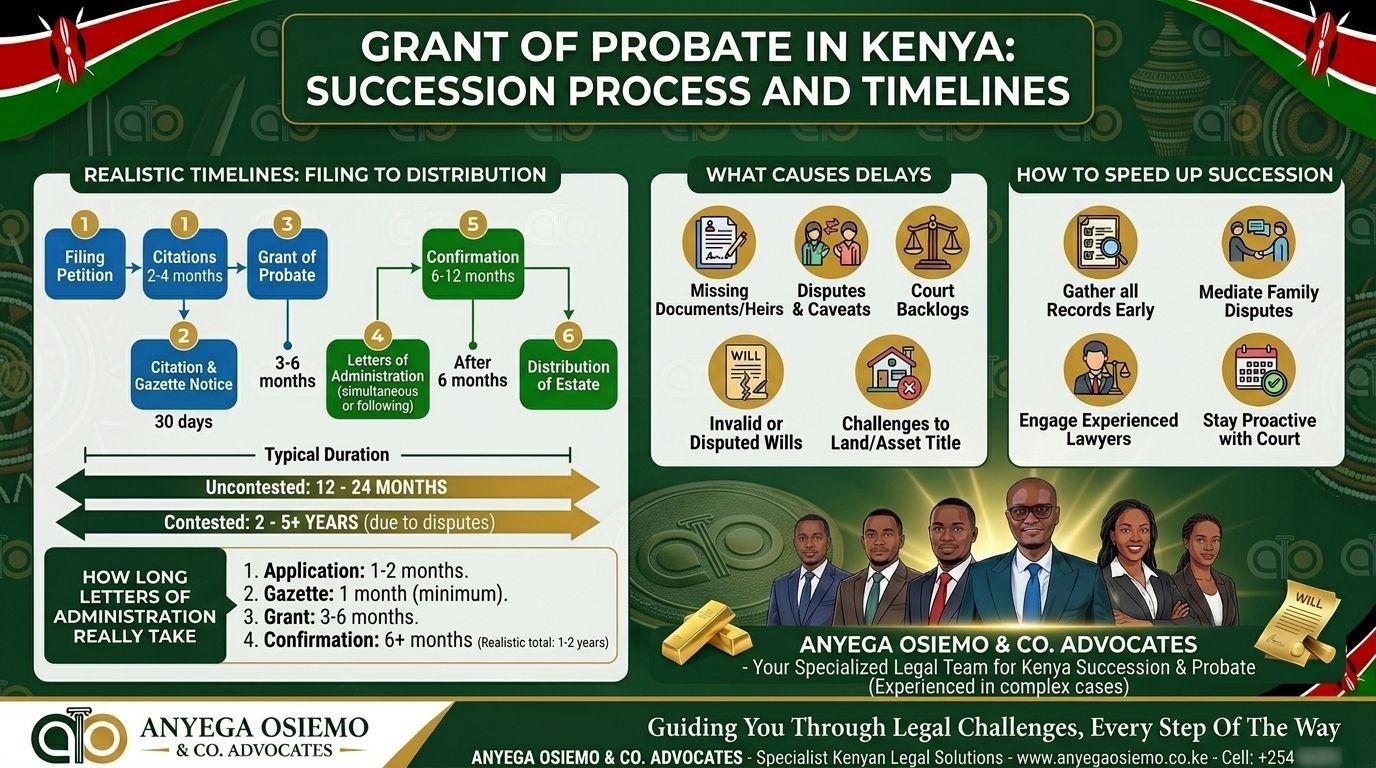
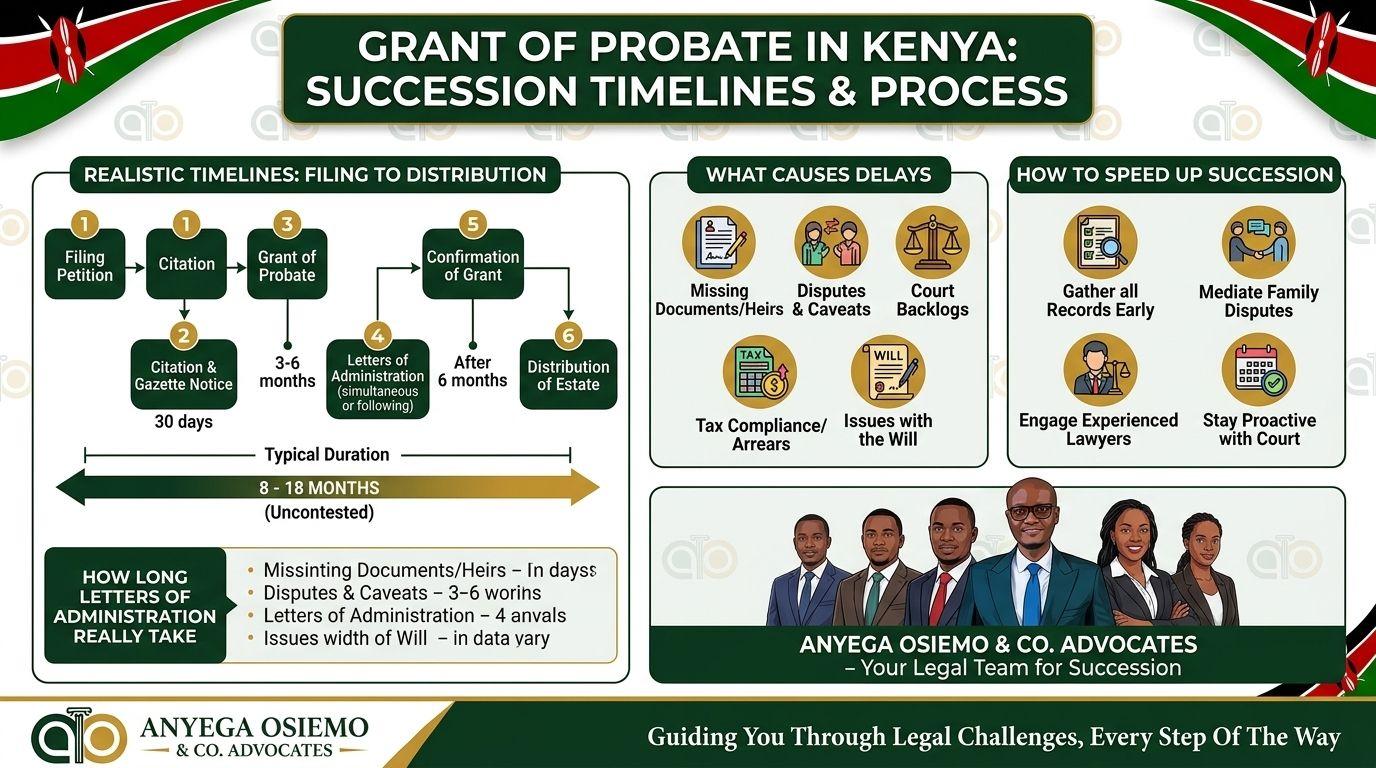
Following the filing of the application, the court issues a notice for publication in the Kenya Gazette and a local newspaper. This notice provides an opportunity for any interested party to file objections within a 30-day period. If an objection is raised by a beneficiary, creditor, or other party, the probate process is suspended until the matter is resolved. Common grounds for objection include concerns regarding the authenticity of the will, the capacity of the testator, the suitability of the executor, or the existence of a more recent will.
Step 6: Hearing and Grant (Days 35–90)
If no objections are submitted, the court proceeds to schedule a hearing. During this hearing, the executor or their legal representative presents the application, verifies the validity of the will, and responds to any queries from the judge. Upon satisfaction with the application, the court issues the Grant of Probate. For straightforward cases, the grant is typically issued within 30 to 60 days of filing, while more complex cases or those involving objections may require 6 to 12 months or longer.
Step 7: Confirmation of Grant (6 Months)
While the Grant of Probate permits the executor to manage the estate, it does not confer authority to distribute assets. Prior to distribution, the executor is required to apply for Confirmation of Grant. This stage involves submitting an updated inventory, settling outstanding debts and taxes, obtaining tax clearance from the Kenya Revenue Authority, and providing a proposed distribution plan for the estate. The court reviews these submissions and, if satisfied, issues a Confirmation Order. Only after this order is granted can the executor proceed with asset transfer, fund distribution, and closure of the estate.
3. Timeline: How Long Does Probate Take in Kenya?
The duration required to obtain a Grant of Probate in Kenya is influenced by several factors, including the complexity of the estate, the volume of cases before the court, and the presence or absence of objections. The following provides an indicative breakdown:
- Simple estate, no objections: 6 months from filing to Confirmation.
- Moderate complexity, some objections: 6–12 months.
- Complex estate, multiple properties, disputes: 1–3 years.
- Highly contested estate, litigation: 3–10 years or more.
Delays in the probate process commonly arise from incomplete or inaccurate documentation, failure to identify all assets, disputes among beneficiaries, unresolved debts or tax liabilities, and court backlog. Engaging a qualified succession lawyer at the outset is the most effective means of minimizing such delays.
4. Costs: What Does Probate Cost in Kenya?
The costs of probate include:
• Court filing fees
• Gazette and newspaper publication
• Lawyer's fees
• Valuation fees: If property valuation is required
• Miscellaneous: Bank charges, land search fees, travel, and disbursements.
5. Common Mistakes and How to Avoid Them
Mistake 1: Failing to locate the original will. The court does not accept copies. Always store the original will in a secure, known location and inform the executor of its whereabouts.
Mistake 2: Delaying the application. The sooner the application is filed, the sooner the estate can be administered. Delay increases the risk of asset dissipation, tax penalties, and family disputes.
Mistake 3: Undervaluing the estate. The inventory must be accurate. Beneficiaries or creditors may challenge undervaluation, which can result in tax reassessment.
Mistake 4: Ignoring debts. The executor is personally liable if they distribute assets before settling all debts. Always obtain a clearance certificate from KRA and confirm that all creditors have been paid.
Mistake 5: Distributing before Confirmation. The Grant of Probate does not authorize distribution. Wait for the Confirmation Order to avoid personal liability and beneficiary disputes.
6. Frequently Asked Questions (FAQ)
Q1: What is a Grant of Probate?
A: A Grant of Probate is a court order that confirms the validity of a will and authorizes the named executor to administer the deceased's estate. It is issued by the High Court or Magistrate's Court under the Law of Succession Act.
Q2: How long does it take to get a Grant of Probate in Kenya?
A: For straightforward cases with no objections, 3–6 months. For complex or contested cases, 1–3 years or longer. The timeline depends on the court's workload, the completeness of the documentation, and whether objections are filed.
Q3: Can I apply for probate without a lawyer?
A: Yes, but it is not recommended. The process is document-heavy and procedurally complex. A single error can delay the grant by months. For estates with property, businesses, or disputes, legal representation is essential.
Q4: What documents do I need for a probate application?
A: The original will, death certificate, petition for grant of probate, affidavit of executor, inventory of estate, bank certificate, land search, and witness affidavits (if required). Your lawyer will guide you on the specific requirements for your case.
Q5: What happens if someone objects to the probate application?
A: The court pauses the probate process and schedules a hearing to resolve the objection. Common grounds for objection include allegations of forgery, lack of testamentary capacity, undue influence, or the existence of a later will. The objector must file a formal objection with supporting evidence.
Q6: What is the difference between Grant of Probate and Confirmation of Grant?
A: The Grant of Probate authorizes the executor to administer the estate (collect assets, pay debts, manage property). The Confirmation of Grant authorizes the executor to distribute the remaining assets to beneficiaries. You cannot distribute without Confirmation.
Q7: Can a beneficiary challenge the executor?
A: Yes. Beneficiaries can apply to the court to remove an executor who is unfit, negligent, or fraudulent. Grounds include failure to administer the estate, misappropriation of assets, conflict of interest, or prolonged delay.
Q8: What if the deceased had property in multiple counties?
A: The probate application should be filed in the court with jurisdiction over the deceased's principal residence or the location of the majority of the estate's value. Once the Grant of Probate is issued, it is valid nationwide. However, property transfers must be registered in each county's Land Registry.
Q9: How can Anyega Osiemo & Co. Advocates help with probate?
A: We provide comprehensive probate and estate administration services: will verification and validation; probate application preparation and filing; representation at probate hearings; Confirmation of Grant applications; estate tax compliance and KRA clearance; property transfer and registration; debt settlement and creditor negotiation; beneficiary dispute resolution; and diaspora executor services including remote representation and power of attorney. Contact us for a confidential consultation.
Conclusion
The Grant of Probate is the legal foundation for estate administration in Kenya. In its absence, the assets of the deceased cannot be accessed, debts remain outstanding, and beneficiaries are unable to receive their entitlements. Although the process is complex, it can be managed effectively with appropriate legal guidance, accurate documentation, and prompt action.
At Anyega Osiemo & Co. Advocates, we recognize that probate is both a legal and personal process for families managing the estate of a deceased relative. Our firm is committed to providing professional, efficient, and transparent legal services to ensure that the estate is administered in accordance with the law and the wishes of the deceased. Executors, beneficiaries, and family members residing abroad are invited to contact us for assistance and guidance.
Disclaimer: This article is general legal information, not legal advice. For guidance on your specific situation, book a consultation with our advocates.