In Kenya, the death of a person without a valid will does not result in their property automatically passing to the nearest relative. The Law of Succession Act, Cap 160, establishes a detailed statutory framework that governs who may apply to administer the estate, who is entitled to inherit, and the proportions in which inheritance is distributed. This process is referred to as intestate succession and is the predominant method of estate administration in Kenya. It is estimated that more than 70% of Kenyans die intestate, which means that applications for Letters of Administration being the court order authorizing the management of an intestate estate—are significantly more common than applications for Grants of Probate.
Despite its frequency, intestate succession is frequently misunderstood. Many family members mistakenly believe that the eldest son, the surviving spouse, or the closest relative is automatically entitled to inherit the entire estate. However, the Law of Succession Act sets out a clear hierarchy of beneficiaries and requires a formal court process. Distributing assets without first obtaining Letters of Administration, omitting beneficiaries, or disregarding the rights of a surviving spouse can expose individuals to personal liability, protracted family disputes, and extended litigation.
This article sets out a comprehensive guide to Letters of Administration in Kenya. It addresses who is eligible to apply, the statutory rules governing inheritance in cases of intestacy, the procedural steps required by the court, common areas of dispute, and measures to safeguard the rights of beneficiaries. Whether you are recently bereaved, considering applying as an administrator, or seeking to clarify your entitlements as a beneficiary, this guide is intended to provide authoritative legal guidance.
1. What Are Letters of Administration?
1.1 Definition and Purpose
Letters of Administration are a court order issued by the High Court or Magistrate's Court that appoints a person called an administrator to manage and distribute the estate of a person who died without a valid will. The legal basis is Section 55 of the Law of Succession Act, which provides that where a person dies intestate, the court shall issue Letters of Administration to the person or persons best entitled to represent the estate.
The function of Letters of Administration is to ensure that the estate of the deceased is managed by a person who has been legally authorized and is accountable both to the court and to the beneficiaries. In the absence of Letters of Administration, no individual has the legal capacity to access the deceased's bank accounts, transfer property, settle debts, or distribute assets. Any person who purports to deal with the estate without such authority risks incurring personal liability for any resulting losses.
1.2 Who Can Apply for Letters of Administration?
Section 56 of the Law of Succession Act sets out the priority order for applicants:
(a) Surviving spouse: The husband or wife of the deceased has the priority.
(b) Children: If there is no surviving spouse, or if the spouse is unwilling or unable to act, the children (or one of them) may apply.
(c) Parents: If there is no spouse or children, the parents of the deceased may apply.
(d) Siblings: If there is no spouse, children, or parents, the siblings may apply.
(e) Other relatives: More distant relatives may apply if no one in the above categories is available.
(f) Creditors: If no relatives are available, a creditor of the deceased may apply.
The court has discretion to appoint any suitable person, even if they are not in the priority order, if the person in the priority order is unfit, unwilling, or under a legal disability. The court may also appoint multiple administrators, typically the surviving spouse and one or more children, to ensure balanced representation.
2. Who Inherits Under Intestate Succession in Kenya?
2.1 The Surviving Spouse's Entitlement
Section 29 of the Law of Succession Act provides that the surviving spouse is entitled to: a personal and life interest in the matrimonial home (the house where the couple lived together); all household goods and effects; and a share of the residue of the estate. The exact share depends on whether children survive the deceased. If there are children, the spouse receives a life interest in the matrimonial home and a child's share of the residue. If there are no children, the spouse receives the entire estate.
A 'life interest' in the matrimonial home entitles the surviving spouse to reside in the property for the duration of their life. However, the spouse may not sell or transfer the property without the consent of the other beneficiaries, who are usually the children. Upon the death of the surviving spouse, the property devolves to the children. This statutory provision is intended to protect the surviving spouse from eviction, but it may also give rise to disputes if the spouse seeks to dispose of the property.
2.2 The Children's Entitlement
Under Section 28, the children of the deceased are entitled to equal shares of the residue of the estate after the spouse's entitlements have been satisfied. "Children" includes biological children, adopted children, and children born out of wedlock who have been acknowledged by the deceased or whose paternity has been established. Step-children who have not been adopted are not entitled under the intestacy rules. However, they may have a claim under dependant provisions if they were financially dependent on the deceased.
The requirement of equal division among children applies irrespective of gender, birth order, or the marital status of the parents. Sons and daughters are entitled to equal shares, as are children born within marriage and those born out of wedlock. This aspect of the Law of Succession Act is a significant departure from customary law, which has historically favored male children or those born within marriage.
2.3 Parents and Other Relatives
Where the deceased is not survived by a spouse or children, the estate devolves upon the parents in equal shares. In the absence of parents, the estate passes to the siblings in equal shares. If there are no siblings, succession proceeds to more remote relatives in the following order: grandparents, uncles and aunts, cousins, and ultimately the nearest relative as determined by the rules of consanguinity. If no relatives are ascertainable, the estate reverts to the government as bona vacantia.
2.4 Dependants Who Are Not Beneficiaries
Section 26 of the Law of Succession Act allows certain dependants who are not entitled under the intestacy rules to apply to the court for reasonable provision from the estate. This includes: a spouse who is not entitled because the marriage was not recognized (e.g., a customary marriage not formally registered); a child who is not entitled because they were not acknowledged; a former spouse who was financially dependent on the deceased; and any other person who was wholly or partially dependent on the deceased. The court has wide discretion to award such provision as it considers reasonable, taking into account the size of the estate, the dependant's needs, and the claims of other beneficiaries.
3. Step-by-Step Process for Obtaining Letters of Administration
The process for obtaining Letters of Administration is similar to that for a Grant of Probate, with some key differences. Here is the step-by-step guide:
Step 1: Confirm That There Is No Valid Will (Days 1–14)
Before applying for Letters of Administration, the family must conduct a thorough search for a will. Check the deceased's home, safe deposit boxes, lawyer's office, and any other likely locations. Ask close friends and relatives. Check with the deceased's bank, employer, and insurance companies. If a will is found, the process shifts to probate. If no will is found after a reasonable search, proceed on the assumption of intestacy.
Step 2: Identify the Administrator(s) (Days 7–14)
The family must agree on who will apply as administrator. The surviving spouse has priority, but if the spouse is elderly, unwell, or unfamiliar with legal processes, the children may agree that one of them should apply jointly or solely. If there is disagreement, the court will decide based on the best interests of the estate. It is important to reach consensus early, as disputes at this stage can derail the entire process.
Step 3: Prepare the Application (Days 14–30)
The application for Letters of Administration includes:
(a) Petition for Letters of Administration: The formal application setting out the deceased's details, the applicant's details, and the basis for the application.
(b) Death Certificate: Official death certificate from the Registrar of Births and Deaths.
(c) Affidavit of Administrator: Sworn statement by the applicant confirming their relationship to the deceased, their fitness to act, and their commitment to administer the estate lawfully.
(d) Inventory of Estate: Detailed list of all assets and liabilities.
(e) Consent of Beneficiaries: Written consent from all beneficiaries (or those with priority) confirming their agreement to the applicant's appointment.
(f) Affidavit of Next of Kin: A sworn statement identifying all next of kin and their relationships to the deceased.
(g) Bank Certificate and Land Search: As with probate applications.
Step 4: File and Publish (Days 30–45)
The application is filed with the High Court or the Magistrate's Court. The court issues a notice for publication in the Kenya Gazette and a local newspaper. The notice invites objections within 30 days. Objections are more common in intestate cases than in probate cases, because the absence of a will often triggers disputes among family members about who should inherit what.
Step 5: Hearing and Grant (Days 45–90)
If no objections are filed, the court schedules a hearing. The judge reviews the application, confirms that the applicant is suitable, and issues Letters of Administration. The grant authorizes the administrator to collect assets, pay debts, and manage the estate but not to distribute assets. Distribution requires Confirmation of Grant.
Step 6: Confirmation of Grant (Months 3–12)
The administrator must prepare a distribution proposal showing how the estate will be divided among the beneficiaries in accordance with the Law of Succession Act. The proposal must be agreed upon by all beneficiaries or approved by the court if there is disagreement. Once the court is satisfied, it issues a Confirmation Order, and the administrator can distribute the assets.
4. Common Disputes in Intestate Succession
Intestate estates are disproportionately prone to disputes. The most common include:
• Disputes over the matrimonial home: The surviving spouse's life interest can conflict with the children's desire to sell the property and divide the proceeds.
• Disputes over the identity of children: Children born out of wedlock may be excluded by relatives who dispute paternity or acknowledgment.
• Disputes between spouses and in-laws: The deceased's parents or siblings may claim that the surviving spouse is not entitled to the matrimonial home or that customary law (which may favor male relatives) should apply.
• Disputes over the administrator's appointment: Multiple family members may claim the right to be administrator, leading to contested hearings.
• Disputes over hidden assets: Relatives may allege that the deceased had property or accounts that the administrator is concealing.
Such disputes are often both emotionally and financially burdensome. Engaging a succession lawyer at an early stage to facilitate family discussions and guide the court process is the most effective means of minimizing conflict.
5. Frequently Asked Questions (FAQ)
Q1: What happens if someone dies without a will in Kenya?
A: The estate is administered under the intestacy rules in the Law of Succession Act. The court appoints an administrator, and the estate is distributed to the surviving spouse, children, parents, siblings, or other relatives in the statutory order of priority.
Q2: Who has the right to apply for Letters of Administration?
A: The priority order is: surviving spouse; children; parents; siblings; other relatives; and creditors. The court has discretion to appoint any suitable person if those with priority are unfit or unwilling.
Q3: Does the surviving spouse automatically inherit everything?
A: No. The surviving spouse is entitled to a life interest in the matrimonial home, household goods, and a share of the residue. If there are children, the spouse shares the residue with them. Only if there are no children does the spouse inherit the entire estate.
Q4: Can children born out of wedlock inherit?
A: Yes. Under the Law of Succession Act, children born out of wedlock are entitled to equal shares if their paternity has been acknowledged or established. The statute overrides customary law practices that exclude such children.
Q5: How long does it take to get Letters of Administration?
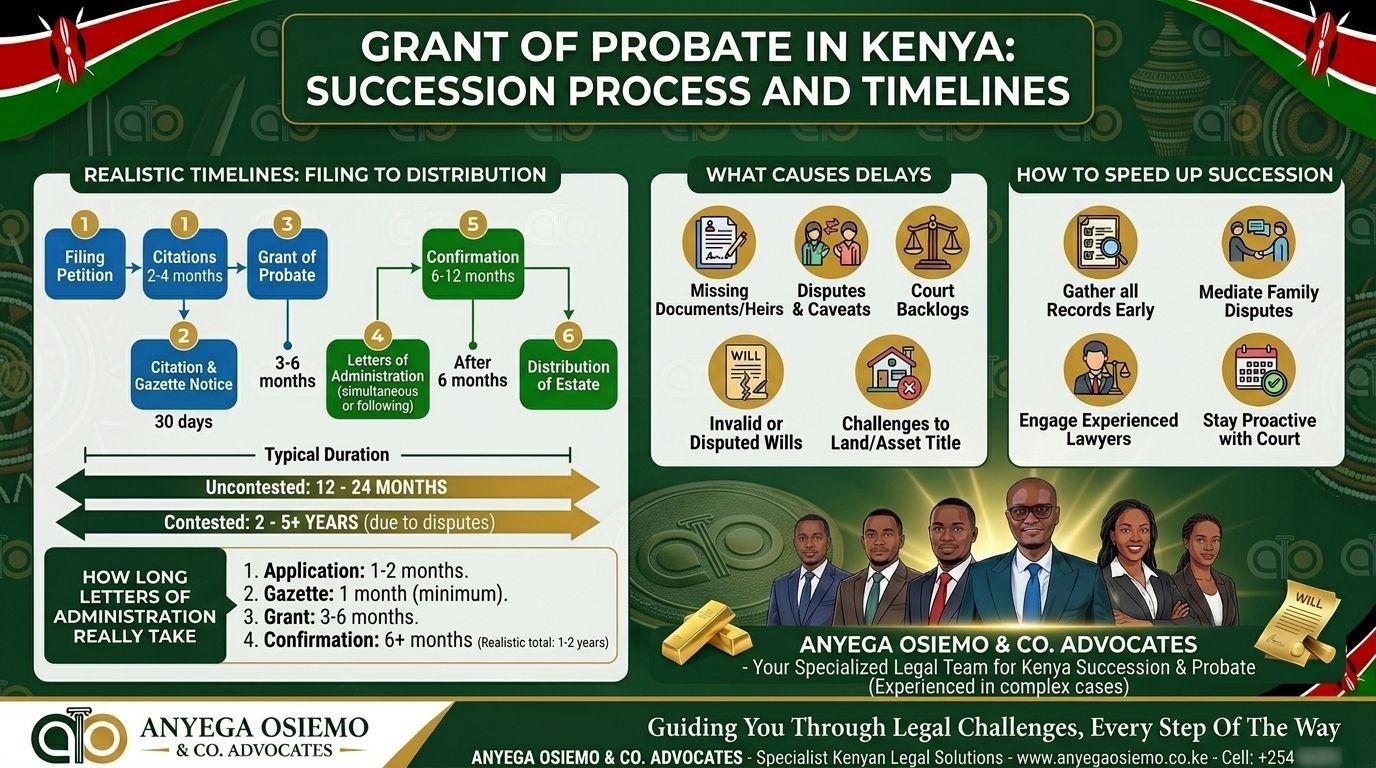
A: For straightforward cases, 3–6 months. For contested cases, 1–3 years or longer. The timeline depends on family consensus, documentation, court workload, and whether objections are filed.
Q6: Can I be removed as administrator?
A: Yes. Beneficiaries can apply to the court to remove an administrator who is unfit, negligent, fraudulent, or in conflict of interest. Grounds include failure to administer the estate, misappropriation of assets, and prolonged delay.
Q7: What if relatives claim customary law should apply?
A: The Law of Succession Act applies to all Kenyans unless the deceased specifically opted out in a valid will. Customary law does not override the statutory intestacy rules. However, customary practices may influence family negotiations and mediation.
Q8: What if the deceased had a spouse and multiple wives?
A: Under the Marriage Act, polygamous marriages are recognized if properly registered. Each surviving wife is entitled to her share of the estate. The distribution becomes complex and often requires court intervention to ensure fairness.
Q9: Can I sell the deceased's property before getting Letters of Administration?
A: No. Selling or transferring property without authority is illegal and exposes you to personal liability. Wait for the Letters of Administration and Confirmation of Grant before dealing with estate assets.
Q10: How can Anyega Osiemo & Co. Advocates help?
A: We provide full-service intestate succession support: family mediation and consensus-building; Letters of Administration application and court representation; beneficiary identification and entitlement advice; distribution proposal drafting and negotiation; Confirmation of Grant applications; property transfer and registration; tax compliance and KRA clearance; and dispute resolution through litigation or mediation. We also specialize in diaspora intestate succession, assisting families abroad to administer Kenyan estates remotely. Contact us for a confidential consultation.
Conclusion
The absence of a will does not extinguish the rights of the deceased's family. The Law of Succession Act establishes a comprehensive, though intricate, framework for intestate succession that safeguards the interests of spouses, children, and other dependants. However, the process demands patience, thorough documentation, and frequently, professional legal assistance to address both family dynamics and procedural requirements.& Co. Advocates, we understand that intestate succession is not just a legal process; it is a family matter. We bring legal expertise, cultural sensitivity, and practical problem-solving to ensure that your loved one's estate is administered fairly, efficiently, and in accordance with the law. Whether you are a surviving spouse, a child, a parent, or a relative seeking clarity on your rights, we are here to help. Contact us today.
Disclaimer: This article is general legal information, not legal advice. For guidance on your specific situation, book a consultation with our advocates.