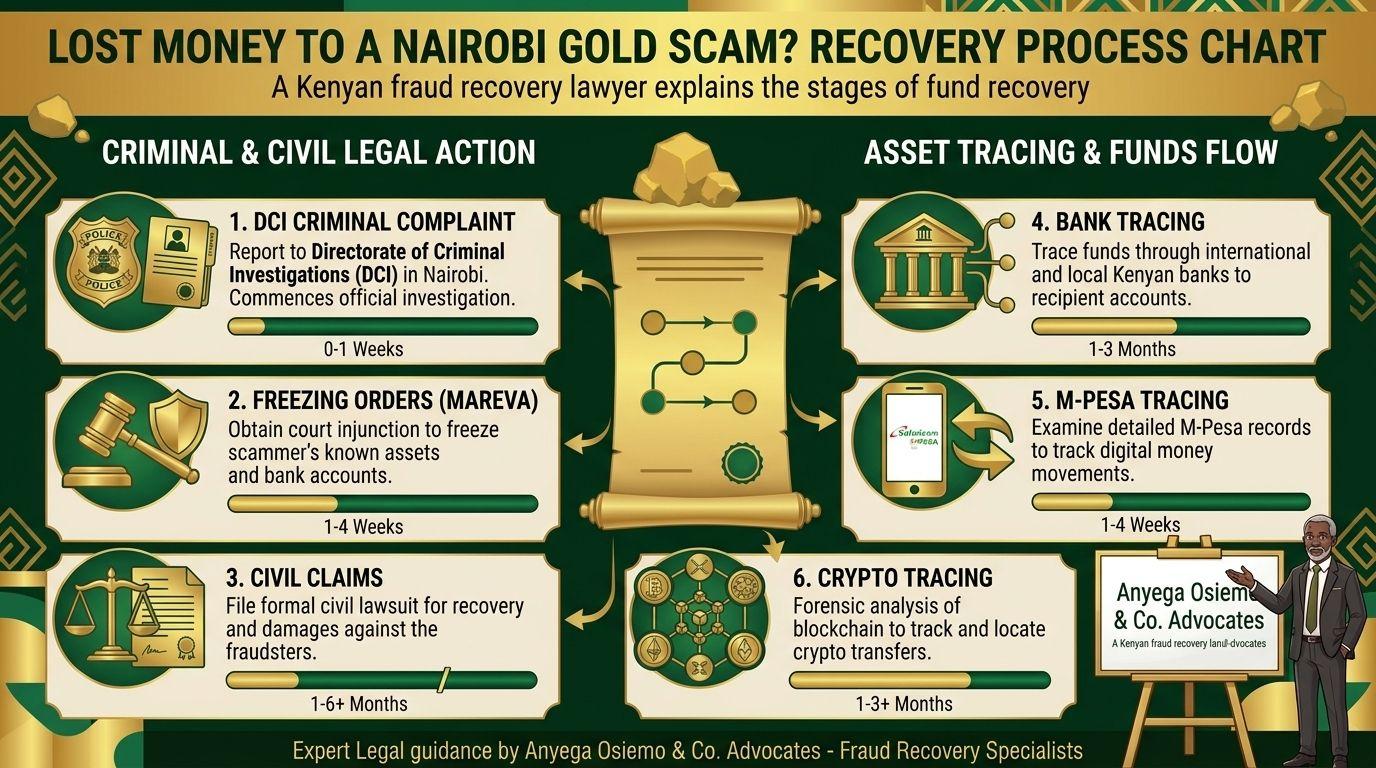
Kenya has emerged as a leading jurisdiction in Africa for cryptocurrency activity, with approximately 4.5 million Kenyans holding digital assets and significant transaction volumes processed through both local and international exchanges. However, this growth has been accompanied by substantial risks. Exchange hacks, investment fraud, phishing, and fraudulent token offerings have resulted in considerable financial losses for Kenyan investors, including many in the diaspora. In many cases, victims have seen their assets transferred to unidentified blockchain addresses, with limited understanding of the available legal remedies.
The legal framework governing cryptocurrency recovery in Kenya remains complex and is still in the process of development. There is currently no statute that specifically addresses digital assets. The Central Bank of Kenya has issued cautionary statements regarding virtual currencies but has not imposed a prohibition. The Capital Markets Authority is in the process of establishing a regulatory sandbox for digital asset innovation. Meanwhile, the Kenya Revenue Authority has begun to require tax compliance from cryptocurrency traders, although comprehensive guidance on the reporting of digital asset gains is lacking.
Despite the absence of comprehensive regulation, Kenyan courts have demonstrated a willingness to adjudicate civil claims for the recovery of stolen cryptocurrency. The courts have granted freezing orders, injunctions, and Anton Piller orders against both exchanges and individuals. Blockchain forensic analysis is increasingly utilised to trace misappropriated assets across various networks, including Bitcoin, Ethereum, and Tether. A growing cohort of Kenyan legal practitioners is acquiring the requisite technical knowledge to integrate established civil procedure with the complexities of digital asset tracing and recovery.
This article provides a comprehensive legal overview for individuals seeking to recover stolen cryptocurrency in Kenya. Whether the loss arises from an exchange hack, an investment fraud scheme, or the misappropriation of private keys by a known party, the following sections set out the legal remedies available under Kenyan law, the immediate procedural steps required, and the measures necessary to enhance the prospects of successful recovery.
1. Understanding the Threat Landscape: How Crypto Is Stolen in Kenya
1.1 Exchange Hacks and Platform Insolvency
The most common source of large-scale crypto losses in Kenya is exchange failure. Both local and international exchanges have suffered hacks, insider theft, or insolvency. When an exchange is hacked, customer funds are drained from hot wallets. When an exchange becomes insolvent, withdrawals are frozen, and customers are left as unsecured creditors in a jurisdiction they may not understand. Kenyan investors who held assets on FTX, Celsius, BlockFi, and various local platforms have learned this lesson the hard way.
1.2 Investment Scams and Ponzi Schemes
Kenya has seen a proliferation of crypto investment scams promising implausible returns. These schemes typically operate through WhatsApp groups, Telegram channels, and slick websites with fake testimonials. Victims are encouraged to deposit Bitcoin, Ethereum, or USDT into a "trading platform" or "investment pool." Early investors may receive small withdrawals to build confidence, but the scheme eventually collapses when new deposits dry up. The operators vanish, leaving victims with no recourse against a faceless entity registered in a tax haven.
1.3 Phishing, Social Engineering, and Private Key Theft
Individual investors are also targeted through phishing emails, fake mobile apps, and social engineering. A victim receives an email purportedly from their exchange requesting password verification. They click the link, enter their credentials, and within minutes their account is drained. In other cases, a victim stores their private keys or seed phrase on their phone or computer. Malware extracts the keys, and the thief transfers the assets to an anonymous wallet. Because blockchain transactions are irreversible, the theft is technically instantaneous.
1.4 Romance Scams and Pig Butchering
A growing category of crypto fraud in Kenya is the "pig butchering" scam, in which fraudsters build romantic or friendship relationships with victims over weeks or months, often through dating apps or social media, before introducing a "lucrative investment opportunity." The victim, emotionally invested and financially groomed, deposits significant sums into a fraudulent platform. By the time they realise they have been scammed, the relationship is severed, and the funds are irretrievable. Diaspora Kenyans are particularly vulnerable to this scheme because of the emotional distance and the desire to invest in opportunities "back home."
2. The Legal Framework: What Kenyan Law Says About Stolen Crypto
2.1 Is Cryptocurrency "Property" Under Kenyan Law?
This is the foundational question. For a victim to sue to recover stolen cryptocurrency, the court must first recognise that cryptocurrency is property capable of being owned, transferred, and stolen. Kenyan courts have not yet issued a definitive ruling on this point. Still, the trajectory of common law globally and the principles underlying the Kenyan Constitution strongly support the proposition that digital assets are property.
In England and Wales, the High Court in AA v Persons Unknown [2019] EWHC 3556 (Comm) held that Bitcoin is "property" for a proprietary injunction. The court reasoned that crypto assets have the characteristics of property: they are definable, identifiable by third parties, capable of assumption by third parties, and have some degree of permanence. The same reasoning applies in Kenya, where Article 40 of the Constitution protects the right to acquire and own property broadly defined. While the Law of Succession Act and the Sale of Goods Act do not explicitly mention digital assets, the general principles of property law are sufficiently flexible to encompass them.
2.2 The Central Bank of Kenya Position: Unregulated, Not Illegal
The Central Bank of Kenya issued a public notice in December 2015 cautioning the public against dealing in virtual currencies. The notice stated that "virtual currencies are not legal tender in Kenya" and that "no entity is currently licensed to offer money remittance services and products in Kenya using virtual currency." However, the CBK did not ban cryptocurrency. It merely warned that crypto transactions are unregulated and that consumers bear the full risk.
This position was reinforced in 2023 when the CBK Governor stated that the bank would not license crypto exchanges but would not prevent Kenyans from trading. The practical effect is that cryptocurrency trading is legal but unregulated. Victims of theft can therefore pursue civil remedies without fear of being accused of engaging in an illegal activity. The fact that crypto is unregulated does not mean it is unownable or unprotectable.
2.3 The Capital Markets Authority and the Regulatory Sandbox
In 2023, the Capital Markets Authority (CMA) announced a regulatory sandbox for digital asset innovators. The sandbox allows firms to test crypto-related products under CMA supervision. While this is a step toward formal regulation, it does not yet provide a comprehensive legal framework for consumer protection or dispute resolution. Victims of theft cannot rely on CMA intervention to recover funds. Still, the existence of the sandbox signals that the Kenyan state recognises digital assets as a legitimate, if nascent, asset class.
2.4 The Tax Angle: KRA and Cryptocurrency Reporting
The Kenya Revenue Authority has begun requiring crypto traders to report their digital asset gains and losses on their annual tax returns. Under the Income Tax Act, gains from the disposal of property, including digital assets, are subject to capital gains tax or income tax, depending on whether the trading is classified as an investment or a business activity. For victims of theft, the tax treatment of stolen crypto is uncertain. Can a theft loss be claimed as a deductible expense? The Income Tax Act does not explicitly address this, but general principles suggest that a loss arising from theft of an income-producing asset may be deductible. Victims should obtain tax advice alongside their recovery litigation.
3. Legal Remedies for Recovering Stolen Cryptocurrency in Kenya
3.1 Civil Suit for Recovery of Property or Damages
The primary remedy is a civil suit filed in the High Court or Magistrate Court (depending on the value of the claim). The suit can be framed in several ways:
(a) Conversion: A claim that the defendant wrongfully assumed ownership or control over the plaintiff's cryptocurrency.
(b) Fraud and Deceit: A claim that the defendant obtained the crypto through fraudulent misrepresentation.
(c) Breach of Trust: A claim that the defendant held the crypto in a fiduciary capacity and misappropriated it.
(d) Unjust Enrichment: A claim that the defendant was enriched at the plaintiff's expense without legal justification.
(e) Negligence: A claim against an exchange or custodian that failed to implement adequate security measures.
The choice of cause of action depends on the facts. In exchange-hack cases, negligence and breach-of-contract claims are often strongest. In investment scam cases, fraud and conversion are more appropriate. In cases involving trusted associates, breach of trust may be the primary claim. A well-drafted suit will often plead multiple causes of action in the alternative.
3.2 Freezing Orders and Injunctions
Speed is critical in crypto recovery. Once stolen funds are moved through multiple wallets, exchanges, and mixing services (such as Tornado Cash), tracing becomes exponentially harder. The first legal step after discovery should be an urgent ex parte application for:
(a) A Mareva injunction (freezing order) restraining the defendant from disposing of, dissipating, or transferring any cryptocurrency or fiat currency traceable to the theft;
(b) A proprietary injunction preventing the defendant from dealing with the specific digital assets identified as belonging to the plaintiff;
(c) A disclosure order (Norwich Pharmacal order) compelling an exchange or intermediary to disclose the identity, contact details, and transaction history of the account holder who received the stolen funds.
These orders are granted under the inherent jurisdiction of the court and the Civil Procedure Act. The applicant must demonstrate a strong prima facie case, that the balance of convenience favours the injunction, and that irreparable harm will occur if the order is not granted. In crypto cases, the risk of dissipation is immediate and severe, which strongly supports the grant of urgent relief.
3.3 Anton Piller Orders: The Digital Raid
An Anton Piller order allows the plaintiff's representatives to enter the defendant's premises without prior notice to seize evidence- in this case, computers, phones, hardware wallets, and any devices containing private keys or seed phrases. While traditionally used in intellectual property cases, Anton Piller orders have been adapted for digital asset recovery. The order is draconian and granted only in exceptional circumstances where there is clear evidence that the defendant will destroy or conceal evidence if given notice. In crypto theft cases, where private keys stored on a defendant's device may be the only means of recovery, Anton Piller orders are a powerful if rarely used tool.
3.4 Third-Party Disclosure from Exchanges
International cryptocurrency exchanges such as Binance, Coinbase, and Kraken are not immune from Kenyan court orders, but enforcing those orders requires navigating complex jurisdictional issues. A Kenyan court can issue a disclosure order against an exchange that operates in Kenya or has customers in Kenya. The exchange may be served through its local representatives, agents, or the Kenya Revenue Authority. If the exchange refuses to comply, the court can issue contempt proceedings or orders affecting the exchange's ability to operate in Kenya.
In practice, many exchanges cooperate with court orders if they are properly framed and served. Exchanges have a commercial interest in maintaining their reputation and regulatory standing. A well-drafted Norwich Pharmacal order, supported by blockchain forensics evidence, is more likely to elicit cooperation than aggressive threats.
3.5 Criminal Prosecution: A Parallel Track
Victims should also report crypto theft to the Directorate of Criminal Investigations (DCI) and the Financial Reporting Centre (FRC). While criminal prosecution does not directly result in recovery of the stolen assets, it serves several purposes: it freezes the defendant's assets through criminal asset recovery procedures; it deters further fraud; and it provides leverage in civil settlement negotiations. The Computer Misuse and Cybercrimes Act, 2018 criminalises unauthorised access to computer systems, interception of electronic data, and cyber fraud. Sections 14, 23, and 29 are particularly relevant to crypto theft cases.
4. Blockchain Forensics: The Technical Foundation of Recovery
4.1 How Blockchain Tracing Works
Blockchain forensics is the scientific analysis of blockchain transactions to trace the movement of stolen funds. Because Bitcoin, Ethereum, and most other cryptocurrencies operate on public ledgers, every transaction is recorded permanently and immutably. A forensic analyst can follow the trail of stolen funds from the victim's wallet through intermediate addresses to the final destination- often an exchange where the thief attempts to convert crypto to fiat.
The process involves: identifying the victim's wallet address and the transaction hash (TXID) of the theft; tracing outgoing transactions through the blockchain; clustering addresses controlled by the same entity using heuristics; identifying exchange deposit addresses where the funds are cashed out; and compiling a forensic report that can be admitted as evidence in court.
4.2 Tools and Experts
Leading blockchain forensics firms such as Chainalysis, Elliptic, and CipherTrace provide enterprise-grade tracing services. In Kenya, a small but growing number of forensic analysts and cybersecurity firms offer crypto tracing services. Victims should engage a forensic expert as soon as possible, ideally within 24 to 48 hours of discovery,ry before the thief moves funds through mixing services or privacy coins that obscure the trail.
4.3 Admissibility of Blockchain Evidence in Kenyan Courts
Under the Evidence Act, electronic records are admissible if they are authenticated and their integrity is demonstrated. A blockchain forensic report, prepared by a qualified expert and supported by the underlying blockchain data, is admissible as expert evidence. The expert must be able to explain the methodology, the tools used, and the conclusions reached in language that a judge without a technical background can understand. The report should include: the expert's qualifications; the instructions received; the data analysed; the methodology applied; the findings; and the expert's opinion on the identity of the recipient addresses.
5. The Diaspora Dimension: Special Challenges for Kenyans Abroad
Kenyans in the diaspora are disproportionately affected by crypto theft for several reasons. They often invest larger sums because of higher earning capacity abroad. They are targeted by scams that exploit their emotional connection to Kenya, such as: "invest in this Kenyan crypto project" or "help fund this blockchain initiative." They face jurisdictional challenges when the theft occurs across multiple countries. And they may struggle to engage Kenyan lawyers while living in the US, UK, UAE, or Australia.
For diaspora victims, the recovery strategy must account for: time zone coordination with Kenyan counsel; authentication of affidavits and powers of attorney at Kenyan embassies or before notaries public; cross-border enforcement of court orders against exchanges based in the US, EU, or Asia; and tax compliance in both the host country and Kenya. At Anyega Osiemo & Co. Advocates, we provide dedicated diaspora legal support for crypto recovery cases, including remote consultation, embassy-authenticated documentation, and coordination with international counsel and forensic experts.
6. Practical Steps: What to Do Immediately After Discovering Crypto Theft
Step 1: Document everything. Take screenshots of your wallet balance, transaction history, and any correspondence with the thief or the exchange. Time-stamp everything.
Step 2: Preserve the blockchain trail. Identify the transaction hash (TXID) of the theft. Do not attempt to move remaining funds until you have legal advice; this may complicate tracing.
Step 3: Report to the exchange. If the theft involved an exchange, file a formal complaint immediately. Request that the receiving account be frozen pending investigation.
Step 4: Engage a blockchain forensic expert. Within 24–48 hours, engage a forensic analyst to begin tracing the stolen funds. The sooner tracing begins, the higher the recovery probability.
Step 5: Engage a crypto recovery lawyer. Within 48–72 hours, engage a lawyer experienced in digital asset disputes to file urgent freezing orders, disclosure orders, and civil suits.
Step 6: Report to DCI and FRC. File a criminal complaint to trigger parallel asset recovery proceedings and deter further fraud.
Step 7: Assess tax implications. Consult a tax advisor to determine whether the theft loss is deductible and how to report it to the KRA.
7. Frequently Asked Questions (FAQ)
Q1: Can I recover stolen cryptocurrency in Kenya?
A: Yes, but success depends on speed, evidence, and the legal strategy employed. Kenyan courts have granted freezing orders, injunctions, and disclosure orders in crypto recovery cases. However, recovery becomes exponentially harder if the thief has moved funds through mixing services, privacy coins, or multiple exchanges. The key is to act within 24–48 hours of discovery.
Q2: Is cryptocurrency legal in Kenya?
A: Yes. Cryptocurrency is not banned in Kenya. The Central Bank of Kenya has issued cautionary notices stating that crypto is neither legal tender nor regulated. Still, it has not prohibited trading, holding, or investing in digital assets. The Capital Markets Authority has established a regulatory sandbox for crypto innovators. Victims of theft can therefore pursue legal remedies without fear of being accused of illegal activity.
Q3: What is a freezing order in a crypto case?
A: A freezing order (Mareva injunction) is a court order that prevents the defendant from disposing of, dissipating, or transferring assets, including cryptocurrency, pending the determination of the suit. In crypto cases, freezing orders are critical because blockchain transactions are irreversible. Once the funds are moved, they are gone. An urgent ex parte application for a freezing order should be filed within 24–48 hours of discovery.
Q4: Can a Kenyan court order a foreign exchange to disclose information?
A: Yes, through a Norwich Pharmacal disclosure order. The court can compel an exchange that operates in Kenya or serves Kenyan customers to disclose an account holder's identity, contact details, and transaction history. Enforcement depends on the exchange's willingness to cooperate and the existence of local representatives or agents. Many exchanges cooperate with properly framed court orders to protect their regulatory standing.
Q5: What is blockchain forensics and why do I need it?
A: Blockchain forensics is the scientific tracing of cryptocurrency transactions on public ledgers. Because Bitcoin, Ethereum, and Tether transactions are recorded permanently, forensic analysts can follow the movement of stolen funds from the victim's wallet through intermediate addresses to the final destination. A forensic report is essential evidence in court and is often required by exchanges before they will freeze an account. You need it to prove your case and to identify the recipient of your stolen funds.
Q6: How long do I have to file a crypto recovery suit?
A: The limitation period for tort claims (such as conversion, fraud, or negligence) is three years from the date the cause of action accrued. For contract claims, the limitation period is six years. However, in crypto cases, delay is fatal to recovery even if the suit is filed within the limitation period. The thief may dissipate the funds, move them offshore, or convert them to privacy coins. You should engage a lawyer within 48–72 hours of discovery.
Q7: Can I recover crypto stolen through a romance scam or pig butchering?
A: Yes, but these cases are among the most challenging. The thief often operates from outside Kenya, uses fake identities, and routes funds through multiple jurisdictions. Recovery requires international coordination, blockchain forensics, and aggressive legal strategy. Diaspora victims are particularly vulnerable to these scams. Early engagement of a lawyer with international reach is essential.
Q8: What are the costs of crypto recovery litigation?
A: Costs vary depending on the complexity of the case, the value of the stolen assets, and the number of jurisdictions involved. A straightforward freezing order application may cost KES 200,000–500,000. A full civil suit with forensic evidence and international coordination may cost KES 1,000,000–5,000,000 or more. Many lawyers, including our firm, offer contingency fee arrangements or staged billing for high-value recovery cases. An initial consultation to assess viability is the best first step.
Q9: Should I report crypto theft to the police?
A: Yes. Report to the Directorate of Criminal Investigations (DCI) and the Financial Reporting Centre (FRC). While criminal prosecution does not directly recover your assets, it triggers asset freezing procedures, deters further fraud, and provides leverage in civil settlement negotiations. The Computer Misuse and Cybercrimes Act, 2018 criminalises unauthorised access, data interception, and cyber fraud. A criminal complaint also creates an official record that may be useful in court.
Q10: How can Anyega Osiemo & Co. Advocates help with crypto recovery?
A: At Anyega Osiemo & Co. Advocates, we are at the forefront of digital asset dispute resolution in Kenya. We provide: urgent freezing order and injunction applications; civil suits for conversion, fraud, and negligence; coordination with blockchain forensics experts; Norwich Pharmacal disclosure orders against exchanges; criminal complaints and asset recovery proceedings; diaspora legal support including remote consultation and embassy-authenticated documentation; and tax advisory on crypto theft losses. We understand both the technical complexity of blockchain and the procedural requirements of Kenyan courts. Contact us for a confidential assessment of your recovery prospects.
Conclusion
The theft of cryptocurrency is a devastating experience financially, emotionally, and psychologically. But it is not necessarily the end of the road. Kenyan law provides powerful remedies for victims who act quickly, engage the right experts, and pursue their claims with determination. The key is speed: every hour after discovery is an hour during which the thief may be moving your funds further out of reach.
At Anyega Osiemo & Co. Advocates, we have built a practice that bridges the gap between traditional civil litigation and cutting-edge digital asset recovery. We combine deep knowledge of Kenyan civil procedure with an understanding of blockchain technology, international exchange operations, and forensic investigation. Whether you have lost Bitcoin, Ethereum, USDT, or any other digital asset, we are here to help you trace, freeze, and recover what is rightfully yours. Do not let the thief win. Contact us today.
Disclaimer: This article is general legal information, not legal advice. For guidance on your specific situation, book a consultation with our advocates.