In December 2015, the Central Bank of Kenya issued a public notice that would define the regulatory landscape for cryptocurrency in the country for nearly a decade. The notice warned the public against dealing in virtual currencies, stating that "virtual currencies are not legal tender in Kenya" and that "no entity is currently licensed to offer money remittance services and products in Kenya using virtual currency." The message was clear: the CBK did not endorse cryptocurrency, would not regulate it, and would not protect consumers who chose to trade it.
By 2026, the situation in Kenya has changed significantly. Approximately 4.5 million Kenyans now hold cryptocurrency. Local exchanges process transactions worth billions of shillings each month. Cryptocurrency is increasingly used for diaspora remittances as an alternative to traditional money transfer services. The Capital Markets Authority has introduced a regulatory sandbox for digital asset innovators. The CBK, under new leadership, has recognised that a prohibition on cryptocurrency is not practical in a digital economy.
Despite these developments, the legal position remains unclear. Kenyan crypto traders operate in a space that is not illegal, not fully regulated, and not clearly protected. This article sets out the current legal status of cryptocurrency in Kenya, the rights and obligations of traders, the tax implications, and the regulatory developments that may affect crypto holders.
1. The CBK Position: A History of Caution
1.1 The 2015 Public Notice
The CBK's December 2015 public notice was issued at a time when global regulators were grappling with the emergence of Bitcoin and the collapse of Mt. Gox. The notice made three key points: virtual currencies are not legal tender in Kenya; no entity is licensed to offer virtual currency remittance services; and the public is cautioned against the risks of volatility, lack of consumer protection, and potential use in money laundering and terrorism financing.
The notice did not, however, ban cryptocurrency. It did not criminalise holding, trading, or investing in digital assets. It merely stated that the CBK would not regulate the sector and that consumers traded at their own risk. This left a regulatory vacuum that has persisted, in various forms, to the present day.
1.2 The 2023–2024 Shift: From Caution to Engagement
In 2023, under Governor Kamau Thugge, the CBK signalled a shift in approach. The Governor stated publicly that the bank would not license crypto exchanges but would not prevent Kenyans from trading. This was a pragmatic recognition that millions of Kenyans were already active in the crypto market and that prohibition would be unenforceable. The CBK also began exploring a central bank digital currency (CBDC) and engaging with international bodies, such as the Financial Action Task Force (FATF), on crypto-asset regulation standards.
As a result of this shift, the CBK no longer actively discourages crypto trading, but it does not endorse it. The sector remains without a dedicated regulatory framework.
1.3 The Legal Status: Unregulated, Not Illegal
It is important to distinguish between unregulated and illegal activities. An activity may be legal even if it is not subject to specific regulation. For example, driving a car is both legal and regulated, while riding a bicycle is legal but largely unregulated. Cryptocurrency trading in Kenya is legal, but there is no dedicated regulatory framework governing it.
Accordingly, you may legally buy, sell, hold, and trade cryptocurrency in Kenya. You may use cryptocurrency for personal investment, remittances, and payments where it is accepted. It is possible to operate a crypto exchange or brokerage without a specific crypto licence, provided you comply with general business registration and tax requirements. Legal remedies are available if you are defrauded, hacked, or otherwise harmed in a crypto transaction.
However, you do not have the consumer protections that apply to regulated financial products, such as deposit insurance. You cannot seek recourse from the CBK or CMA in relation to a crypto exchange, unless the exchange is participating in the CMA sandbox. You bear the full risk of exchange insolvency, hacking, and fraud.
2. The CMA Regulatory Sandbox: A Glimpse of the Future
2.1 What Is the Sandbox?
In 2023, the Capital Markets Authority launched a regulatory sandbox for financial technology innovators, including digital asset firms. The sandbox allows approved firms to test crypto-related products and services under CMA supervision for a limited period, with relaxed regulatory requirements. This is a significant development because it represents the first formal regulatory engagement with the crypto sector by a Kenyan government agency.
2.2 Who Can Participate?
To participate in the sandbox, a firm must: be incorporated in Kenya or have a significant Kenyan presence; demonstrate innovation in financial services; have a viable business model; commit to consumer protection and risk management; and agree to exit the sandbox and apply for full licensing if the test is successful. Firms that have participated or are expected to participate include local crypto exchanges, blockchain-based lending platforms, and tokenization projects for real estate and agricultural assets.
2.3 What Does the Sandbox Mean for Consumers?
The regulatory sandbox provides consumers with certain protections not available in the unregulated market. Participants in the sandbox must maintain adequate capital reserves, implement cybersecurity measures, provide clear disclosures, submit to CMA oversight, and have an exit strategy in the event of failure. The sandbox is limited in scope, with only a small number of firms able to participate at any time. Participation in the sandbox does not guarantee success or prevent losses. Consumers should exercise caution.
3. Tax Obligations: What KRA Expects from Crypto Traders
3.1 Income Tax on Crypto Trading
The Kenya Revenue Authority has made it clear that gains from cryptocurrency trading are subject to tax. Under the Income Tax Act, any gain arising from the disposal of property, including digital assets, is taxable. For individual traders, crypto gains are typically classified as income from employment or business, depending on the frequency and volume of trading. For companies, crypto trading profits are subject to corporation tax at the standard rate of 30%.
Determining the taxable amount can be complex. Crypto traders may conduct numerous transactions each year, often with significant price volatility. Calculating the cost basis for each transaction and the resulting gain or loss requires careful accounting. The KRA has not issued detailed guidance on crypto tax calculation, but general principles indicate that the 'first in, first out' (FIFO) or 'average cost' methods may be acceptable. Traders should keep detailed records of all transactions, including dates, amounts, prices, and fees.
3.2 Capital Gains Tax on Crypto Investments
Long-term investors who hold cryptocurrency as a capital asset, rather than for active trading, may be subject to capital gains tax on disposal. The Capital Gains Tax Act was suspended for many years and reinstated in 2014 at a rate of 5% on net gains. The application of capital gains tax to cryptocurrency remains uncertain, as KRA has not issued specific guidance. Investors should seek professional tax advice to determine whether their crypto gains should be reported as income or capital gains.
3.3 VAT and Withholding Tax on Crypto Services
Services related to cryptocurrency, such as exchange fees, wallet services, and blockchain consulting, may be subject to VAT at the standard rate of 16%. Crypto salaries and payments may also create withholding tax obligations for employers. The tax treatment of staking rewards, airdrops, and mining income is uncertain. The KRA's general position is that all income is taxable unless specifically exempted. Crypto traders and service providers should disclose all relevant income and seek professional tax advice.
3.4 The Risk of Non-Compliance
KRA has begun using data analytics and international information The KRA now uses data analytics and international information exchange agreements to identify crypto traders who have not declared their gains. The OECD's Common Reporting Standard and the FATF's travel rule require exchanges to share customer information with tax authorities. A Kenyan trader who uses a foreign exchange and fails to declare gains may be subject to tax assessments, penalties, and interest. The penalty for tax evasion under the Tax Procedures Act is 20% of the tax shortfall, plus interest at 2% per month. Criminal prosecution is possible in cases of willful evasion.
4.1 Contract Law Protections
General contract law principles apply to crypto transactions, even in the absence of specific regulation. Depositing funds with an exchange under its terms of service creates a binding contract. If the exchange breaches the contract by failing to process withdrawals, misappropriating funds, or changing terms without agreement, you may bring a claim for breach of contract. The same principles apply to peer-to-peer transactions, over-the-counter trades, and crypto lending agreements.
4.2 Tort Law Protections
If you are defrauded in a crypto transaction, you may bring a claim for fraud, deceit, conversion, or unjust enrichment. These are common law torts that do not require specific legislation on cryptocurrency. Identifying the defendant and proving fraud can be challenging, and may require blockchain forensic analysis and legal expertise.
4.3 The Consumer Protection Act
The Consumer Protection Act, 2012, provides general protections against unfair trade practices, misleading advertising, and defective products. Although the Act does not specifically refer to cryptocurrency, its provisions apply to crypto services marketed to consumers. A crypto exchange that makes false claims regarding security, insurance, or returns may be liable under the Act. The Competition Authority of Kenya has authority to investigate and penalise such conduct.
4.4 The Computer Misuse and Cybercrimes Act
The Computer Misuse and CybercThe Computer Misuse and Cybercrimes Act, 2018, criminalises unauthorised access to computer systems, data interception, cyber fraud, and identity theft. These offences are relevant to crypto theft, exchange hacks, and phishing attacks. Victims may report such crimes to the Directorate of Criminal Investigations and the Financial Reporting Centre. Criminal prosecution does not guarantee asset recovery, but it may assist in civil proceedings and deter future fraud.nd Counter-Terrorism Financing
The pseudonymous nature of cryptocurrency can facilitate money laundering and terrorist financing. Kenya, as a member of the FATF, is required to implement anti-money laundering and counter-terrorism financing measures for the crypto sector. The Proceeds of Crime and Anti-Money Laundering Act requires financial institutions and designated non-financial businesses to report suspicious transactions to the Financial Reporting Centre. Crypto exchanges operating in Kenya are expected to implement know-your-customer procedures, monitor transactions for suspicious activity, and report large or unusual transactions.
For individual traders, the anti-money laundering framework requires the provision of identity documentation when opening exchange accounts. Transactions may be monitored and reported to authorities, and traders may be required to explain the source of funds for large deposits or withdrawals. Failure to comply with know-your-customer requirements can result in account suspension or closure. Attempting to circumvent KYC requirements by using privacy coins, mixing services, or unregulated exchanges may result in criminal liability under the Proceeds of Crime and Anti-Money Laundering Act.
6. Frequently Asked Questions (FAQ)
Q1: Is cryptocurrency legal in Kenya?
A: Yes. Cryptocurrency is not banned in Kenya. The CBK has issued cautionary notices but has not prohibited trading, holding, or investing in digital assets. Crypto trading is legal but unregulated. You can buy, sell, hold, and trade cryptocurrency without fear of criminal prosecution, provided you comply with general tax and business registration requirements.
Q2: Do I need a license to trade crypto in Kenya?
A: No. Individual traders do not need a specific crypto license. However, if you operate a crypto exchange, brokerage, or other crypto business, you must register your business under the Companies Act and comply with general tax, employment, and consumer protection laws. If you wish to operate under formal regulatory oversight, you can apply to participate in the CMA regulatory sandbox.
Q3: Do I have to pay tax on crypto gains?
A: Yes. Gains from cryptocurrency trading are subject to income tax or capital gains tax, depending on whether you are classified as a trader or an investor. Crypto-related services may also be subject to VAT. KRA expects crypto traders to declare their gains and maintain detailed transaction records. Failure to declare crypto gains can result in penalties, interest, and criminal prosecution.
Q4: What happens if a crypto exchange collapses or is hacked?
A: In the absence of specific regulation, there is no deposit insurance or consumer compensation scheme for crypto exchange failures. You are an unsecured creditor of the exchange. Your remedies are: filing a civil suit for breach of contract or negligence; reporting the hack to DCI for criminal investigation; and, if the exchange has assets, participating in any insolvency or liquidation proceedings. Prevention is better than cure: use reputable exchanges, enable two-factor authentication, and do not store large amounts on exchanges.
Q5: Can I use crypto for remittances?
A: Yes. Many Kenyans, particularly in the diaspora, use cryptocurrency for remittances as a faster and cheaper alternative to traditional money transfer services. However, you must comply with tax obligations in both the sending and receiving jurisdictions. You should also be aware of exchange rate risks and the potential for price volatility between the time of sending and conversion to Kenyan shillings.
Q6: What is the CMA regulatory sandbox?
A: The CMA regulatory sandbox is a controlled environment where fintech and crypto firms can test innovative products under relaxed regulatory requirements. Sandbox participants receive CMA oversight and consumer protection standards that do not apply to unregulated firms. For consumers, trading with a sandbox participant offers greater security than trading with an unregulated exchange. However, the sandbox is limited in scope and does not cover all crypto activities.
Q7: Can I be prosecuted for using privacy coins or mixing services?
A: Using privacy coins (such as Monero) or mixing services (such as Tornado Cash) is not inherently illegal. However, these tools are closely associated with money laundering and sanctions evasion. If you use them to conceal the source or destination of funds, you may face investigation under POCAMLA, the Computer Misuse and Cybercrimes Act, or international sanctions regimes. The burden of proving legitimate use falls on you.
Q8: What should I do if I am scammed in a crypto transaction?
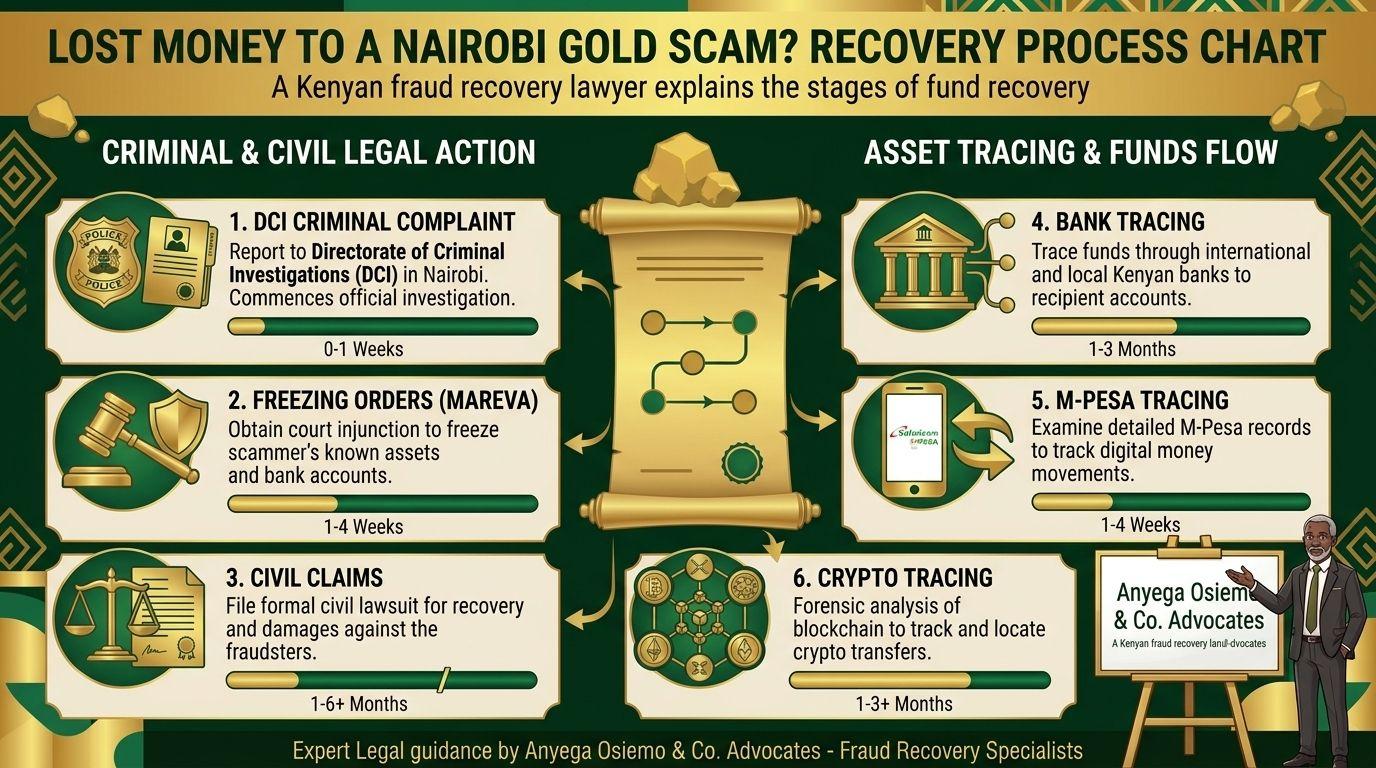
A: Act immediately. Document all evidence (screenshots, transaction hashes, correspondence). Report to the exchange if applicable. Engage a blockchain forensic expert to trace the funds. File a criminal complaint with DCI and FRC. Engage a crypto recovery lawyer to file urgent freezing orders and civil suits. The faster you act, the higher your chances of recovery. See our comprehensive guide on recovering stolen cryptocurrency for detailed steps.
Q9: Will Kenya ban cryptocurrency in the future?
A: A total ban is unlikely. The global trend is toward regulation, not prohibition. The CBK has already shifted from discouragement to tolerance. The CMA is actively engaging with the sector through the sandbox. And the economic benefits of crypto- particularly for remittances, financial inclusion, and innovation- are too significant to ignore. More likely is a gradual move toward comprehensive regulation, including licensing requirements for exchanges, consumer protection standards, and tax compliance mechanisms.
Q10: How can Anyega Osiemo & Co. Advocates help crypto traders?
A: We provide comprehensive legal services for crypto traders, exchanges, and investors, including: tax advisory and compliance for crypto gains; contract review and drafting for exchange terms of service, lending agreements, and OTC trades; recovery litigation for stolen or misappropriated crypto; AML/CFT compliance advisory for crypto businesses; representation in regulatory matters before CBK, CMA, and KRA; and diaspora legal support for cross-border crypto transactions. Contact us for a confidential consultation.
Conclusion
The difference between the CBK's 2015 position and the current state of Kenya's crypto market demonstrates the rapid pace of technological change and the challenges of regulatory adaptation. Kenyan crypto traders operate in a legal environment that is not illegal, not fully protected, and not clearly regulated. Traders who understand their rights, comply with tax obligations, and implement appropriate security measures are better positioned to navigate the market.
The regulatory landscape is expected to continue evolving. The CMA sandbox represents an initial step, and comprehensive legislation is likely to follow. Kenyan courts will increasingly address disputes involving cryptocurrency. At Anyega Osiemo & Co. Advocates, we remain committed to monitoring these developments and providing clients with the legal guidance required to operate in the digital asset economy. Whether you are a retail trader, a crypto entrepreneur, or a diaspora investor, we are available to assist you in understanding your legal rights.
Disclaimer: This article is general legal information, not legal advice. For guidance on your specific situation, book a consultation with our advocates.