In December 2025, a Kenyan investor deposited KES 5 million worth of Ethereum into a decentralised finance (DeFi) protocol which advertised an 18% annual yield. The protocol was governed by a smart contract, which is a self-executing code on the Ethereum blockchain that automatically allocates funds, distributes rewards, and permits withdrawals. There was no identifiable company or management behind the protocol, and no formal terms of service were provided. Six months later, the protocol was compromised by a hacker, resulting in the loss of KES 4.2 million from the investor's deposit. This scenario raises a legal question that has not yet been conclusively addressed by Kenyan courts: can an investor bring a claim for breach of contract in such circumstances?
The emergence of decentralized finance activities such as lending, borrowing, trading, and yield farming, all conducted through smart contracts without intermediaries, has introduced legal disputes that traditional contract law may not be fully equipped to address. Smart contracts differ from conventional contracts in that they are computer programs which execute automatically when specified conditions are met. They do not require signatures, witnesses, or even mutual awareness between parties. A user interacts with a smart contract by sending a transaction to its blockchain address, after which the code executes and the outcome is recorded immutably. The legal questions that arise include whether such arrangements are legally binding and, in the event of failure, who may be held liable.
This article considers the enforceability of smart contracts under Kenyan law, outlines the legal remedies available in the event of DeFi protocol failures, and sets out practical steps that investors, developers, and platforms should take to protect their interests in a jurisdiction where there is currently no specific legislation governing blockchain-based agreements.
1. What Is a Smart Contract?
1.1 Definition and Mechanics
A smart contract is a computer program stored on a blockchain that automatically executes predefined actions when specific conditions are met. The term was coined by cryptographer Nick Szabo in 1994, long before blockchain technology existed. Szabo described smart contracts as "computerized transaction protocols that execute terms of a contract." On Ethereum and other programmable blockchains, smart contracts are written in programming languages such as Solidity and deployed as immutable code. Once deployed, the code cannot be altered, only interacted with.
The mechanics of smart contracts are, in principle, straightforward. A developer may write code specifying that if User A deposits 1 ETH, the funds are allocated to Liquidity Pool B, interest accrues at a specified rate, and withdrawal of principal plus interest is permitted after a defined period. When User A sends 1 ETH to the smart contract address, the code verifies the deposit, allocates the funds, and commences interest accrual. Upon withdrawal, the code calculates the accrued interest, transfers the total amount to User A's wallet, and updates the ledger. This process occurs without the involvement of a bank, lawyer, or intermediary.
1.2 The Promise and the Peril
Smart contracts offer the potential benefits of efficiency, transparency, and the removal of the need for trust between parties. The public and immutable nature of the code allows participants to verify the manner in which their funds will be managed. Automatic execution reduces the risk of counterparty default, and the absence of intermediaries can lower costs and increase transaction speed.
However, the risks associated with smart contracts are considerable. Code may contain errors, and vulnerabilities can be exploited by malicious actors. Oracles, which are external data feeds that trigger smart contract actions, may also be subject to manipulation. In the event of a failure or exploit, there may be no identifiable defendant, no company or director to hold accountable, and no insurance available to cover losses. Investors may find themselves unable to pursue a clear legal remedy for the recovery of their funds.
2. Are Smart Contracts Legally Binding Under Kenyan Law?
2.1 The Contract Law Framework
Under the Law of Contract Act, Cap 23, a contract is defined as an agreement that gives rise to obligations enforceable or recognised by law. For a contract to be valid, there must be: offer and acceptance; intention to create legal relations; consideration (something of value exchanged); capacity to contract; and legality of purpose. Smart contracts, at first glance, appear to satisfy these requirements. The deployment of the smart contract is the offer. The user's interaction with the contract (sending funds) is the acceptance. The economic nature of the transaction implies the intention to create legal relations. The consideration is the deposit of funds in exchange for promised returns. The capacity and legality requirements are generally met.
2.2 The Signature Problem
However, a critical requirement under Kenyan law is that certain contracts must be in writing and signed. Section 4 of the Law of Contract Act provides that contracts for the sale of land, guarantees, and certain other transactions must be evidenced in writing. While this does not apply to all contracts, it raises a fundamental question: is a transaction with a smart contract "signed"? Under the Evidence Act, an electronic signature is defined as "any letter, character, number, sound, or any other symbol or any combination thereof created in an electronic form and attached to or logically associated with an electronic record." A blockchain transaction which is cryptographically signed using the user's private key arguably satisfies this definition. The private key is a unique identifier that authenticates the user and demonstrates their intent. Courts in other jurisdictions have accepted cryptographic signatures as legally valid.
2.3 The "Code Is Law" Fallacy
A common mantra in the crypto community is "code is law", the idea that the outcome of a smart contract execution is legally determinative, regardless of whether it aligns with the parties' subjective intentions. This is a dangerous oversimplification. Code is not law. Code is a tool that may or may not give effect to a legal agreement. If a smart contract contains a bug that causes it to transfer funds to the wrong address, the fact that the code executed correctly does not mean the transfer was legally authorized. If a hacker exploits a vulnerability to drain a protocol, the fact that the code permitted the exploit does not absolve the hacker of criminal liability or the developer of potential negligence. Kenyan courts will look at the substance of the transaction, the parties' intentions, the representations made, and the fairness of the outcome, not merely at the technical execution of the code.
2.4 The Jurisdictional Challenge
Smart contracts exist on decentralized networks that transcend national borders. A DeFi protocol may be deployed by anonymous developers, hosted on servers across multiple countries, and used by users from every continent. Which court has jurisdiction when a dispute arises? Under Kenyan law, jurisdiction is determined by: the place where the contract was made; the place where the contract was to be performed; or the place where the defendant resides or carries on business. For smart contracts, these questions are murky. The "place" of contract formation is the blockchain, a distributed ledger with no physical location. The place of performance is wherever the user accesses the funds. And the defendant may be anonymous or located in a jurisdiction with no reciprocal enforcement agreement with Kenya. This jurisdictional ambiguity is one of the greatest barriers to smart contract enforcement.
3. Legal Remedies for Smart Contract and DeFi Failures
3.1 Breach of Contract
If a smart contract fails to perform as advertised, for example, by failing to distribute promised yields, locking user funds without authorization, or executing withdrawals incorrectly, a user may sue for breach of contract. The challenge is identifying the counterparty. In a traditional contract, the counterparty is the other signatory. In a DeFi protocol, there may be no identifiable counterparty. The protocol may be governed by a decentralized autonomous organization (DAO) with no legal personality. The developers may be anonymous. The users may be scattered across the globe. In such cases, the plaintiff may need to sue the developers (if identifiable), the platform hosting the user interface, or the entity controlling the protocol's treasury or governance tokens.
3.2 Negligence and Professional Liability
If a smart contract failure is caused by a coding error, security vulnerability, or flawed design, the developers may be liable for negligence. Software developers owe a duty of care to users who rely on their code. If they breach that duty by failing to conduct adequate security audits, ignoring known vulnerabilities, or misrepresenting the protocol's safety, they may be liable for damages. The challenge is proving negligence in a jurisdiction where blockchain software development standards have not yet been established. Kenyan courts may look to international standards such as the smart contract security guidelines published by ConsenSys, OpenZeppelin, or the Ethereum Foundation as benchmarks for reasonable care.
3.3 Fraud and Misrepresentation
Many DeFi failures are not technical accidents but deliberate frauds. Developers may deploy a protocol, attract deposits, and then drain the treasury through a "rug pull", a deliberate exploit built into the code. Or they may make false representations about the protocol's security, audits, or returns to induce deposits. In such cases, victims can sue for fraud, deceit, or misrepresentation. The criminal law also applies: the Computer Misuse and Cybercrimes Act criminalizes unauthorized access, data interception, and cyber fraud. A developer who deliberately codes a backdoor to steal user funds commits a crime under Kenyan law, regardless of whether the theft was executed through "smart" code.
3.4 Consumer Protection Claims
The Consumer Protection Act, 2012 prohibits unfair trade practices, misleading advertising, and the supply of defective goods or services. DeFi protocols that market themselves to Kenyan consumers through social media, influencer partnerships, or local community channels may be subject to the Act. If a protocol makes false claims about its security audits, insurance coverage, or guaranteed returns, the Competition Authority of Kenya may investigate and penalize the conduct. Individual consumers may also sue for damages under the Act.
3.5 Arbitration and Alternative Dispute Resolution
Given the jurisdictional challenges of smart contract litigation, arbitration may be a more practical remedy. Some DeFi protocols include arbitration clauses in their user interfaces or governance documents. Others are beginning to adopt decentralised arbitration mechanisms such as Kleros or Aragon Court, in which a panel of token-holding jurors resolves disputes. The enforceability of such clauses under Kenyan law depends on whether they meet the requirements of the Arbitration Act, 1995: a valid arbitration agreement, a defined legal relationship, and a written record. A smart contract transaction, confirmed by a cryptographic signature and recorded on the blockchain, may satisfy these requirements. However, the enforceability of decentralised arbitration awards in Kenyan courts remains untested and is likely to be contested.
4. Practical Steps for Smart Contract Investors and Developers
4.1 For Investors: Due Diligence Before Depositing
- Verify the audit: Has the smart contract been audited by a reputable firm (CertiK, Trail of Bits, OpenZeppelin)? Request and review the audit report.
- Check the team: Are the developers doxxed (publicly identified) or anonymous? Anonymous teams are higher risk.
- Review the code: If you have technical expertise, review the smart contract code on Etherscan or a similar blockchain explorer. Look for known vulnerability patterns.
- Understand the governance: Who controls the protocol treasury? Can the admin key be used to drain funds? Is the protocol truly decentralized or controlled by a small group?
- Start small: Never deposit more than you can afford to lose. Test the withdrawal function with a small amount before committing significant funds.
4.2 For Developers: Legal Risk Mitigation
- Incorporate a legal entity: Do not deploy protocols as anonymous individuals. Incorporate a company or foundation that can be sued, insured, and held accountable.
- Draft clear terms of service: Even for "decentralized" protocols, a terms of service document that defines the legal relationship, disclaimers, and dispute resolution mechanism provides clarity and protection.
- Conduct security audits: Engage reputable auditors and fix all critical vulnerabilities before deployment. Document the audit process.
- Obtain insurance: Smart contract insurance products (such as Nexus Mutual) can provide coverage against hacks and exploits.
- Comply with securities laws: If your protocol involves investment contracts, profit-sharing, or governance tokens that function like securities, you may need to comply with the Capital Markets Act.
5. Frequently Asked Questions (FAQ)
Q1: Is a smart contract legally binding in Kenya?
A: Probably yes, but the law is not settled. Smart contracts that satisfy the basic requirements of offer, acceptance, consideration, and intention to create legal relations are likely enforceable under the Law of Contract Act. However, challenges arise around signatures, jurisdiction, and the identification of counterparties. Each case will turn on its specific facts.
Q2: Can I sue a DeFi protocol if I lose money?
A: Yes, but recovery is challenging. You can sue for breach of contract, negligence, fraud, or consumer protection violations. The challenge is identifying the correct defendant (developers, platform, DAO, or treasury controller) and obtaining jurisdiction over them. If the protocol is anonymous or based offshore, enforcement becomes extremely difficult.
Q3: What is a "rug pull" and is it illegal?
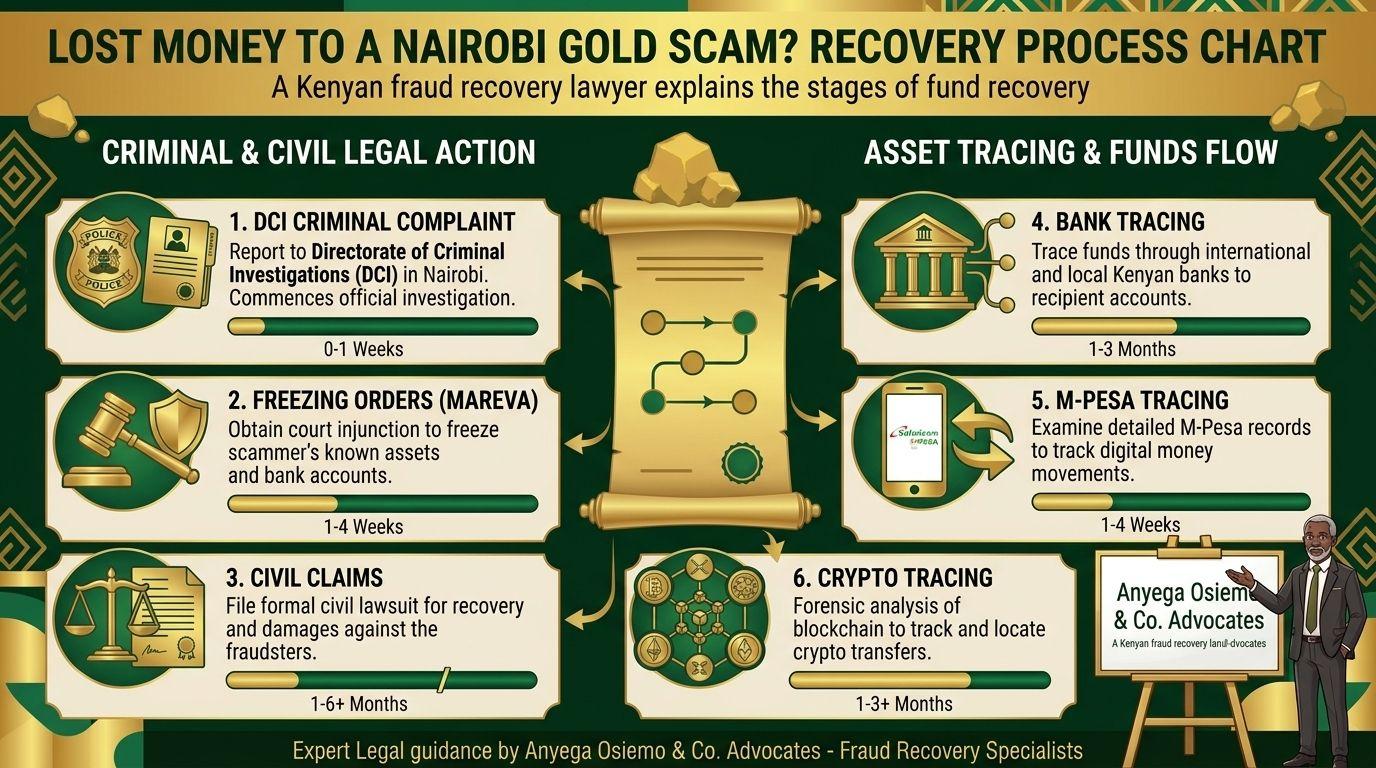
A: A rug pull is when developers deliberately drain a DeFi protocol's treasury and disappear with user funds. It is illegal under Kenyan law. It constitutes fraud, theft, and potentially cybercrime under the Computer Misuse and Cybercrimes Act. Victims should report rug pulls to the DCI and FRC, engage a lawyer to trace the funds, and file civil recovery proceedings.
Q4: Can I use arbitration for smart contract disputes?
A: Yes, if the smart contract or platform includes a valid arbitration clause. Arbitration can be faster and more flexible than court litigation, and it allows parties to choose arbitrators with technical expertise. However, the enforceability of decentralized arbitration awards in Kenyan courts is untested. Traditional institutional arbitration (under the Nairobi Centre for International Arbitration or LCIA rules) is more reliable.
Q5: What is a DAO and can it be sued?
A: A DAO (decentralized autonomous organization) is an organization governed by smart contracts and token-holder votes, with no traditional management structure. Under Kenyan law, a DAO may not have legal personality, meaning it cannot be sued directly. However, the individuals behind the DAO, the token holders who control it, or the legal entity that operates the user interface may be liable. This is a rapidly evolving area of law.
Q6: Do I need a lawyer to review a smart contract?
A: For high-value investments, yes. A lawyer with expertise in both contract law and blockchain technology can review the terms of service, assess the legal risks, and advise on dispute resolution options. For smaller investments, the cost of legal review may exceed the investment value. However, the cost of not reviewing, as the KES 5 million investor discovered, can be catastrophic.
Q7: What happens if a smart contract has a bug?
A: If a bug causes unintended losses, the developer may be liable for negligence if they failed to conduct adequate testing or audits. However, if the bug was unforeseeable and the developer made reasonable efforts to ensure security, liability may be limited. Most smart contracts include disclaimers limiting liability for bugs, but these disclaimers may not be enforceable if they are unconscionable or contrary to public policy.
Q8: Can I recover funds from a hacked DeFi protocol?
A: Recovery depends on whether the hacker can be identified, whether the funds can be traced, and whether the protocol has insurance or reserves. In some cases, white-hat hackers or protocol governance have recovered funds through negotiations or counter-exploits. In other cases, the funds are gone forever. Legal action, including freezing orders, civil suits, and criminal complaints, should be initiated immediately to maximise the prospects of recovery.
Q9: Are DeFi yields guaranteed?
A: No. DeFi yields are typically variable and depend on market conditions, liquidity demand, and protocol performance. Any protocol that guarantees a fixed yield is likely a scam or a high-risk scheme. Investors should treat promised yields as projections, not guarantees, and understand the mechanisms that generate them (lending, liquidity provision, staking, or inflationary token emissions).
Q10: How can Anyega Osiemo & Co. Advocates help with smart contract disputes?
A: We provide specialized legal services for smart contract and DeFi disputes including: contract review and risk assessment for DeFi investments; litigation for breach of contract, negligence, and fraud; arbitration and alternative dispute resolution; coordination with blockchain forensic experts; criminal complaints for hacks, exploits, and rug pulls; and advisory for DeFi developers on legal entity formation, terms of service, and compliance. We bridge the gap between traditional contract law and cutting-edge blockchain technology. Contact us for a confidential consultation.
Conclusion
Smart contracts are significantly altering the landscape of finance, law, and commerce. At the same time, they are giving rise to new categories of legal disputes that Kenyan courts, lawyers, and regulators are only beginning to address. The central issue is not whether smart contracts will become prevalent, but whether the legal system can adapt in a timely manner to safeguard the interests of the many Kenyans who are already engaging with these technologies.
For investors, the message is caution: do not assume that "code is law" or that a smart contract's automatic execution absolves the developer of liability. Conduct due diligence, understand the risks, and seek legal advice for high-value investments. For developers, the message is accountability: incorporate legal entities, conduct security audits, draft clear terms, and accept that you owe a duty of care to your users.
At Anyega Osiemo & Co. Advocates, we are committed to providing legal guidance at the intersection of smart contract technology and Kenyan law. Our expertise encompasses both the technical aspects of DeFi protocols and the legal principles governing contractual relationships. Whether you are an investor seeking recovery of lost funds, a developer aiming to mitigate legal risk, or a platform navigating regulatory requirements, we are available to assist. As the financial sector evolves through technological innovation, it is essential to ensure that your legal rights are clearly defined and protected. Please contact us for further assistance.
Disclaimer: This article is general legal information, not legal advice. For guidance on your specific situation, book a consultation with our advocates.