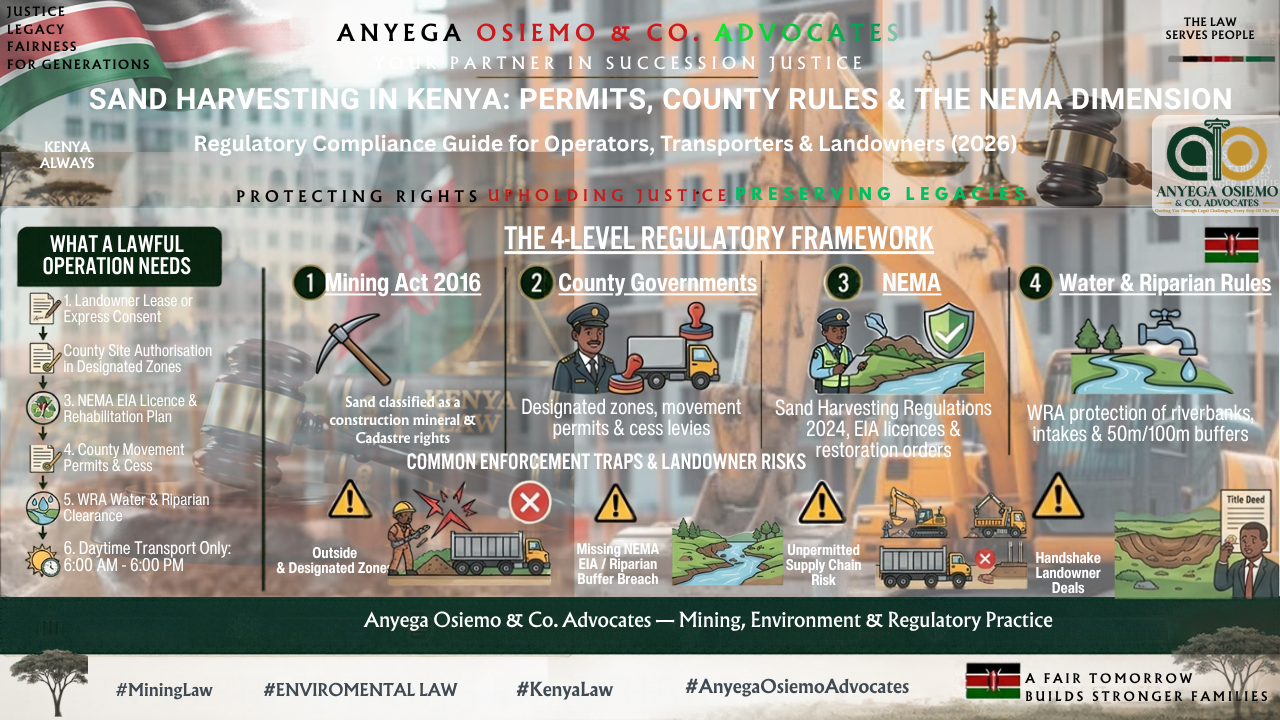
Many people do not recognise sand as a mineral. However, under Kenyan law and in commercial practice, sand is classified as a mineral. The demand created by Kenya’s construction sector has made riverbeds, farms and coastal deposits areas of legal contention. Sand harvesting is governed by mining law, county government regulation and environmental law. Many operators encounter legal difficulties because they obtain a single permit and mistakenly believe that this is sufficient compliance.
This is not the case. This article provides a comprehensive overview for operators, transporters, buyers and landowners.
Is sand actually regulated as a mineral?
Yes. Sand is included within the definition of minerals under Kenyan law and is generally treated as a construction or industrial mineral. (Mining Act, 2016 (No. 12 of 2016), n.d.) As a result, its extraction and sale are subject to the mining regulatory framework. Because sand is often extracted from rivers, riparian land and farms, county governments and environmental agencies also exercise regulatory authority. The legal regime governing sand harvesting operates at four principal levels:
- The mining framework: mineral rights and dealings fall under the Mining Act 2016 and the cadastre system;
- County governments: sand harvesting is a county-level concern under the devolved structure, and counties regulate harvesting sites, movement permits and cess (county levies on transported goods), enforced through county legislation and inspectorates;
- NEMA: environmental impact assessment requirements apply to significant extraction, and environmental offences carry real penalties;
- Water and riparian rules: riverbed harvesting implicates the water resources regulator and riparian protection rules designed to protect banks, intakes and flows. (Mining Act, 2016 (No. 12 of 2016), n.d.)
It is important to note that compliance with one regulatory level does not constitute compliance with the others. A county site authorization is distinct from an environmental impact assessment licence. An environmental impact assessment licence is not a mineral right. Landowner consent does not substitute for any of these legal requirements. (Environmental Management and Co-ordination (Sand Harvesting) Regulations, 2024, 2024)
What a lawful sand operation typically needs
The specific requirements vary by county and the scale of the operation. However, a lawful sand harvesting operation will generally require the following:
- Rights to the site: landowner consent or a lease that expressly covers extraction, and clarity on who controls the resource;
- County approvals: harvesting site authorization within designated zones, and county movement permits and cess arrangements for transporting sand;
- Environmental clearance: a NEMA assessment appropriate to the scale of extraction, with conditions on riparian buffers, depth and method of extraction, operating hours and site rehabilitation;
- Compliance with harvesting rules in practice: designated site transporters and buyers should be aware that liability extends beyond the harvester. Transporting sand without valid county documentation exposes vehicles and traders to impoundment, fines and prosecution. A construction company that sources sand from unpermitted suppliers risks enforcement action that may halt its operations. A construction company whose supply chain is unpermitted sand is one enforcement sweep away from a stalled site. (Sand Harvesting Regulations 2022, 2022)
Where operations go wrong
The patterns in enforcement are consistent:
- Harvesting outside designated sites. Counties designate harvesting zones; operating outside them is unlawful even with other paperwork in place; (Environmental Management and Co-ordination (Sand Harvesting) Regulations, 2024, 2024)
- No environmental assessment. “It’s just sand” is not a defence. Degraded rivers, collapsed banks and silted intakes attract NEMA enforcement and community lawsuits; (NEMA restores over 15 farms from illegal sand harvesting activities, 2023)
- Ignoring riparian buffers. Extraction too close to riverbanks and water infrastructure is a fast route to closure orders; (Environmental Management and Co-ordination (Sand Harvesting) Regulations, 2024, 2024)
- Buying from illegal sites. Traders and contractors sourcing from unpermitted sites inherit regulatory and reputational risks, and their supply can be cut off overnight (Environmental Management and Co-ordination (Sand Harvesting) Regulations, 2024, n.d.).
- Community conflict. Sand sites frequently sit on community or family land; extraction without genuine consent invites disputes, injunctions and criminal complaints. (Environmental Management and Co-ordination (Sand Harvesting) Regulations, 2024, n.d.)
For landowners: sand on your land
If your land has commercially attractive sand, you are holding both an asset and a liability:
- Do not let extraction start on a handshake. Insist on a written agreement covering volumes, payment (per load or per cubic metre), access routes, working hours and critically site rehabilitation, with security for performance;
- Verify the operator’s permits before signing anything. If they harvest unlawfully, the environmental damage lands on your title.
- Uncontrolled harvesting causes permanent damage to land. The resulting cratered, waterlogged pit remains the landowner's responsibility after extraction ceases. (Lemeleny & Namalwa, 2024) Written rehabilitation obligations are essential and should not be regarded as unnecessary formality.
If sand is being harvested from your land without your consent, this constitutes trespass and unlawful extraction. It is important to act promptly: document the activity with dated photographs and video, record vehicle registration numbers, report the matter to the county authorities and the police, and seek legal assistance before the damage becomes irreversible. Delay increases the risk of loss in proportion to the quantity of sand removed. (Environmental Management and Co-ordination (Sand Harvesting) Regulations, 2024, 2024).
The bigger picture: why enforcement is tightening
Sand is no longer regarded as a trivial commodity. The environmental impact of unregulated extraction, including damage to rivers, reduced water tables and compromised infrastructure, has led counties and regulatory agencies to adopt stricter zoning, documentation and enforcement measures. (Environmental Management and Co-ordination (Sand Harvesting) Regulations, 2024, 2024) Operators who comply with formal requirements at an early stage will be better positioned as enforcement becomes more stringent. Those who rely on informal arrangements face significant legal and operational risks. (Environmental Management and Co-ordination (Sand Harvesting) Regulations, 2024, 2024)
Frequently asked questions
Q1. Can I harvest sand from my own farm without permits?
A. Land ownership does not authorise commercial mineral extraction. Beyond genuinely domestic-scale use, extraction for sale requires approvals from the applicable county, environmental, and mining frameworks.
Q2. Who enforces sand rules: the county or the national government?
A. Both, in their lanes. Counties police sites, movement and cess; NEMA polices environmental compliance; the mining framework governs mineral rights. Expect to deal with all three.
Q3. What are the penalties for illegal harvesting?
A. Depending on the violation: impounding of vehicles, county fines, NEMA enforcement and restoration orders, and criminal prosecution. Repeat or large-scale illegal operations attract the most serious consequences.
Q4. I bought sand in good faith from an illegal site. Am I liable?
A. Good faith helps but does not guarantee insulation, particularly for repeat commercial buyers expected to verify their supply chain. Due diligence on suppliers is the protection.
Disclaimer: This article is general legal information, not legal advice. For guidance on your specific situation, book a consultation with our advocates.