A mining licence is not a title deed you can hand over at a closing dinner. It is a right granted by the state, held subject to statute, and transferred only through a legal process with specific consents, specific evidence, and a specific registration step that most private agreements quietly ignore.
Deals have collapsed, payments have been stranded, and buyers have discovered after paying that they own a contract for a licence rather than the licence itself. This article explains how mining licence transfers actually work in Kenya, and the traps that catch the unwary.
The Legal Framework: Consent, Evidence, Registration
The Mining Act governs transfers of mineral rights, and its core requirements are three:
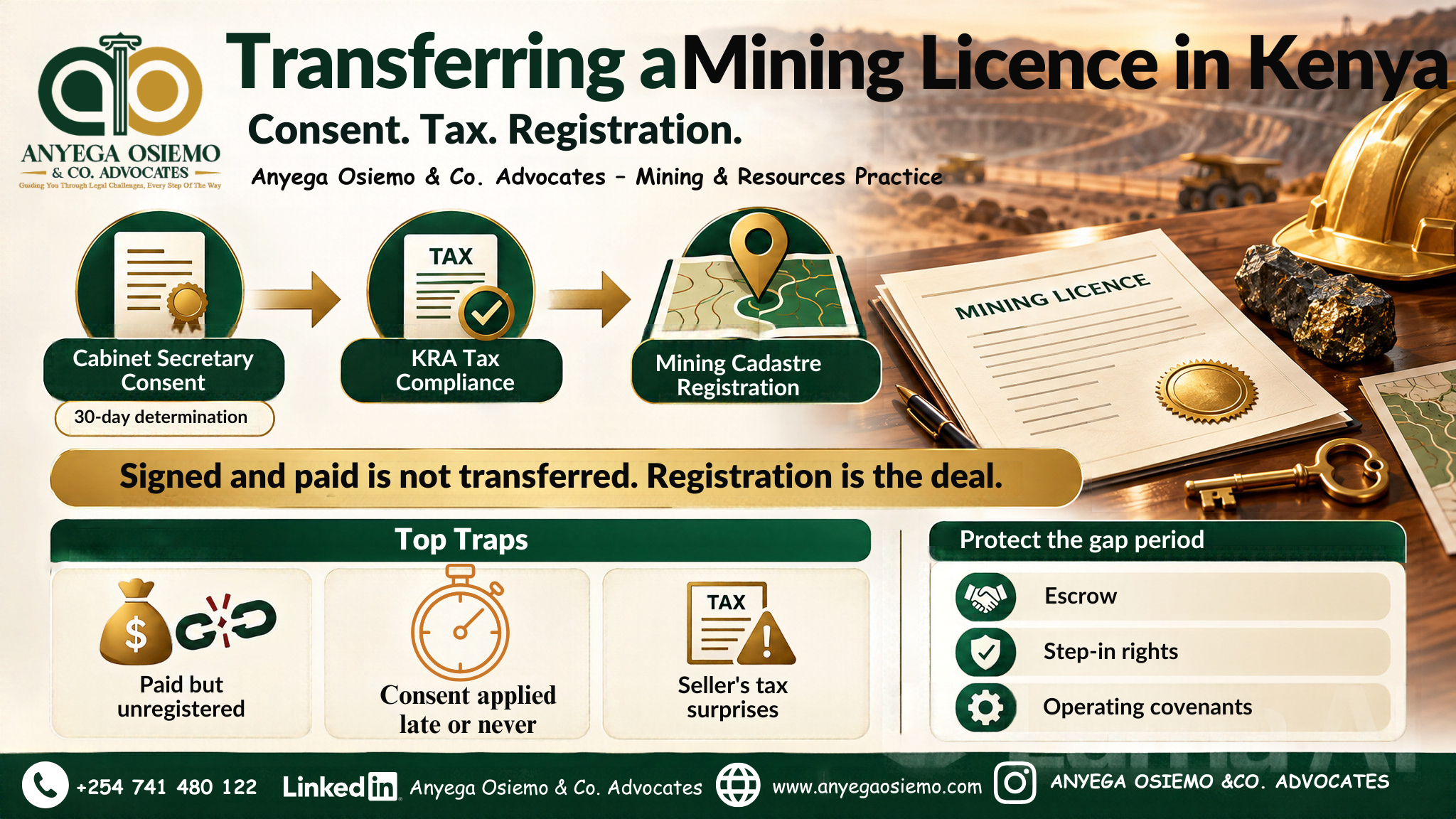
1. Consent of the Cabinet Secretary. A mineral right cannot simply be sold like an asset on a shelf. Transfer requires the consent of the Cabinet Secretary responsible for mining, applied for in proper form with the framework providing for determination of such applications within thirty days.
2. Tax compliance evidence. Registration of the transfer is conditional on the transferor producing evidence of compliance with the Kenya Revenue Authority. Practically, this means the seller's tax house must be in order, and the parties must build time into the transaction for KRA processes that neither controls.
3. Registration in the cadastre. The transfer is completed by registration of the transferee's interest in the Mining Cadastre. Until registration, the buyer has contractual rights against the seller but not the mineral right itself. This distinction is the single most dangerous misunderstanding in private mining transactions.
What This Means Transactionally
- The process must be planned, not discovered. A licence transfer transaction has a critical path: agreement, consent, application, tax evidence, registration. Each step has its own timeline and its own failure modes. Transactions structured around this path close; transactions that treat registration as post-closing housekeeping discover that "post-closing" can mean "never."
- Conditions precedent must mirror the statutory steps. The sale agreement should make consent, tax compliance, and registration express conditions, with obligations allocated for each: who applies for consent, who pursues KRA, who lodges the registration. Vague drafting here produces the classic dispute: the buyer paid, the seller "handled" the transfer, and the cadastre shows nothing.
- The gap period must be managed. Between signing and registration, the seller remains the holder of record. During this window, the buyer's interests are protected only by the contract and by whatever security and undertakings the deal provides, including step-in rights, escrow of key documents, and covenants about operation of the right. Buyers who ignore the gap operate at the seller's mercy.
- Existing obligations follow the right. Compliance status: rent, returns, work programmes, environmental conditions attach to the right and flow to the new holder. A transfer due diligence that checks title but not the compliance file is half a diligence.
The Traps, Specifically
- The paid-but-unregistered buyer. Full price paid, consent never applied for, right still in the seller's name and the seller's creditors, ex-spouses, or new partners now claim it. This is not a hypothetical; it is the standard failure mode of informal licence sales. Registration is not a formality to complete the deal; it is the deal.
- Consent applied for late or never. Some parties sign, pay, and plan to "regularise" the transfer later. The Act's consent requirement is not a technicality to be tidied up at leisure; a transfer without required consent is vulnerable to challenge, and unregistered transfers leave the buyer's position exposed indefinitely.
- Tax surprises. The KRA evidence requirement means the seller's tax history becomes a closing condition. Sellers with messy tax records discover this at the worst moment; sophisticated buyers discover it during due diligence, where it belongs.
- Partial and encumbered transfers. Transfers of partial interests, transfers of rights subject to charges or security, and transfers layered under shareholder changes each carry their own mechanics. What looks like "the same deal, slightly different" can be a completely different statutory pathway.
- The share-transfer lookalike. Buying the company that holds the licence avoids the transfer mechanics and changes everything else: all liabilities are inherited, and the reasons are analysed in our separate guide to share vs asset acquisitions. Choosing between the routes is a structuring decision, not a drafting afterthought.
Getting It Right
The clean transfers we see share a pattern: experienced counsel on both sides, a transaction timetable built around the statutory steps, conditions precedent that match the law, gap-period protections that are actually drafted, and a closing checklist that ends with not before cadaster registration confirmed.
Frequently Asked Questions
Q1. How long does a mining licence transfer take in Kenya?
A. The consent framework provides for determination within thirty days of a complete application, but realistic timelines include tax evidence processes and registration steps. Well-prepared transfers move at the speed of the process; poorly prepared ones move at the speed of their surprises.
Q2. Can I buy a mining licence without the Cabinet Secretary's consent?
A. You can sign an agreement, but you cannot complete the transfer, and until registration the right remains with the sellers. Transactions that skip consent are vulnerable and, in substance, unfinished.
Q3. What tax must be cleared before a transfer registers?
A. The framework requires evidence of the transferor's compliance with the KRA before registration. The specific processes and documents should be confirmed for your transaction with advisers who handle them routinely.
Q4. What if the seller's tax affairs are not in order?
A. This becomes a deal issue: cure before closing, hold back funds, restructure, or walk. It is precisely the kind of finding that proper due diligence surfaces early before it strands a payment.
Disclaimer: This article is general legal information, not legal advice. For guidance on your specific situation, book a consultation with our advocates.