Every mining investor in Kenya eventually meets the same clause: the state acquires a ten per cent free carried interest in large-scale mining operations without paying for it. It appears in the Mining Act, surfaces in every serious term sheet, and is routinely misunderstood by both sides of the table.
Misunderstanding it is expensive. The free carry shapes your capital structure, your dilution maths, your farm-in negotiations, and ultimately your exit value. This article explains what it actually is, what it does to your numbers, and how sophisticated investors structure around it.
What a Free Carried Interest Actually Is
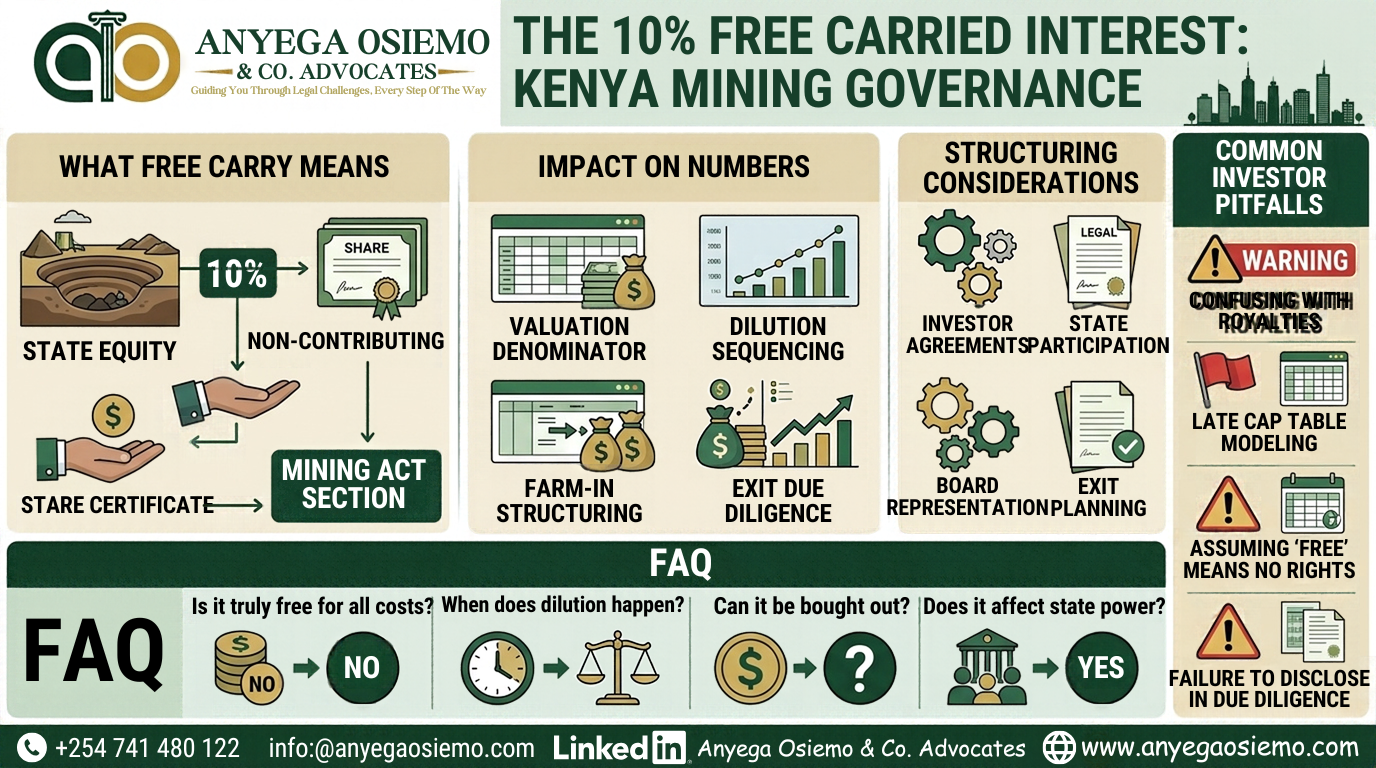
Under Kenya's Mining Act, the State acquires a ten per cent free carried interest in large-scale mining licence holders, and critically that financial contribution is not paid by the State.
Translating the legal language into commercial reality:
- The state's 10% is free. The government does not pay for it not at grant, not through exploration, not through development. The ten percent is simply allocated.
- "Carried" means carried. Through the project's capital-hungry phases drilling, feasibility, construction the state contributes nothing. Its share is carried by the investors who are actually funding the work.
- It attaches at the operation level. The interest is in the large-scale licence holder, the operating company, not in the investor's upstream holding structures (subject to how those structures are arranged, which is where planning begins).
The concept is not unique to Kenya; carried state participation is standard across African mining codes, but each jurisdiction's details differ, and the details are where value is won or lost.
What It Does to Your Numbers
- Valuation. Any serious valuation of a Kenyan large-scale asset prices the free carry in. The economic interest investors are buying is ninety per cent of the operation's economics, not a hundred and deals negotiated on the wrong denominator misprice from day one.
- Dilution sequencing. The free carry sits alongside, not instead of, your other equity arrangements. Founders, farm-in partners, and the state each take their slice from the same pie. Investors who model dilution from their own funding rounds but forget the state's 10% discover at the worst moment that the pie was smaller than they thought.
- Farm-in negotiations. When a junior brings in a major to fund development, the state carried interest is a fixed point in the negotiation. Who bears its effective cost and how the carried 10% is apportioned between the parties is a structuring question that must be answered in the farm-in documents, not left to an argument later.
- Exit. Buyers of producing or near-production assets will price the free carry explicitly. A clean, well-documented understanding of how the interest was created and how it is reflected in the holding structure materially smooths exit due diligence.
The Structuring Questions That Matter
- The free carry is a fact; what is negotiable is how its consequences flow through your structure:
- Where the operating company sits, the interest attaches to the large-scale licence holder. The shareholding, jurisdiction, and governance of that entity determine how the carried interest interacts with everything above it.
- Documentation of the grant. How the interest was legally effected at what stage, in what documents, affects later transactions. Ambiguity here surfaces at the worst times: on refinancing, on sale, on dispute.
- Relationship with other state entitlements. The state's carried interest sits alongside royalties and taxes. Sophisticated investors model the state's total take: carry plus royalty plus tax as one number, because that is what the project's economics feel.
- Change-of-control sensitivity. How does the carried interest interact if the licence holder is sold? The answer shapes deal structure and must be understood before the term sheet, not after.
Common Mistakes
- Treating it as a royalty by another name. It is equity, not a tax: it carries governance implications, information rights, and (in some frameworks) additional consequences that royalties do not.
- Modelling it late. Free-carry consequences compound through every round of funding. Structures designed around it from the start are cheaper than structures retrofitted after the cap table calcifies.
- Ignoring it in small print negotiations. Investors sometimes focus exclusively on royalty rates while the free carry quietly takes its larger share of lifetime economics.
- Assuming uniformity. "Ten percent free carry" in Kenya is not identical to the analogous provisions of every neighbouring code. Cross-border structures must be checked jurisdiction by jurisdiction.
The Bigger Picture
Kenya's carried interest is moderate by global standards, and it buys investors something real: a state that holds equity has aligned incentives, stable ground for operations, support through the bureaucracy, and skin in the project. Investors who treat the state's 10% as a partnership rather than a toll tend to navigate Kenyan mining more smoothly than those who treat it as an affront.
The free carry is a price of admission. The skill is not in resenting it; it is in structuring so that its cost is known, bounded, and priced from the first model.
Frequently Asked Questions
Q1. Does the 10% free carry apply to all mining licences in Kenya?
A. The free carried interest applies to large-scale mining operations. Smaller operations and other right categories are governed by different provisions — the application should be confirmed for your specific structure.
Q2. Can the state dilute below or be diluted below 10%?
A. The carried interest's behaviour on future issuances is a legal and drafting question that depends on how the interest was affected and how subsequent capital raises are structured. This is precisely the point where early legal advice pays for itself many times over.
Q3. Does the free carry apply to exploration-stage companies?
A. The interest attaches to large-scale mining licence holders. Whether and when it crystallises for a given corporate structure should be analysed at the structuring stage — before the licence application, not after.
Q4. Is the state's 10% in addition to royalties?
A. Yes. The carried interest coexists with royalty obligations and ordinary taxation. The state's aggregate take across all instruments is the number that matters for project economics.
Disclaimer: This article is general legal information, not legal advice. For guidance on your specific situation, book a consultation with our advocates.