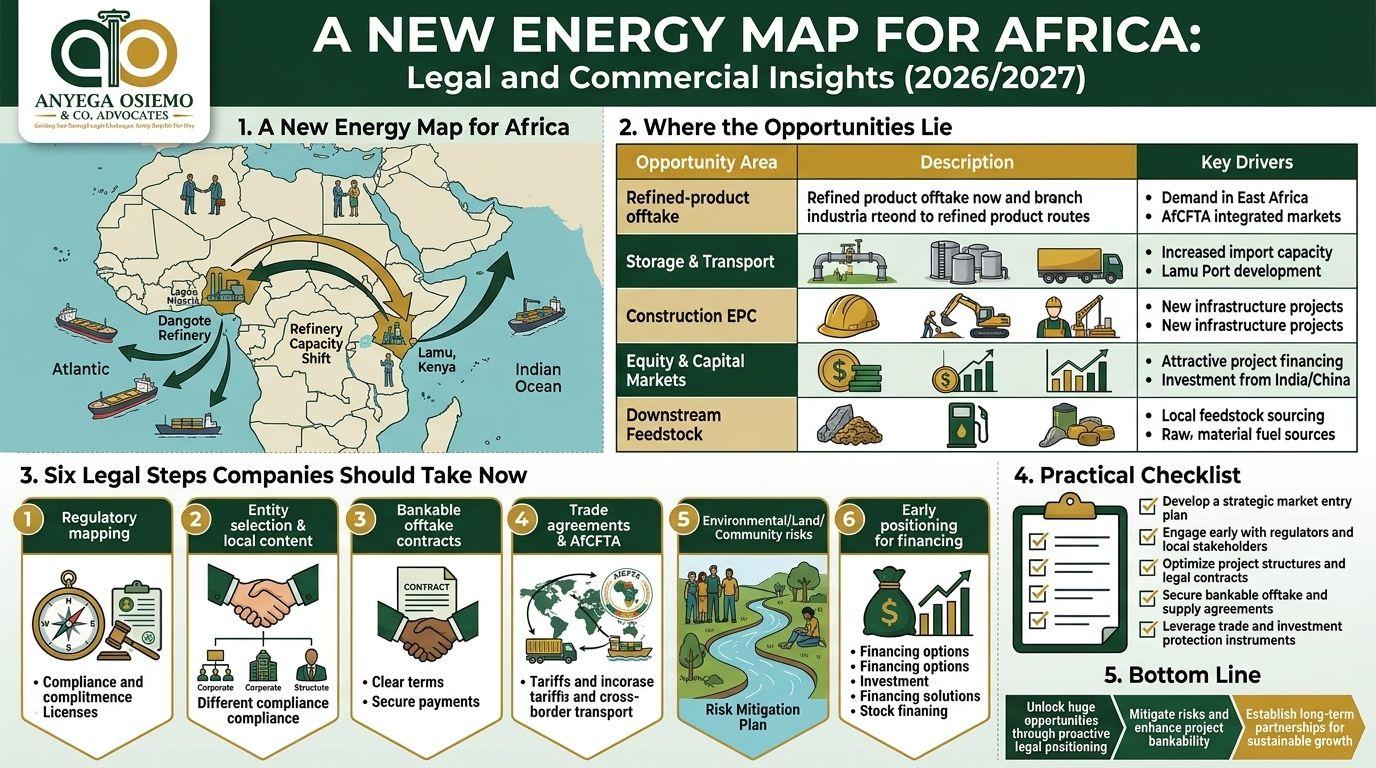
1. A new energy map for Africa
For decades, Africa's hydrocarbon sector operated under a structural inefficiency: crude oil was exported, while refined petroleum products were imported to meet domestic demand. That arrangement is now changing significantly on both the Atlantic and Indian Ocean coasts. Companies should act promptly and comply with applicable legal and regulatory frameworks to benefit materially from this transition.
On the Atlantic side, the Dangote Petroleum Refinery outside Lagos, built at a cost of roughly US$20 billion and in operation since 2024, reached its nominal capacity of 650,000 barrels per day (bpd) in early 2026 and has since pushed processing rates to about 700,000 bpd, exporting jet fuel and other products across Africa and to Europe. In September 2026, the company signed the prospectus for what is set to be the largest IPO in African history: an offer of 4.1 billion shares targeting roughly US$1.63 billion, part of a US$14.3 billion plan to double capacity to 1.4 million bpd by 2029. The refinery reported an after-tax profit of US$1.82 billion for the first half of 2026.
On the Indian Ocean coast, the Dangote East Africa Petroleum Refinery project in Lamu County, Kenya, was formally initiated on 30 September 2026, with the participation of President William Ruto, Aliko Dangote, and regional heads of state. This US$16 billion project is structured to process 700,000 barrels per day, with a targeted construction period of 40 months. The Kenyan government, acting through its National Infrastructure Fund, has entered into a framework agreement with Dangote Group, and a future initial public offering is anticipated to allow public participation. Subsequently, Dangote Group acquired a 25% equity interest in Kenya Pipeline Company, joining the Kenyan government and Uganda's national oil company as shareholders in a key regional logistics asset. Taken together, these developments present significant commercial opportunities for market participants across the value chain. However, access to these opportunities is strictly governed by legal and regulatory requirements. Against that backdrop, the following analysis identifies the principal opportunity areas and outlines six legal steps that will determine which entities are able to participate effectively.
2. Where the opportunities lie
The expansion of refinery capacity generates opportunities that extend beyond the downstream retail sector. To show where those opportunities lie, the following table sets out the main areas of commercial potential and the corresponding legal considerations for each.
Opportunity area
Who it suits
Key legal considerations
Refined-product offtake and trading
Oil marketing companies, commodity traders, airlines, industrial consumers
Supply and offtake contracts, quality specifications, pricing benchmarks, letters of credit, import and wholesale licensing, customs
Storage, transport and logistics
Terminal and depot operators, fleet owners, shipping and pipeline investors
EPRA licensing (Kenya) and NMDPRA licensing (Nigeria), safety and environmental permits, throughput and access agreements, port and cabotage rules
Construction and engineering of the Lamu project
EPC contractors, subcontractors, materials suppliers, professional and technical services
Public procurement and PPP frameworks, FIDIC-based construction contracts, local employment and training commitments, performance security
Equity and capital markets
Institutional and retail investors, pension funds, development finance institutions
Securities regulation and prospectus requirements, foreign investor eligibility, disclosure and insider-trading rules
Downstream industry and feedstock users
Fertiliser, petrochemical, plastics and manufacturing businesses
Long-term feedstock offtake security, competition law, industrial licensing, special economic zone incentives
3. Six legal steps companies should take now
3.1 Map the regulatory terrain before committing capital
Petroleum is among the most heavily licensed sectors in every African jurisdiction. Accordingly, companies should map the regulatory terrain before committing capital. In Nigeria, midstream and downstream activities are governed by the Petroleum Industry Act 2021 and licensed by the Nigerian Midstream and Downstream Petroleum Regulatory Authority (NMDPRA). In Kenya, the Energy Act 2019 empowers the Energy and Petroleum Regulatory Authority (EPRA) to license the import, export, storage, transport and wholesale of petroleum products, alongside product-quality standards enforced by the Kenya Bureau of Standards. A company lifting product in Lagos for sale in East Africa faces at least two regulatory systems and two customs regimes and, once Lamu is commissioned, a third supply option with its own rules. This makes early regulatory mapping essential, and a regulatory mapping memorandum, prepared before term sheets are signed, is the cheapest risk money a company will spend on this opportunity.
3.2 Choose the right vehicle and the right partners
Market-entry structure drives tax, liability and licensing outcomes. Accordingly, companies should choose the right vehicle and the right partners early. Key questions include whether to incorporate locally or register a branch; whether a joint venture with an established local distributor accelerates licensing and market access; and how local-content rules apply in Nigeria's Oil and Gas Industry Content Development Act 2010 for petroleum services, and Kenya's strong policy emphasis on local participation, which the Lamu project has made explicit through commitments to local training and to channelling work to Kenyan businesses in transport, logistics, construction materials and professional services. These choices should be considered together, and tax residence, double-taxation treaties and special economic zone incentives (the Lagos refinery sits in the Lekki Free Zone; Lamu anchors the LAPSSET corridor's planned zones) should all be modelled before contracts are priced.
3.3 Negotiate bankable offtake and supply contracts
The supply agreement is where value is won or lost. Accordingly, companies should negotiate bankable offtake and supply contracts. They should pay particular attention to product specification and independent inspection clauses (EN 590 diesel, Jet A-1 and equivalents); quantity tolerances and demurrage; delivery terms FOB Lekki and CIF Mombasa allocate freight, insurance and risk very differently; pricing linked to recognized benchmarks with clear premium and discount mechanics; and payment security through letters of credit, escrow or advance-payment guarantees. Foreign-exchange risk deserves express treatment where revenues arise in local currency. Finally, companies must draft force majeure and hardship clauses, not copy them: the Middle East and Ukraine supply disruptions that boosted the refinery's export revenues in 2026 are a live demonstration of how quickly trade flows can shift. They should also treat dispute-resolution clauses with equal care; international arbitration (for example under ICC, LCIA or Nairobi Centre for International Arbitration rules) with a neutral seat is often the only enforcement-realistic option for cross-border energy contracts. These contract points should be read as one package, not isolated terms.
3.4 Use trade agreements and investment protection deliberately
The African Continental Free Trade Area can materially change the economics of moving refined products across borders. Accordingly, companies should use trade agreements and investment protection deliberately. Still, preferential tariffs apply only where the AfCFTA rules of origin are met and correctly certified, and those rules are technical for petroleum products. Investors should map their protection before investing: the AfCFTA Protocol on Investment, applicable bilateral investment treaties, and political-risk insurance from providers such as MIGA or the African Trade and Investment Development Insurance (ATIDI) can be decisive to both project bankability and board approval. Taken together, these tools should be assessed before capital is committed.
3.5 Treat environmental, land and community risk as deal-critical
Lamu itself supplies the cautionary precedent: in 2019, Kenya's National Environment Tribunal revoked the environmental licence for the proposed Lamu coal power plant, citing a deficient impact assessment and inadequate public consultation. Major projects in the county remain socially sensitive. Accordingly, companies should treat environmental, land and community risk as deal-critical. Lamu residents have already voiced concerns about consultation on the refinery, and President Ruto responded publicly at the ground-breaking with commitments that land will be handled lawfully and that environmental and social impacts will be rigorously assessed and enforced. Companies contracting with or investing in the project should commission their own environmental, land-title and community-engagement due diligence rather than relying on the sponsor's; lenders will apply standards such as the IFC Performance Standards, and today's consultation record is tomorrow's litigation evidence. That makes this risk a central issue, not a peripheral one.
3.6 Position early for financing and capital-market events
The current phase of infrastructure development is taking place within the context of public capital markets. Accordingly, companies should position early for financing and capital-market events. The Lagos refinery's initial public offering was open for subscription from mid-September to mid-October 2026, with trading scheduled to commence in late November. Kenya Pipeline Company was listed in 2026 following the government's divestiture of a 65% stake, marking its first significant share sale in two decades. An initial public offering for the Lamu project has also been announced. Prospective investors should assess prospectus eligibility, foreign investment regulations and custody arrangements at an early stage. Lenders and contractors should pay particular attention to the structuring of security packages, intercreditor arrangements and payment protection mechanisms, as these provisions will determine the allocation of proceeds in the event of project delays. These financing steps should be planned alongside the broader market-entry strategy.
4. A practical checklist
For management teams evaluating entry, we recommend the following sequence:
- Commission a regulatory mapping memorandum for each target market Nigeria, Kenya, and every destination market before signing anything.
- Confirm licensing requirements and approval timelines with the relevant regulators (NMDPRA in Nigeria, EPRA in Kenya) and build them into the deal timetable.
- Set the structure early: entity form, tax residence, local partners and special economic zone incentives should be decided before contracts are negotiated, not after.
- Insist on payment security, and on tested force majeure and hardship clauses, in every offtake or supply agreement.
- Verify AfCFTA rules-of-origin treatment before pricing any cross-border movement of refined products.
- Run independent environmental, land-title and community-engagement due diligence on any project-linked investment or contract.
- Obtain political-risk insurance quotes early; insurer capacity can tighten as a project becomes headline news.
- Engage counsel in each jurisdiction, coordinated through a single lead adviser so that positions stay consistent across borders.
5. The bottom line
The Dangote projects represent an accelerated transformation of Africa's energy infrastructure, delivering tangible benefits in terms of supply security, construction and service opportunities, investable equity, and expanded trade corridors. However, in a sector characterized by extensive regulation, success will accrue not merely to those who act quickly, but to those who ensure comprehensive legal and regulatory compliance. Entities that undertake thorough regulatory mapping, adopt deliberate structuring, negotiate robust contractual arrangements, and address environmental and community obligations will be best positioned to sustain their participation as these projects come online.
How Anyega Osiemo Advocates can help
Our Energy, Projects and Infrastructure practice provides comprehensive legal advisory services to both local and international clients in matters relating to petroleum regulation and licensing, cross-border supply and offtake agreements, project structuring and financing, public-private partnerships, environmental compliance, land due diligence, and dispute resolution within East Africa. Where a client is considering participation in opportunities associated with the Dangote refinery programme in Kenya, Nigeria, or the broader region, we are available to provide guidance on the legal and regulatory frameworks applicable to such engagements.
Disclaimer: This article is general legal information, not legal advice. For guidance on your specific situation, book a consultation with our advocates.