A common challenge faced by companies arises when a director, who may also be a co-founder or relative, begins to act in a manner inconsistent with their fiduciary duties. This may include unauthorised transfers of company funds, awarding contracts to entities in which they have an undisclosed interest, or failing to maintain proper records. In such circumstances, it is important to note that under Kenyan law, a director cannot be removed in the same manner as an employee. Specific statutory procedures govern the removal of a director.
However, the Companies Act, 2015 sets out a clear legal framework for the lawful removal of a director. If the prescribed procedures are followed, removal can be effected within a relatively short period, and there are mechanisms for recovering company assets or funds misappropriated by the director. This guide outlines the statutory process, including preliminary protective measures, the mechanics of removal, responses to director opposition, and available remedies for recovery.
Definition and Legal Implications of Director Misconduct
Kenyan law distinguishes between several categories of director conduct, each of which attracts a distinct legal remedy:
- ·Incapacity or honest disagreement handled by negotiation or board restructuring.
- ·Breach of duty, negligence, conflicts of interest, exceeding authority: remedied by removal, ratification, or claims.
- Fraud and asset-stripping theft, forgery, diversion of corporate assets: criminal conduct running in parallel with everything below, and requiring the fastest possible protective steps.
The Companies Act codifies the duties of directors, including the obligation to act within their powers, to promote the success of the company, to exercise independent judgment, to avoid conflicts of interest, and to account for any benefits received. Where a director breaches these duties, shareholders are entitled to take a series of steps: first, to secure the company's assets and records; second, to initiate removal proceedings; and third, to pursue recovery of any losses sustained.
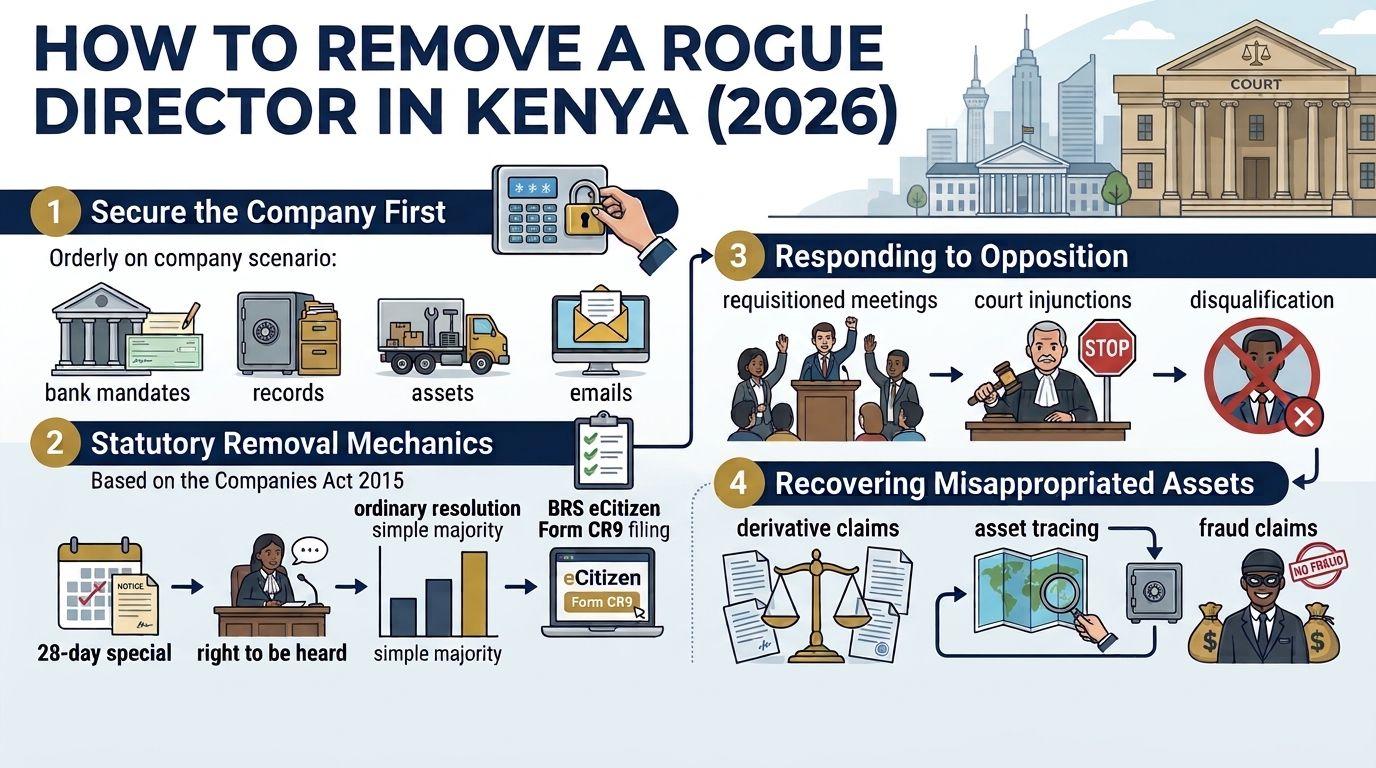
Step 1: Secure the Company First
Prior to initiating any removal proceedings, it is essential to safeguard the company's assets and interests that may be at risk of dissipation or interference by the director in question.
- Bank mandates: review signatories; where the articles and board allow, add controls (dual signatories) and where the director acts to strip mandates unilaterally, treat that as evidence and urgency.
- ·Records: secure (lawfully) the statutory books, financial records and company stamp usually held by the company secretary.
- ·Assets: inventory high-value movables; where diversion is threatened, an injunction restraining disposals can be obtained urgently.
- ·Communications: preserve emails and accounting data before access is lost.
These protective measures do not require the director's cooperation and should be implemented prior to any notification or indication that removal proceedings are contemplated.
Step 2: The Removal Mechanics
The Companies Act provides the standard route: shareholders may remove a director before the end of their term, by an ordinary resolution, with special notice of the resolution given to the company, which must then forward it to the director, who has the right to be heard, to circulate representations, and to be heard at the meeting. Key practical points:
- Ordinary resolution: means a simple majority of votes cast; no supermajority is required unless your articles say otherwise.
- The director's right to be heard is a procedural safeguard and does not confer a right to prevent removal. The meeting must allow the director to make representations, after which the shareholders may proceed to vote on the resolution.
- Check the articles: some constitutions add removal conditions for managing directors or founder-directors; others are drafted to entrench. The articles set the floor, not the ceiling, of difficulty, but you must read them first.
- Service contracts: The removal of a director does not extinguish any employment rights or claims that may have accrued under a service contract. Such claims should be considered as part of the overall decision-making process, but they do not generally preclude removal.
- ·The meeting must be properly requisitioned, convened with adequate notice, and accurately minuted. Failure to adhere to procedural requirements may provide grounds for the director to challenge the removal.
Where shareholding or articles make the shareholder route impractical, alternatives exist: negotiated resignation (often bought), court orders restraining conduct, disquote 3: Responding to Director Opposition dispute-resolution tools described in our business-divorce guide.
Step 3: When the Director Fights and They Will
Directors subject to removal proceedings may resist through various means, including refusal to convene meetings, seeking injunctions on grounds of oppression, asserting derivative or employment claims, or exerting external pressure. The appropriate response is to maintain strict procedural compliance and act expeditiously.
- Requisitioned meetings: shareholders with the statutory minimum can requisition a meeting the board refuses to call, and the court can order one where the company resists.
- Injunctions against the director restraining asset dealings, transactions with their own companies, and interference with records obtainable on an urgent basis.
- Disqualification: directors guilty of fraud, breach of duty or insolvency misconduct can be disqualified by the court from acting as directors, a remedy worth invoking against serial offenders.
- Criminal complaints where conduct crosses into theft, forgery or fraud: pressure and accountability, sequenced with the civil strategy by counsel.
Step 4: Recover What Was Taken
While removal of the director addresses ongoing risk, it is also necessary to pursue recovery of any losses sustained by the company. The available legal remedies include:
- Derivative claims: shareholders, with the court's permission, sue the director in the company's name for breach of duty, recovering diverted funds, secret profits and losses caused. The recovery belongs to the company, where the shareholders' value lies.
- Accounting and tracing: court orders compelling accounts of profits and tracing of assets into land, vehicles and companies.
- Fraud claims in the company's name or, where the fraud touched shareholders directly, personal claims.
- Insolvency remedies where the company's position has been prejudiced, including, in serious cases, winding-up proceedings that expose the director's dealings to liquidator scrutiny.
The success of recovery actions depends significantly on the quality of documentation preserved during the initial protective measures, including bank records, contracts, and correspondence, which form the evidentiary basis for derivative claims.
Prevention: Drafting Articles and Shareholder Agreements to Mitigate Director Misconduct
Many instances of director misconduct can be traced to deficiencies in the company's constitution or shareholder agreements, which may lack adequate provisions to address conflicts or for removal. Key provisions include requirements for shareholder approval of major transactions, conflict-of-interest rules mandating disclosure and abstention, clear director removal procedures, audit and information rights, and mechanisms for resolving deadlocks. Proper drafting of these documents is a cost-effective preventive measure.
Consider the following example: In a family-owned trading company with three siblings as directors, the managing director is found to have authorized payments to a company in which he has an undisclosed interest and diverted stock to a warehouse leased to his spouse. The appropriate response involves reviewing and amending bank mandates, securing company records, issuing special notice of a removal resolution, and conducting a properly convened meeting at which the director is heard and removed by ordinary resolution. Subsequent legal proceedings for wrongful removal are dismissed due to proper documentation, and derivative claims result in recovery of misappropriated assets. The company is able to resolve the matter efficiently by adhering to statutory procedures. Process was followed, and speed was preserved.
Ten Mistakes in Removing a Director
1. Removing without the special-notice process: procedurally void removals create the rogue's best counterclaim.
2. No securing of the company: first removed directors with live bank mandates can do more damage in a week than in their whole tenure.
3. Conveningsloppy meetings: bad notice, bad minutes, bad resolutions: appeal ground after appeal ground.
4. Ignoringthe articles: founder-entrenchment clauses bite only those who never read them.
5. Confusing removal with dismissal: employment claims survive removal; price them, don't be surprised by them.
6. Skipping the hearing right: the director must be heard; deny it, and you hand them the procedural win.
7. It is important to note that if a derivative claim is removed without first securing recovery, the misappropriated assets remain unrecovered by the company.
8. Any delay in taking action allows further dissipation of company assets, so prompt steps are essential.
9. If it becomes necessary to obtainrecords from a director personally, this must be done through the company secretary and by following lawful procedures. Resorting to self-help or force is not permitted.
10. Once removal has occurred, it cannot be undone retrospectively. The articles of association may be re-drafted to promote future harmony among shareholders.
Frequently Asked Questions
Q1. Can shareholders remove a director without cause?
A. Yes. The statutory power requires only an ordinary resolution and the special-notice process; no proof of misconduct is needed, though cause usually exists and helps.
Q2. How much notice does a director get?
A. Special notice to the company (typically 28 days before the meeting), with the company forwarding it to the director, who may make written representations and be heard at the meeting.
Q3. What if the director refuses to call the meeting?
A. Shareholders with the statutory threshold can requisition one; the company must convene it, and the court can compel where it refuses.
Q4. Can the articles prevent removal?
A. They can add conditions for certain offices, but they cannot abolish the statutory power entirely; entrenched provisions need careful analysis before you act.
Q5. What happens to the director's shares?
A. Nothing automatically; removal is from office, not ownership. Share transfers follow the articles, shareholder agreements or negotiated buy-outs.
Q6. Can a removed director sue?
A. For employment-related claims under a service contract, yes, within limits; for the removal itself, only on procedural grounds, which is why process discipline matters so much.
Q7. How do we recover money the director stole?
A. Recovery may be pursued through derivative claims brought in the company's name, as well as accounting and tracing orders. Fraud claims may also be available, and in serious cases, criminal proceedings can be initiated, with findings that may support subsequent civil recovery.
Q8. What if the director is also the majority shareholder?
A. Where the director in question is also the majority shareholder, the usual voting remedies are unavailable. In such cases, shareholders may need to consider unfair-prejudice petitions, derivative claims, or seek a negotiated exit. For further guidance, refer to our business-divorce guide.
Q9. Does removal affect third-party contracts?
A. Bank mandates and signing authorities must be updated with institutions; counterparties should be notified properly to avoid the removed director purporting to bind the company.
Q10. How long does removal take?
A. From decision to vote: a few weeks, governed by notice periods. Emergency injunctions where assets are moving: days. Recovery: months to years depending on the tracing.
Disclaimer: This article is general legal information, not legal advice. For guidance on your specific situation, book a consultation with our advocates.