For many individuals and small businesses, their initial encounter with the legal system arises from unpaid invoices, defaulted loans, or unreturned informal loans. Frequently, this occurs with two common misconceptions: first, that instituting legal proceedings is the immediate solution, and second, that obtaining a court judgment guarantees recovery of the debt. In reality, a debtor who lacks the means to pay cannot be compelled to do so, regardless of the judgment obtained. Conversely, a debtor who possesses assets but refuses to pay presents an opportunity for recovery, provided the process is executed correctly. It is important to note that a judgment obtained without due diligence may amount to little more than a costly document.
This guide outlines the debt recovery process in Kenya as it is approached by legal practitioners: beginning with an assessment of collectability, followed by the application of appropriate pressure, proceeding to litigation where necessary, and culminating in execution. At each stage, the relevant costs, timelines, and legal instruments are considered.
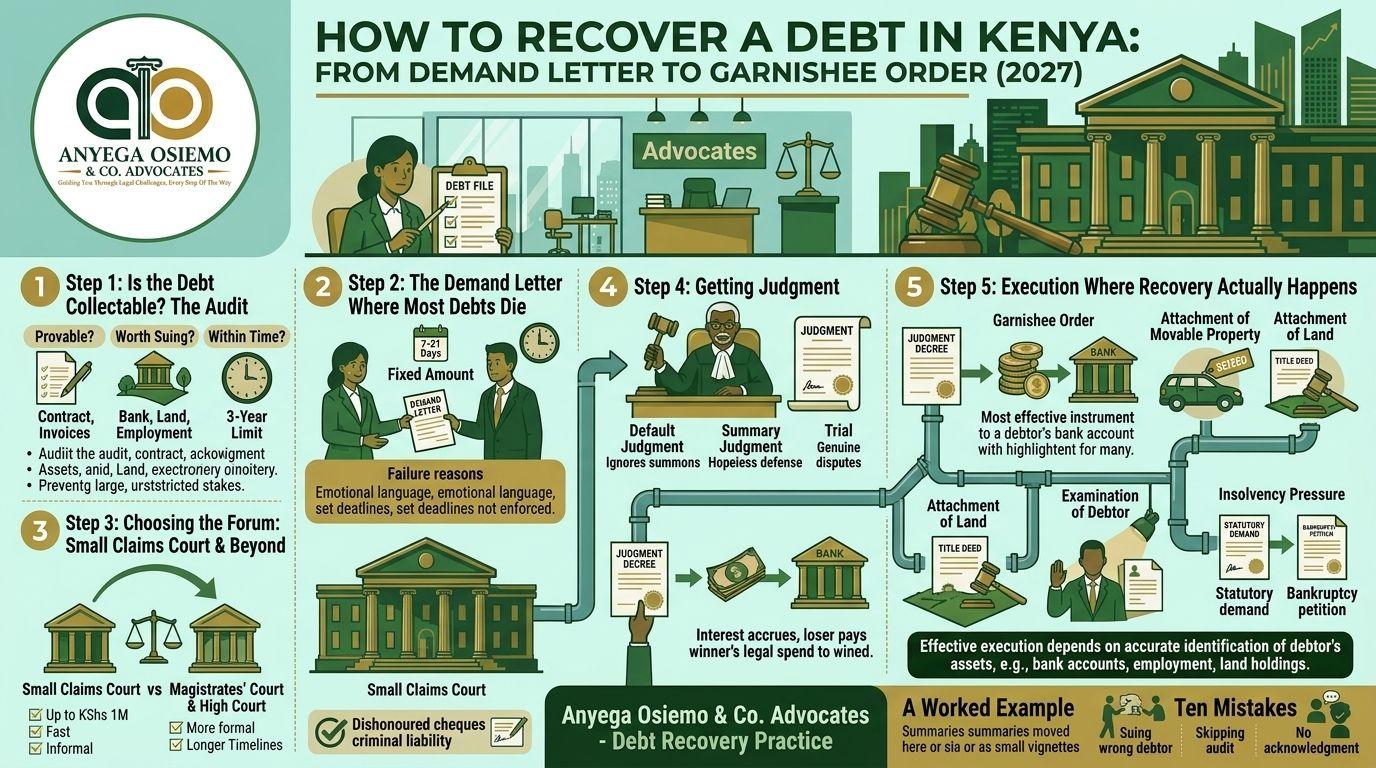
Step 1: Is the Debt Collectable? The Audit Before the Battle
Before spending a shilling on recovery, answer three questions:
- Is the debt real and provable? Contract, invoices, delivery notes, statements, acknowledgments in writing or email. Oral debts are recoverable but harder; a written acknowledgment of debt, even a WhatsApp message conceding the amount, transforms the file.
- Is the debtor worth suing? Employed? Banking? Owning land, vehicles, a business? Judgments are enforced against assets and income, not against character. A judgment against a genuinely asset-less debtor is a trophy.
- Is the debt within time? Contractual claims generally carry a three-year limitation period. Debts older than that need limitation analysis, and sometimes a fresh acknowledgment, which restarts the clock, is the first objective.
Step 2: The Demand Letter Where Most Debts Die
A well-drafted letter of demand from advocates resolves the majority of commercial debts without proceedings. It does four jobs: it fixes the amount and its basis, gives a defined deadline (commonly 7 to 21 days), states the consequences precisely (legal action, costs, interest), and critically often produces a written response: acknowledgment, proposal, or dispute. Each response is evidence; a proposed payment plan documented properly becomes a new, stronger debt instrument.
Non-professional demand letters often fail for predictable reasons: they may substitute emotional language for precise figures, set deadlines that are not enforced, or make threats that are not intended to be acted upon. In contrast, a professionally drafted letter is concise, supported by documentation, and followed by consistent action. Failure to enforce a stated deadline undermines the credibility of future demands.
Step 3: Choosing the Forum: Small Claims Court and Beyond
Kenya's Small Claims Court, operational since 2020, handles civil claims up to KShs 1,000,000 on a fast-track informal procedure, documentary focus, and a statutory design aimed at determination within weeks. For unpaid invoices, loans and deposits within the limit, it is usually the right venue: cheap, quick, and forgiving of litigants without counsel.
For claims exceeding the Small Claims Court limit, proceedings are instituted in the Magistrates' Courts (subject to their statutory jurisdiction) or in the High Court. These forums require more formal pleadings, involve discovery, and are associated with longer timelines. The selection of the appropriate forum is critical, as it directly impacts the cost, speed, and likelihood of recovery. Pursuing a KShs 900,000 claim in an inappropriate court may negate the advantages otherwise available.
Where the debt arises from a dishonoured cheque, there is additional potential for criminal liability under the Bills of Exchange Act. The sequencing of civil and criminal proceedings in such circumstances should be discussed with legal counsel.
Step 4: Getting Judgment
The litigation itself commonly resolves by one of three routes:
- Default judgment: the debtor ignores the summons; judgment enters on your documents. Faster than expected, and enforceable but only as good as your proof of service and your pleadings.
- Summary judgment: where the defence is hopeless on the documents, you can apply to skip trial entirely. The right application against a manufactured defence ends matters in months, not years.
- Trial: where genuine disputes exist, performance, quality, set-off, the claim proceeds through hearing. Well-prepared documentary cases win here too; poorly prepared ones discover what "he who alleges must prove" costs.
Through all three: interest accrues, and the court's eventual award of costs follows the event the loser pays a substantial share of the winner's legal spend, which belongs in every settlement calculation.
Step 5: Execution Where Recovery Actually Happens
A decree in hand, the enforcement menu opens:
- Garnishee orders: the court orders the debtor's bank to pay you from the account. For employed and banking debtors, this is often the single most effective instrument; multiple garnishees against known banks cost little and hit hard.
- Attachment and sale of movable property seized and auctioned: vehicles, equipment, stock.
- Attachment of land: the debtor's property is attached in the register and sold by public auction. Slow but potent against landed debtors.
- Attachment of earnings for employed debtors, periodic deductions from salary toward the decree.
- Examination of the debtor: court-ordered disclosure of assets under oath; concealment is contempt, and the disclosed assets become the execution map.
- Insolvency pressure: a statutory demand under the Insolvency Act, unmet, grounds bankruptcy (individuals) or winding-up (companies) petitions. For debtors with reputations, credit lines or contracts that would die with insolvency, the petition is frequently the moment the money appears.
Effective execution depends on accurate identification of the debtor's assets, such as bank accounts, employment, or land holdings. The success of recovery efforts is determined more by the thoroughness of asset tracing than by the quality of legal argument.
A Worked Example: The Supplier's Twelve Invoices
Consider the following illustrative scenario: A food distributor is owed KShs 840,000 on twelve unpaid invoices by a restaurant group that has ceased substantive communication, offering only delays and assurances through intermediaries. The distributor's documentation includes signed supply agreements, delivery notes countersigned by the restaurant's manager, and a comprehensive statement of account. The initial step involves issuing a fourteen-day demand letter. The debtor proposes to settle for KShs 200,000, which is declined, and a formal repayment plan for the full amount plus interest is proposed and signed. The debtor defaults within two months. The written acknowledgment strengthens the distributor's position, who then files a claim in the Small Claims Court. The debtor mounts a weak defence based on alleged quality issues, contradicted by the documentary evidence. Judgment is obtained within four months, inclusive of costs. When the debtor fails to comply with the decree, a garnishee order against the group's bank account yields partial recovery, and subsequent examination of the director reveals additional assets, resulting in full recovery of the principal, interest, and costs within a year. The distributor's legal expenditure is a small fraction of the claim. In contrast, a non-professional approach might have resulted in acceptance of the initial settlement offer and a financial loss; the professional approach secures full recovery and deters future default.
Ten Mistakes Creditors Make in Debt Recovery
1. Suing the wrong debtor: the individual instead of the company, the company instead of its guarantor.
2. Skipping the collectability audit: judgment against the asset-less is charity.
3. Letting limitation run: three years pass faster than hope.
4. Demanding without following through: empty deadlines train debtors to wait.
5. No written acknowledgment: a signed acknowledgment of debt is worth more than a year of excuses.
6. Wrong forum: fighting a KShs 900,000 claim like a High Court epic.
7. Ignoring interest and costs: they are recoverable, and they pressure settlement.
8. Weak service of process: judgment entered on defective service invites setting aside.
9. Stopping at judgment: the decree is the midpoint, not the finish.
10. No execution intelligence: garnishing the bank the debtor no longer uses, attaching the vehicle they already sold.
Frequently Asked Questions
Q1. How long does debt recovery take in Kenya?
A. Demand letters: days to weeks. Small Claims Court: often two to four months. Mainstream courts: a year or more. Execution: weeks to months depending on the assets — full timelines run from a quarter to two years.
Q2. What does it cost to sue for a debt?
A. Court fees scaled to the claim, advocate fees (agreed in writing), service and execution fees. The loser pays a substantial share of costs, and interest accrues on judgment debts.
Q3. Can I claim interest on an unpaid debt?
A. Yes, contractual interest per the agreement, or court-awarded interest from filing and on the judgment, at court rates.
Q4. What is the Small Claims Court limit?
A. KShs 1,000,000. It's fast, inexpensive and document-driven the default venue for qualifying commercial debts.
Q5. The debtor has no assets. Now what?
A. Examine them under oath to confirm; consider insolvency proceedings where debts are substantial; and evaluate payment plans secured by guarantors; a signed acknowledgment with a guarantor is new security.
Q6. Can I recover from a company that has stopped trading?
A. Winding-up on a statutory demand can reach the company's remaining assets and, in cases of misconduct, its directors, but abandoned shells yield little; asset tracing beforehand tells you whether the effort pays.
Q7. What if the debtor claims the goods were defective?
A. That is a genuine defence to prepare for: countersigned delivery notes, inspection records and correspondence decide it. Prevention documentation at delivery wins these cases before they're filed.
Q8. Does a bounced cheque help my case?
A. Yes, criminal exposure under the cheque’s regime is real pressure, sequenced with the civil claim by counsel.
Q9. Can I recover debts from someone abroad?
A. Where the debtor or their assets are located outside Kenya, enforcement of a Kenyan judgment is subject to the recognition and enforcement procedures of the foreign jurisdiction. The effectiveness of a Kenyan judgment abroad will depend on the laws and practices of the destination country. It is advisable to seek legal advice in the relevant jurisdiction before taking any steps to enforce the judgment.
Q10. When should I write off a debt instead?
A. A debt should be written off when a thorough assessment indicates that recovery is unlikely. This may be the case where the debtor has no assets, the claim is time-barred, or the anticipated recovery is outweighed by the costs of enforcement. The decision to write off a debt is a business judgment that should be based on objective evidence rather than emotion.
Disclaimer: This article is general legal information, not legal advice. For guidance on your specific situation, book a consultation with our advocates.