The Entry Sequence, Step by Step Across Kenya's gold belt: Migori, Kakamega, Siaya, Vihiga, and beyond, tens of thousands of people make their living from artisanal and small-scale mining. Most of them operate informally: no permit, no protection, no access to the formal market, and constant exposure to harassment, extortion, and the criminal networks that wash through the informal gold trade.
Kenyan law provides a pathway out of informality: the artisanal mining permit, the small-scale mining permit, and the group structures that make them work. This article explains how legalization works and how to pursue it without losing the site that feeds your family.
Why Informality Is a Trap
The informal miner faces a stacked deck:
- No legal protection for the site. The ground you work today can be claimed by anyone with a license tomorrow and formal rights, once granted to another, generally trump years of informal digging.
- Exploitative pricing. Informal gold is sold at deep discounts to intermediaries because informal sellers cannot access formal buyers, banks, or dealers.
- Criminal exposure. Unlicensed mining is an offense, and informal miners are the easiest targets in the enforcement chain while the criminal networks that buy their gold at gunpoint prices operate above them.
- No standing. Informal miners cannot sign supply contracts, open formal trading relationships, or complain to authorities without exposing themselves.
Informality feels like freedom; it functions as a form of dependency.
The Legal Pathways
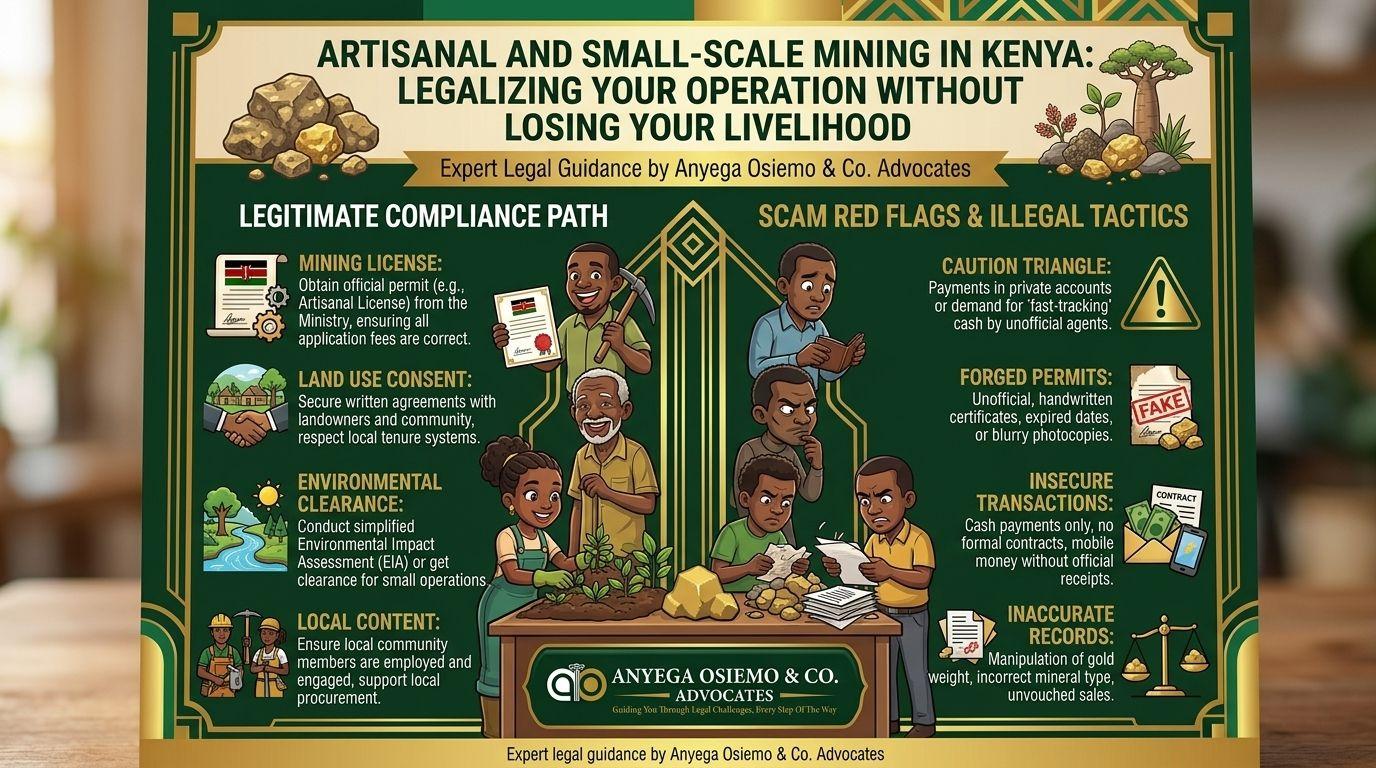
The artisanal mining permits. The entry tier for individuals and small groups, administered through local Artisanal Miners' Committees under the Ministry's framework. It is designed to be accessible at modest costs, with local administration and requirements proportionate to the scale of work. For the individual miner or small family group, this is the front door.
The small-scale mining permits. A step up: for operations with more substantial workings, equipment, and production, the tier at which much of western Kenya's gold economy actually operates. Higher thresholds, more documentation, but access to the full formal trade.
Group structures. Kenya's framework contemplates organized artisanal mining through groups and co-operatives. For miners, grouping is not just paperwork; it is how small operators pool the resources, documentation, and bargaining power that individual miners lack. A co-operative buys equipment, negotiates prices, engages authorities, and holds rights that individuals cannot hold alone.
How to Legalize Without Losing Your Site
The fear every informal miner has “if I come forward, I will lose my site” is not irrational, but the remedy is sequencing, not silence:
1. Organize first, individually later. Move as a group where possible. Groups regularize from a position of strength; individuals regularize from a position of supplication.
2. Document your presence now. Records of working dates, production, witnesses, and any prior dealings with authorities establish the history that matters if your site is ever contested. The miner who can show three years of continuous working is in a different position from the miner who cannot show anything.
3. Check the ground before you invest. Before spending on equipment or deepening workings, establish whether the ground is free of formal claims or in dispute. Your advocates can run the checks that prevent the worst outcome: building a livelihood on ground someone else holds a right to.
4. Regularize through the proper tier the artisanal permit for the individual scale; the small-scale permit for the operation scale. Applying for more than you can support invites rejection; applying for less than you need invites another round of informality.
5. Use the window deliberately. Regularization programs and enforcement drives come in waves. Miners who regularize between waves do so cheaply and calmly; miners who wait for the wave arrive as targets rather than applicants.
The Benefits That Follow Legalization
Legalized miners gain what the informal trade can never provide:
- A lawful site defensible against newcomers and claim-jumpers
- Access to licensed dealers selling at real market prices to the formal trade
- Standing with authorities to complain, contract, and engage from the right side of the law
- Eligibility for support programs, finance, and technical assistance that flow to the formal sector
Formal trade is not a favor the state grants; it is a market the informal miner is currently locked out of. The permit is the key.
The Bigger Picture
Kenya's artisanal mining sector is economically significant and politically visible. Policy increasingly recognizes that the sector's problems informality, smuggling, mercury use, child labor, criminal infiltration are problems of exclusion, and that legalization is the tool of integration. Miners who move early ride that policy; miners who wait will one day find the state moving without them, on terms written by others.
Frequently Asked Questions
Q1. Is artisanal mining legal in Kenya?
A. Artisanal mining is lawful when conducted under an artisanal mining permit through the recognized structures. Digging without any permit is unlawful regardless of how small the operation is.
Q2. How much does an artisanal mining permit cost?
A. Costs at the artisanal tier are designed to be modest and locally administered. Your advocates can confirm the current fees and process for your county.
Q3. What if someone else has already formally claimed my site?
A. This is the hardest situation in artisanal mining, and the answer depends on the specifics, the timing and validity of the competing right, your documented history, and the parties' conduct. Specialist advice, given early, materially changes the outcome.
Q4. Can a group of miners hold a permit together?
A. Yes, group and co-operative structures exist precisely for this. Organizing as a group also strengthens documentation, negotiation, and protection of the site.
Disclaimer: This article is general legal information, not legal advice. For guidance on your specific situation, book a consultation with our advocates.