Ask most investors about the Mining Act's requirements, and they will talk about licences, royalties, and the cadastre. Ask them about their Community Development Agreement, the legally required contract between their operation and the people who live on top of the deposit, and the room often goes quiet.
Yet the CDA is arguably the Act's most operationally consequential instrument. Properly understood, it is not philanthropy with legal trimmings. It is a statutory agreement that structures the relationship between a mine and its host community for the life of the operation, and it is one of the most commonly mismanaged obligations in Kenyan mining. This article explains what the law requires, where projects go wrong, and how to get it right.
What the Law Requires
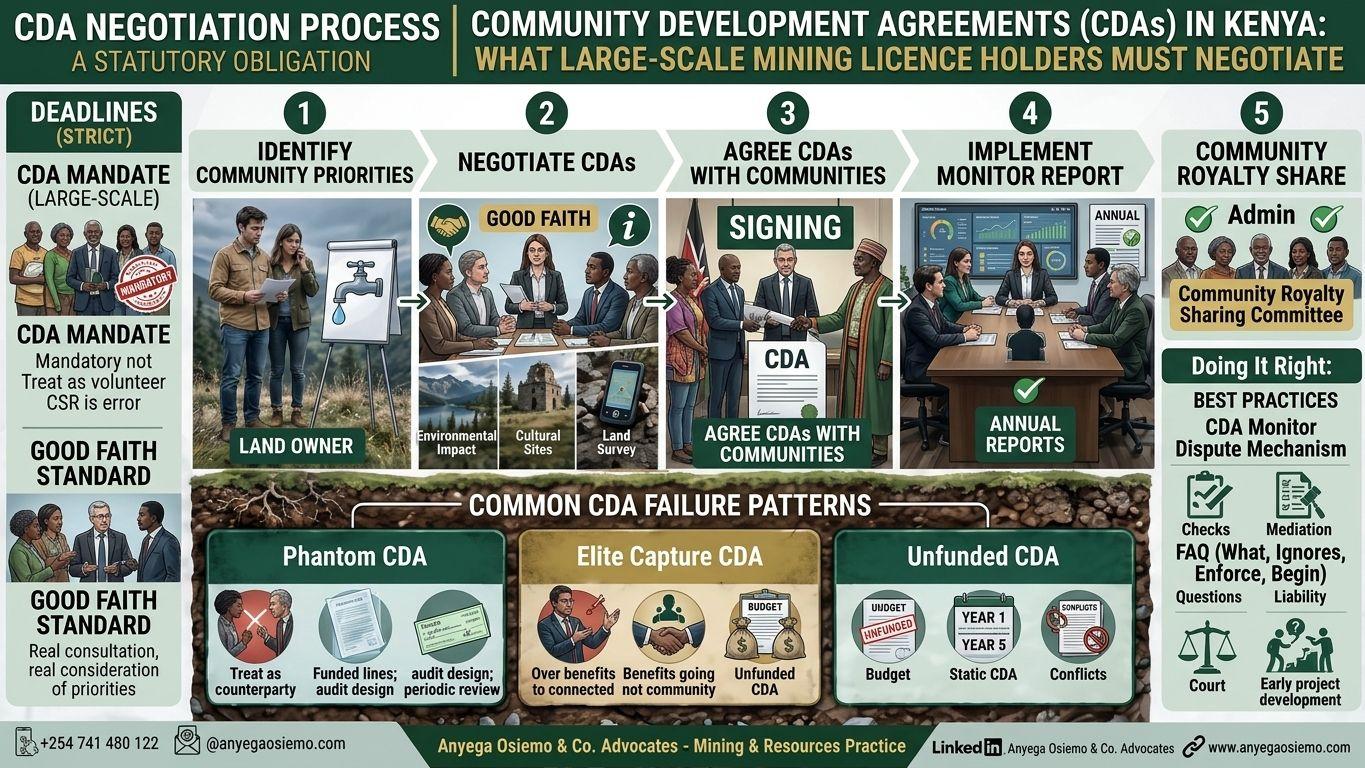
Kenya's mining framework defines a Community Development Agreement as an agreement entered into between a large-scale mining licence holder and a community. In substance, the law imposes three things:
1. It is mandatory, not optional. Large-scale licence holders must conclude a CDA with the communities their operations affect. Treating it as a voluntary CSR document is a legal error — and, increasingly, an enforceable one.
2. It must be negotiated in good faith with the community. The community is not a passive recipient; it is a counterparty. Good faith negotiation real consultation, real information, real consideration of community priorities is a legal standard, not a public relation one.
3. It carries obligations that outlast the signing ceremony. A CDA creates continuing duties: implementation, monitoring, reporting. An agreement that exists only on paper, with projects that exist only in the annual report, is a liability accumulating in public.
What a Serious CDA Contains
While each agreement reflects its context, serious CDAs share a structure:
Scope and parties. Which communities, which operation, over what area and period. Defining this precisely prevents the most common later dispute: who is actually covered.
Community priorities and commitments. The specific projects and benefits the holder commits to: water, education, health, infrastructure, employment, local procurement prioritised through community processes, not dictated by the mine.
Implementation and governance. Who implements, through what structures, with what community participation. The governance design determines whether benefits arrive or evaporate.
Monitoring, reporting, and review. How progress is measured, reported, and periodically renegotiated. A CDA that cannot be monitored cannot be enforced, and an unenforceable CDA is a time bomb.
Dispute resolution. How disagreements under the agreement are resolved: mediation, arbitration, or otherwise before they harden into conflict.
Where CDAs Go Wrong
The failure patterns are consistent across mining jurisdictions, and Kenya shows them all:
- The phantom CDA. Signed to satisfy a licence condition, never implemented. The community's discovery of this gap and its always-surfacing converts a compliance failure into a community-relations crisis, precisely the outcome the CDA was designed to prevent.
- The elite-capture CDA. Negotiated with a handful of local intermediaries whose priorities are not the community's. Benefits flow to the connected; resentment flows to the mine.
- The unfunded CDA. Commitments made without a budget line. When commodity prices dip, "community investment" is the first thing cut and the CDA becomes a record of broken promises.
- The static CDA. Signed at project start, never reviewed as the operation, community, and political context evolve. An agreement frozen in year one becomes an anachronism by year five, and a grievance by year eight.
Why This Matters More Than Ever
Two 2026 developments raise the stakes further. First, the new royalty-sharing framework gives communities a statutory 10% revenue share, a right, not a gift and formal Community Royalty Sharing Committees are proposed to administer it. Communities are learning the difference between entitlements and favours. Second, as major operations' licences expire and renew, CDAs and their implementation records are becoming factors in the regulatory calculus.
A well-implemented CDA is now a genuine asset: it protects the licence, the operation's stability, and the company's position in every royalty and renewal debate. A neglected one is evidence against you.
Doing It Right
- Treat the community as a counterparty, not an audience. Information, time, and genuine negotiation are legal requirements here, not soft skills.
- Budget before you commit. Every commitment should have a funded line item and an owner. Unfunded commitments are worse than none.
- Design for audit. Measurable commitments, third-party verification where possible, public reporting. Transparency is both compliance and insurance.
- Review on a cycle. Build periodic review into the agreement itself, so it evolves with the operation and the community.
- Get advice at the table. CDA negotiation sits at the intersection of mining law, community law, and practical politics. Experienced counsel at the table prevents the drafting errors that become decade-long disputes.
Frequently Asked Questions
Q1. Who must sign a CDA in Kenya?
A. Large-scale mining licence holders are required to conclude CDAs with the host communities affected by their operations. Smaller operations are subject to other community obligations, but the CDA framework targets large-scale holders.
Q2. What happens if a mining company ignores its CDA?
A. Non-performance exposes the holder to regulatory consequences, community disputes, and reputational damage and, in the current political environment, to the same public contestation now surrounding royalty shares. A breached CDA is a liability with a clock on it.
Q3. Can communities enforce a CDA?
A. Yes, through the dispute mechanisms the agreement provides, and through the wider legal framework. The enforceability of CDAs is precisely why their drafting quality matters so much.
Q4. When should CDA negotiation begin?
A. Early in parallel with licensing and project development, not after production starts. CDAs negotiated late are negotiated weakly, by holders who have already lost the community's trust.
Disclaimer: This article is general legal information, not legal advice. For guidance on your specific situation, book a consultation with our advocates.