One morning, a public notice appears in the Gazette, on a county noticeboard, online announcing that a company has applied for a mining or prospecting licence over land that includes yours. Nobody consulted you. Nobody asked. And at the bottom of the notice: a deadline, measured in days, after which your right to object expires.
Thousands of Kenyan landowners, communities and county governments face this moment every year. Most do nothing, because nobody has ever told them the law gives them a voice a formal, structured, potentially decisive one. This article explains the objection process under the Mining Act, what grounds work, and how to make an objection that actually changes outcomes.
Your Right to Object
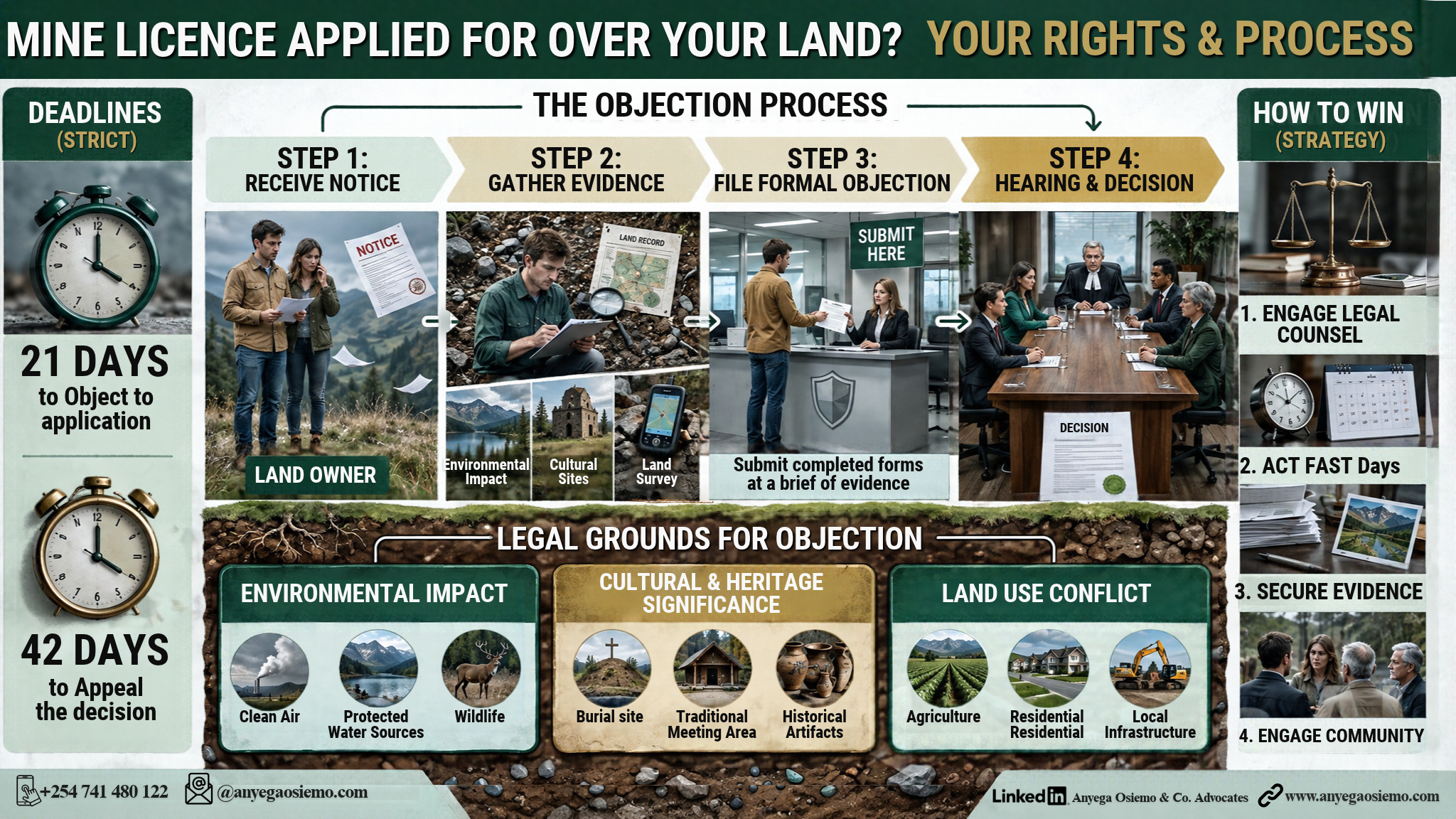
The Mining Act builds public objection directly into the licensing process. When an application for a mineral right is received, notice is given and affected persons may lodge objections within strict timeframes: 21 days for a prospecting licence application, and 42 days for a mining licence application.
The deadlines are hard. An objection filed on day 43 is, in law, no objection at all. The first rule of objecting is therefore the simplest: diarise the deadline the day you see the notice, and treat it as immovable.
Who Can Object and on What Grounds?
The objection mechanism exists for precisely the people a mining application most affects:
- Landowners and lawful occupiers of land within the application area
- County governments whose territory and planning the operation touches
- Persons with existing rights or interests overlapping mineral rights, registered interests, or documented prior use
The grounds on which objections succeed share a pattern. Effective objections are grounded in law, evidence, and specific impact not generalised opposition:
Land and access rights. Where the applicant cannot lawfully access or use the surface absent consent, disputed ownership, or occupied land the application is fundamentally defective at the point where it matters most.
Overlapping or prior rights. Where the application area overlaps an existing mineral right, or where the applicant's claimed ground conflicts with rights already granted, the cadastre itself provides the objection's foundation.
Environmental and community impact. Where the proposed operation threatens water, land, or community resources in ways the application does not address, the environmental framework gives these concerns legal standing, but they must be specific, evidenced, and connected to the legal requirements, not asserted in general terms.
Procedural defects. Applications that are incomplete, misleading, or founded on consents that were never properly obtained are challengeable on the process itself.
The Process, Step by Step
1. Confirm the application and the deadline. Obtain the application details: the applicant, the area, the minerals, the right sought. Note the objection deadline from the notice, and verify it. Your advocates can obtain the relevant records.
2. Assemble your evidence immediately. Land documents, title records, photographs, existing rights, correspondence, community resolutions. Objections are won on documents, not indignation, and evidence takes time to assemble, which is why the deadline discipline matters.
3. Prepare the objection. A proper objection identifies the application, states your standing (why you are a person entitled to object), sets out each ground with its supporting evidence, and specifies the relief, refusal of the application, reduction of the area, and conditions on grant. Precision here separates the objections that are considered from those that are merely received.
4. Lodge it properly, within the deadline. Through the channels the Act prescribes, with proof of service and filing. A brilliant objection that misses the deadline or the proper channel accomplishes nothing.
5. Be ready for what follows. Objections may be considered with the application itself, and applicants are commonly given the chance to respond. Strong objections hold; weak ones are answered. The difference is almost always the quality of the preparation — and frequently, the presence of legal counsel.
Why Most Objections Fail (and How Yours Won't)
The typical failed objection is one page long, sent late, and grounded in sentiment. The typical successful objection is grounded in documents, lodged early, and framed in the language of the Act.
The asymmetry is worth understanding. The applicant has often spent months and professional fees preparing their application. Objecting is not a letter to the editor it is a legal intervention in a formal process, and it deserves the same professionalism the applicant brought to their side. This is where advocates earn their fee: the objection that stops or reshapes an application is written by someone who knows what the decision-maker must find before they can refuse.
What Success Looks Like
Objections can and do change outcomes: applications refused, areas reduced, conditions imposed that reshape what the applicant may do. Even where the objection does not stop the application outright, a well-grounded one creates a record valuable if later disputes arise over the same ground, the same consent, the same impacts.
Frequently Asked Questions
Q1. How do I find out if a licence has been applied for over my land?
A. Applications are notified through public notice in the Gazette and other prescribed channels. Landowners in mining-active counties should actively watch for notices, and your advocates can monitor applications touching your area.
Q2. Can a community object, or only landowners?
A. Both communities and county governments have standing on grounds of impact and interest. Community objections are strongest when organised, documented, and specific about the impacts and the legal basis.
Q3. What if the deadline has already passed?
A. Options narrow, but do not always vanish: later-stage interventions, complaints to the regulator, and litigation may remain available depending on the facts. The first step is urgent legal advice, not resignation.
Q4. Does objecting cost a fortune?
A. Far less than the value of what may be lost. A properly prepared objection is a bounded, predictable piece of legal work and infinitely cheaper than the disputes that follow an unopposed grant over your land.
Disclaimer: This article is general legal information, not legal advice. For guidance on your specific situation, book a consultation with our advocates.