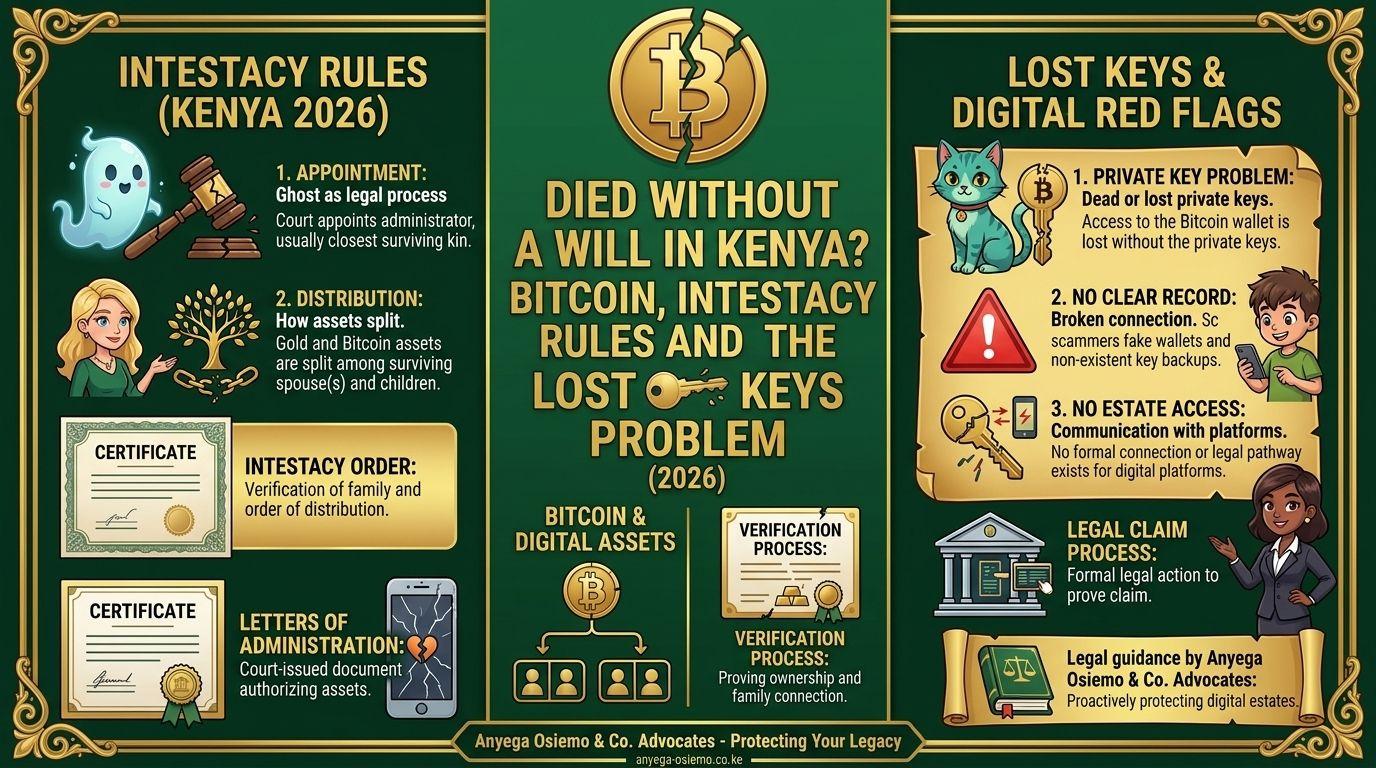
Where a Kenyan crypto holder dies intestate, two distinct issues arise. The first is legal: the estate is governed by the intestacy provisions of the Law of Succession Act and must be distributed through a court-supervised process under statutory rules that may not reflect the deceased's wishes, on a timeline determined by the court. The second is practical: digital assets such as Bitcoin may not be readily identifiable, as there is no equivalent to a bank statement, branch, or account manager to alert the family to their existence.
This guide addresses the legal framework governing the inheritance of cryptocurrency under Kenyan intestacy law, as well as the practical steps required to identify and recover digital assets when the deceased leaves no clear instructions.
Intestacy in Kenya: Who Inherits When There Is No Will
The Law of Succession Act (Cap 160) distributes an intestate estate strictly by family relationship. In outline, the rules are as follows:
- Surviving spouse and children: the spouse takes the deceased's personal and household effects absolutely and a life interest in the residue of the net estate, with the remainder passing to the children (and if there are no children, to the further relatives the statute designates). A life interest means the spouse enjoys the assets, including crypto, for life without owning the capital itself; on the spouse's death, the capital passes as the statute directs.
- Spouse but no children: the spouse takes the personal effects, a statutory preferential share, and a life interest in the remainder, as provided by the Act for this scenario.
- Children but no spouse: the estate divides among the children, with adopted children inheriting on equal terms.
- No spouse or children: the estate passes through parents, then siblings and more remote relatives in a defined statutory order.
- No qualifying relatives at all: the estate passes to the State bona vacantia, the law's last word for "there was no one left to give it to."
Two cautions are necessary at the outset. First, the intestacy regime does not take account of personal relationships or family dynamics; the statutory order applies irrespective of separation, estrangement, or personal preference. Second, all statutory entitlements presuppose that the assets in question can be located and accessed, a presumption that is often problematic in the context of cryptocurrency.
Who Administers: Priority, Consents and Renunciation
In the absence of a named executor, the court appoints administrators by issuing letters of administration, following the statutory order of priority: surviving spouse, then children, then parents, and thereafter more remote relatives. Typically, the surviving spouse applies, sometimes jointly with an adult child. Where multiple individuals within the same class are eligible, they may apply together, consent to the appointment of one or more among them, or formally renounce their right to apply. Renunciation is appropriate for those who are abroad, lack capacity, or are unwilling to assume fiduciary responsibilities, but it must be effected promptly and in the prescribed manner. Multiple competing applications from the same family inevitably result in procedural delays.
The Process in Brief: From Death to Distribution
The machinery of an intestate estate runs as follows: death certificate and a genuine search for a will; family alignment on the applicant; petition, affidavits (including the affidavit of means valuing the estate in Kenya Shillings where any crypto leads must be listed with best-evidence values), consents and inventory filed; statutory public notice with a minimum thirty-day window for objections; grant issued; assets collected and secured; debts, taxes, and dependants' maintenance settled; proposed mode of distribution filed; confirmation of the grant; distribution. For crypto recovery, begin by identifying every possible lead and recording each asset and access clue before any recovery attempt. Start with an exchange notification email, a hardware wallet, or a friend who knows the deceased traded, then check email records, bank and M-Pesa statements, devices, paper backups, tax and financial records, and relevant people in that order. Every item located during the search must be recorded before access or transfer. An estate plan based on a valid will is effective because it provides three essential elements: the appointment of an executor, an inventory or register of assets, and a letter of wishes detailing access procedures. Intestacy deprives the family of all three. There is no executor with authority, no asset inventory prepared by the deceased, and no guidance regarding the location or access credentials for digital wallets and seed phrases. The likely consequence is that exchange accounts may be identified belatedly, hardware wallets may be discovered without the necessary passwords, and seed phrase backups may be found without context, resulting in assets being lost or accessed by individuals without proper authority.
- Email records for exchange sign-up confirmations, login alerts, and statements are the single richest lead source.
- Bank and M-Pesa statements showing transfers to known exchanges or OTC dealers; those trails identify platforms even when the family knows nothing else.
- Devices: phones and computers with wallet apps; browser saved sessions; password managers (accessed lawfully by the family's representatives; locked devices go to forensic specialists in accordance with the law).
- Paper and metal: seed phrases and recovery sheets among document files, safes, storage boxes, bookshelves.
- Tax and financial records: KRA filings and accountants' files mentioning digital assets or unexplained disposals.
- People: the deceased's trading friends, the "tech cousin," community members where they were active online.
All assets and evidence located during the search must be documented before any attempt to access or transfer them. The administrator is required to maintain a clear evidentiary record for both the court proceedings and for engagement with digital asset platforms.
What Can Actually Be Recovered
- Exchange-held assets are recoverable, with paperwork. The administrator obtains the grant, death certificate, and identity documents, then engages each platform's deceased-estate process. Start with the platform most likely to hold the asset, submit the required proof, and track each response. Licensed Kenyan platforms operate under the VASP Act, 2025 regime with regulated obligations toward lawful representatives; foreign platforms have their own documented processes. Expect verification rigour; it protects estates from impersonation fraud, and start early, because platform processing is often the slowest leg.
- Self-custodied assets for which the seed phrase or access credentials are located are recoverable. The individual lawfully in possession of the private keys can control the funds. Once located, the administrator should verify the credentials, secure the wallet, consolidate the holdings into estate-controlled custody, and document each transfer. The administrator should confirm access, then move the holdings into estate-controlled custody, document every transfer, and account for all transactions throughout the administration.
- Where self-custodied assets are concerned, the absence of a seed phrase, backup, or password renders recovery virtually impossible. This is a technical, rather than a legal, limitation: there is no mechanism to reset or regenerate a private key, and no court order or customer service can circumvent it. If partial seed phrases, forgotten passwords, or known hints exist, the administrator may assess professional wallet-recovery services, but should first confirm the limits, document the attempt, and treat success as rare. Offers of 'guaranteed recovery' in exchange for upfront fees are frequently fraudulent and should be treated with caution.
The Administration Timeline for a Crypto Estate: A Realistic Walk
Weeks one to four: death certificates; the search for a will concludes; devices, documents, and financial records secured; a preliminary asset map, including crypto leads, documented; the applicant question settled. Then identify each recovery lead, record the evidence, and decide whether the asset is exchange-held or self-custodied. For exchange-held assets, prepare the grant documents and platform proof requirements; for self-custodied assets, verify any seed phrase, password, or backup before attempting access.
Months one to three: petition and affidavits prepared and filed, the affidavit of means listing every crypto lead with best-evidence shilling values; the search for further holdings continues in parallel.
Months three to six: statutory notice runs; absent objections, the grant issues. The administrator immediately notifies all identified platforms and secures all identified accounts and devices.
Months six to twelve and beyond: platform verifications run usually the slowest leg; wallet assets consolidate into estate-controlled custody. Delays in administration commonly arise from contested priority among applicants, objections raised during the statutory notice period, the late discovery of additional assets, or additional requirements for notarisation or resealing imposed by foreign platforms. However, the most intractable delay occurs where an asset exists but cannot be accessed due to missing credentials. While a diligent administrator can address most procedural delays, access failures cannot, underscoring the importance of preventative planning. Where minor children are beneficiaries under intestacy, an additional layer of administration is required. While children may inherit, they are not legally competent to administer the estate. Kenyan law addresses this through the appointment of guardians, and more effectively, through the establishment of trusts. A properly drafted trust safeguards a minor's inheritance from dissipation, with a trustee subject to enforceable legal duties. In cases where the inheritance includes cryptocurrency, the trust must incorporate provisions for secure key custody, trustee succession, and the authority to hold, convert, or prudently manage digital assets. Failure to implement such measures often results in the loss or misappropriation of assets intended for minors.ld, convert or prudently manage the assets. Families who skip this step routinely discover years later that "the children's plot" or the children's wallet was quietly sold.
Prevention, Honestly Stated
For individuals holding cryptocurrency, the solution is straightforward and cost-effective. Prepare a written will appointing an executor, maintain a dated and signed register of crypto assets with your testamentary documents, and provide a sealed letter of wishes specifying the location of access credentials. The expense involved is minimal compared to the value of the assets protected, and these measures transform a potentially complex and contentious administration into an orderly process. The issues described in this article are entirely preventable with proper planning.
Ten Mistakes Families Make With Intestate Crypto Estates
- Assuming the crypto died with the deceased before searching the exchange assets properly is very often wrong; exchange assets are very often recoverable.
- 2. Accessing accounts without documentation, contaminating the administrator's trail.
- 3 . Letting one relative "handle it" before the grant of informal moves invites disputes and tax problems.
- 4. Ignoring small balances: dust today, meaningful holdings tomorrow.
- 5. Falling for recovery scams targeting grieving families.
- 6. No preservation: leaving exchange accounts unsecured during administration, exposing them to SIM-swap and takeover fraud.
- 7 . Fighting over who administers instead of applying promptly in the statutory order.
- 8. Distributing before confirmation: early payouts create personal liability for debts that surface later.
- 9. Overlooking dependants' claims and debts before distribution.
- 10 . Treating a found seed phrase casually photographed, emailed, or shared in family groups. Whoever holds it holds the estate.
Frequently Asked Questions
Q1. Who inherits Bitcoin if there is no will in Kenya?
A. Whoever the Law of Succession Act's intestacy rules designate: spouse, children, parents and other relatives in statutory order, with the spouse typically holding a life interest in the residue. The rules govern; unwritten wishes do not.
Q2. Can we get Bitcoin back from an exchange after death?
Yes, through the platform's deceased-estate process with the grant of letters of administration, death certificate, and identification. Start early; verification takes time.
Q3. What if we cannot find the seed phrase?
A. If no seed phrase, backup, or password exists anywhere, self-custodied coins are effectively unrecoverable mathematically, not merely legally. Narrow recovery cases exist; "guaranteed recovery" offers are fraud markers.
Q4. Do adopted or out-of-wedlock children inherit crypto?
A. Yes, the Act gives adopted children and children born outside marriage inheritance rights on equal terms.
Q5. What happens if there are no relatives at all?
The estate passes to the State as bona vacantia; thorough genealogical work sometimes surfaces qualifying relatives, but crypto with no heirs and no keys is gone in every sense.
Q6. Is it worth applying for letters of administration over a small estate?
A. Often yes; simplified routes exist for genuinely small estates, and unclaimed exchange balances benefit no one. Match the process to the asset schedule, with advice.
Q7. How long does the whole process take?
A. Uncontested, many months to a year or more end to end; contested or complicated estates run longer. Platform estate-processing is frequently the slowest single leg.
Q8. Can an administrator sell the crypto?
A. Yes to pay debts, taxes and expenses, and as part of distribution with the grant's authority, proper valuation, accounting to beneficiaries, and in line with the confirmed distribution. Undervalued sales to insiders are a classic ground for liability.
Q9. What records should the administrator keep?
A. Everything: valuations at each stage, platform correspondence, wallet consolidation transactions, debts paid, dependants maintained. Good accounts are the administrator's defence.
Q10.How do I make sure my own family never faces this?
A. A will, a register, and a sealed letter of wishes reviewed annually. At Anyega Osiemo & Company Advocates, we provide comprehensive legal services to families administering intestate estates that include digital assets. Our services include the identification and documentation of cryptocurrency holdings, assistance in obtaining letters of administration, engagement with exchange estate procedures, coordination of lawful forensic analysis of devices and wallets, representation of administrators in the discharge of their duties, and resolution of disputes among beneficiaries. For individuals seeking to avoid these complexities, we offer will-drafting services to ensure that your estate is administered according to your wishes.nd for holders reading this with growing unease, we draft the will that makes this article irrelevant to your family.
Disclaimer: This article is general legal information, not legal advice. For guidance on your specific situation, book a consultation with our advocates.