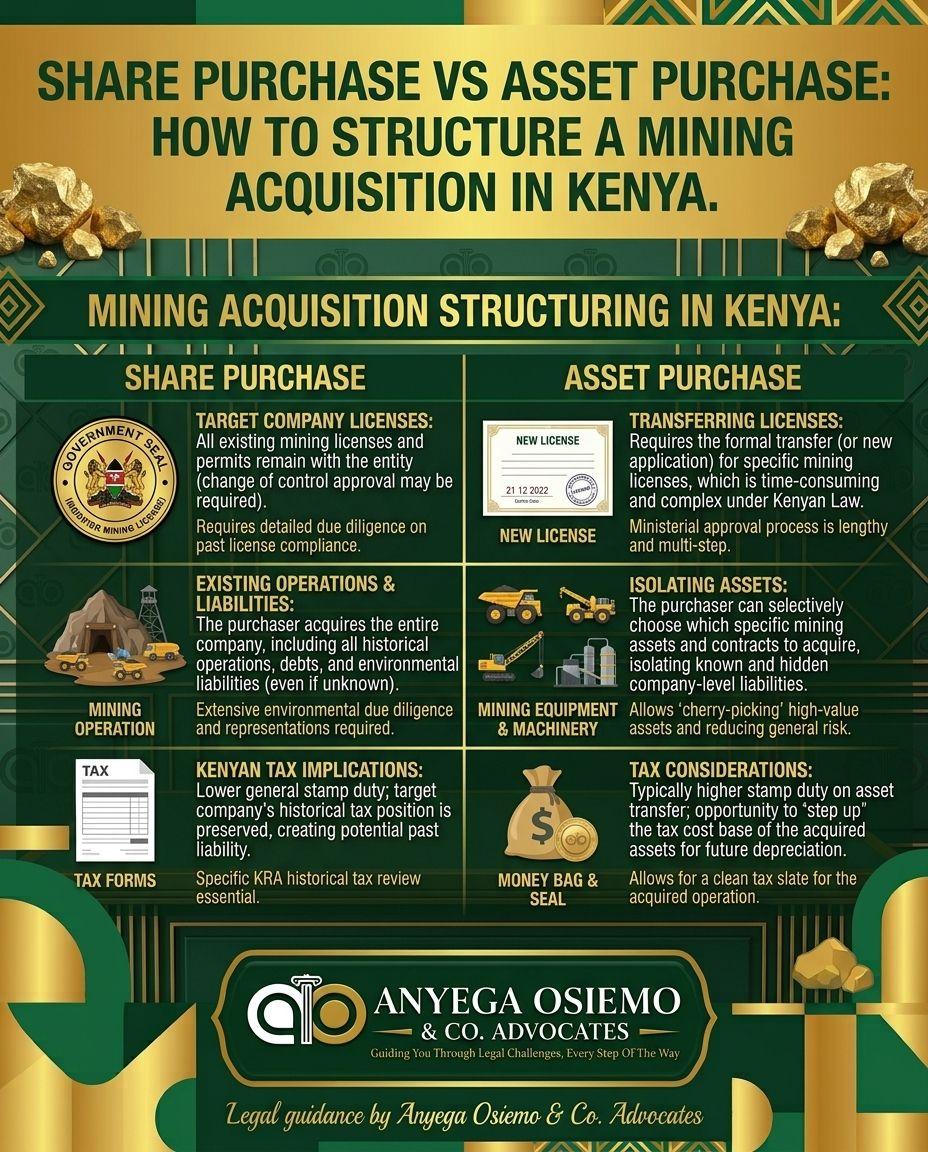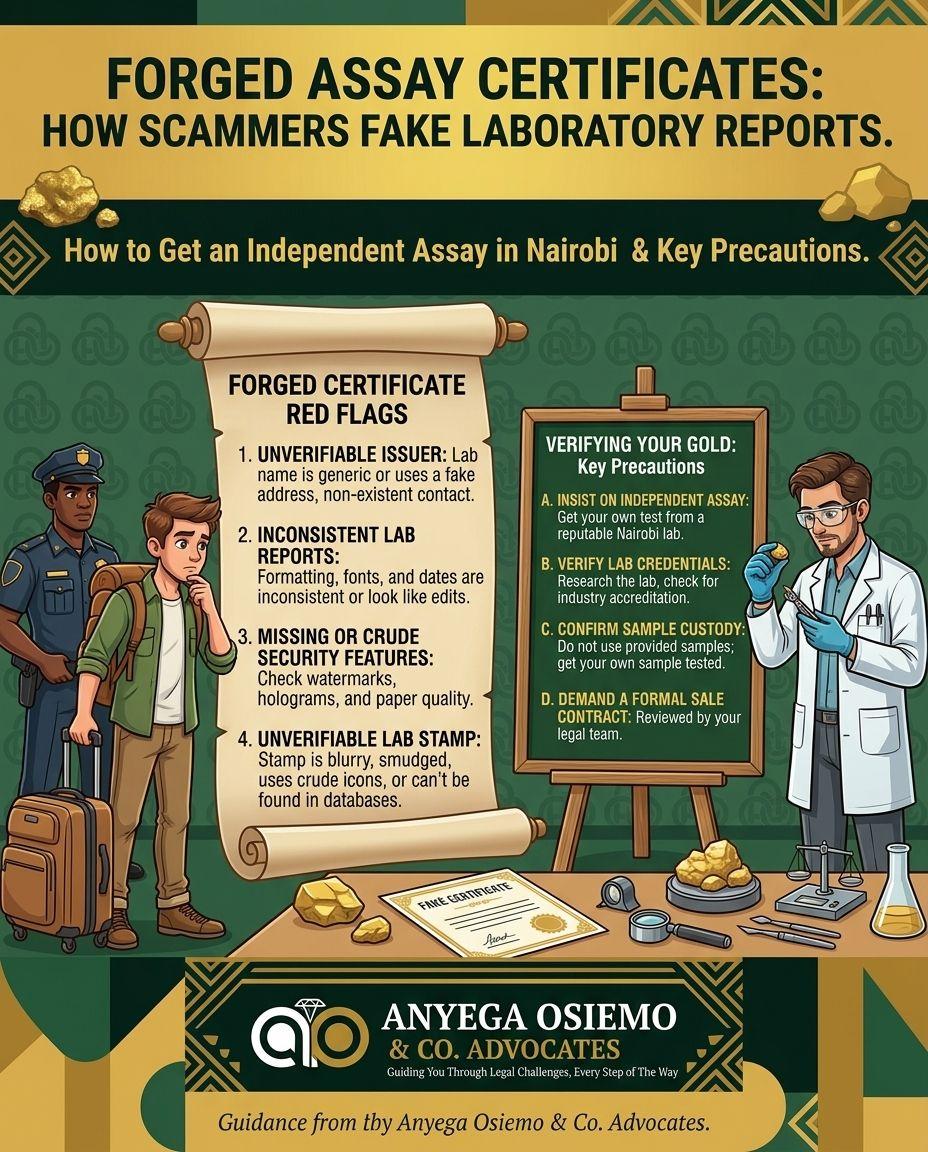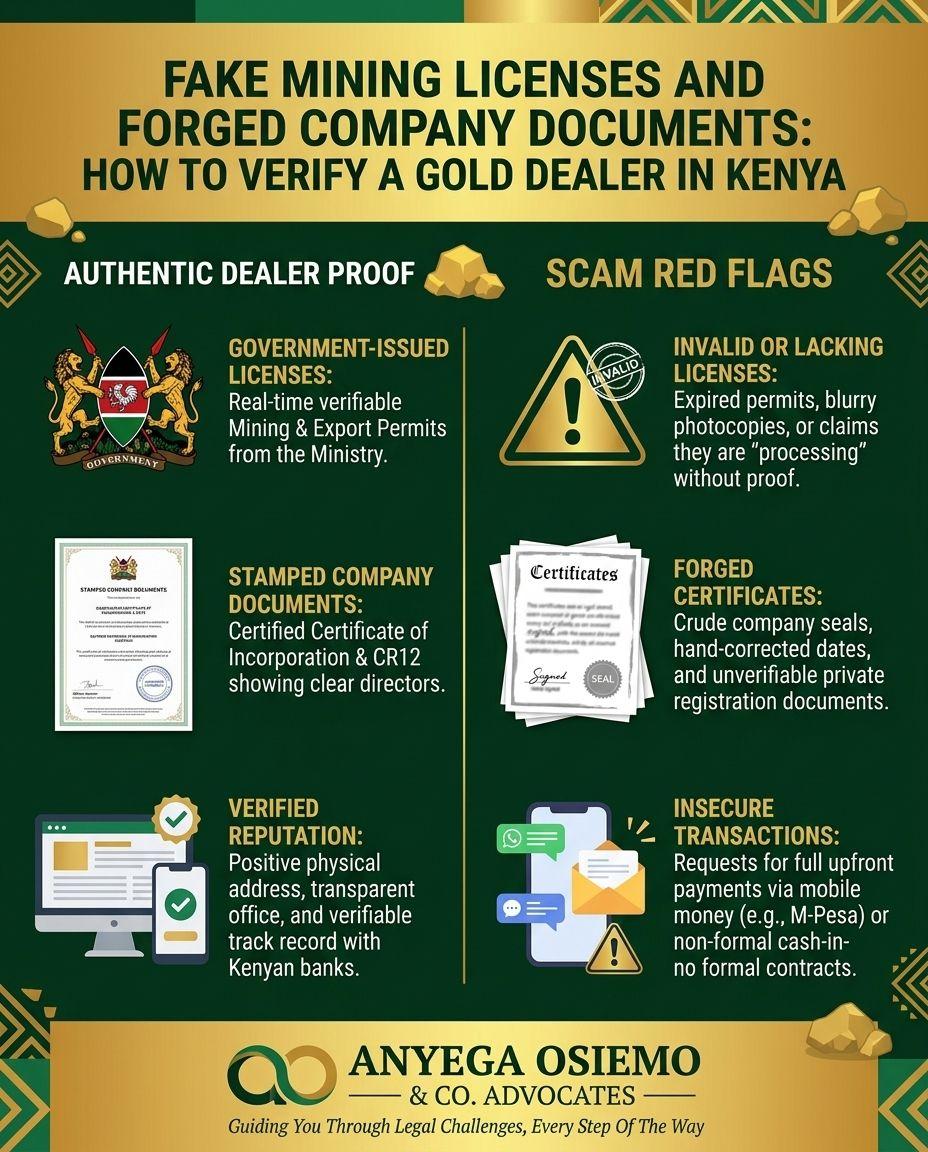
Every fake gold operation in Nairobi eventually produces documents: a certificate of incorporation, a mineral dealer's license, a mining license, an export permit, and tax certificates. They look official because they are usually copied from real ones, with names, numbers, and logos altered; the forger's art applied to genuine templates.
The good news: almost every document a fraudster can forge can also be independently verified, often in minutes, through official Kenyan systems. This article walks through each check, step by step.
Check 1: Company Registration: eCitizen / Business Registration Service.
Every legitimate Kenyan company is registered with the Business Registration Service, and its registration can be searched through the government's eCitizen platform.
What to verify:
- The company exists: Fraudsters sometimes use names of companies that were never registered, or that were registered in a different country.
- It is active and in good standing: A company "struck off" or dormant years ago cannot lawfully trade.
- The directors match the people you are dealing with: Ask for the company number, then check who actually controls the company. If the "director" you have been speaking to appears nowhere in the official records, you are dealing with a fiction.
- The registered address: A registered office at a residential plot or a post office box says something about the scale of the operation.
- The registration date: A company incorporated three months ago has no history, no track record, and no excuse for claiming years of export experience.
Check 2: Mineral and Mining Licenses: The Ministry's Records
If the seller claims to hold a mining license, exploration license, or mineral dealer's license, the claim can be verified through the Ministry responsible for mining and its Mining Cadastre system, which maintains the official register of mineral rights in Kenya.
What to verify:
- The license number is real and appears in official records, not merely on a PDF the seller emailed you
- The license holder's name matches the company or person you are dealing with
- The license is current; licenses expire, lapse, and get suspended for non-compliance
- The license covers what is being sold. A mineral dealer's license authorizes trading; it says nothing about owning a mine. A mining license over Plot A does not cover gold allegedly stockpiled from Plot B. Match the license type to the story.
A claimed license that does not appear in official records is not a license. Full stop.
Check 3: Tax Compliance: KRA
Legitimate, active businesses transact with the Kenya Revenue Authority. A Tax Compliance Certificate can be requested from any serious counterparty, and a business that cannot produce one, or produces one that fails KRA verification, is not a business you should wire money to.
Check 4: Litigation and Regulatory History
Kenyan court records and published enforcement actions tell stories that documents never will. A seller whose name surfaces in previous fraud suits or in press coverage of police operations is a seller to walk away from, regardless of how clean the paperwork looks.
Check 5: The Physical Reality
Documents are necessary but never sufficient. A licensed dealer operates from real premises, employs real people, holds real stock, and transacts through traceable bank accounts rather than personal mobile money numbers. Physical verification, an unannounced visit, an inspection arranged through your own representatives completes the picture.
The Pattern to Watch: Real Documents, Wrong Story
The most dangerous operators mix truth and fiction: a real company (registered, active, with real directors) fronting for a scam; a genuine dealer's license held by a company whose "gold" has no lawful source; real documents attached to a fabricated transaction. This is why verification is not a checklist to complete but a matrix to cross-check: does the company match the licensee, the license match the stock, the stock match the assay, and the bank account match the company?
Breaks in that chain are where fraud lives.
If Verification Exposes a Fraud
- Do not tip off the sellers before preserving evidence and taking advice
- Preserve every document they sent; forgeries are evidence
- Report to the police/DCI; document fraud and gold fraud are criminal offenses
- If you have paid anything, seek legal advice immediately on tracing and freezing the funds
Frequently Asked Questions
Q1. How long does company verification in Kenya take?
Basic registration checks can be completed quickly through official channels. A fuller due diligence review including licensing, litigation, and financial verification takes longer and is exactly what legal counsel is for.
Q2. Can my lawyer verify a seller's documents for me?
Yes, document verification is standard due diligence. Critically, it must be your lawyer, engaged independently, not a lawyer introduced by the seller.
Q3. The seller sent me a license number. Isn't that proof?
A license number is a claim, not proof. Claims are verified directly against the issuing authority's records via official channels, with details sourced independently of the seller.
Disclaimer: This article is general legal information, not legal advice. For guidance on your specific situation, book a consultation with our advocates.