Each week, foreign investors transfer funds to Nairobi gold dealers without proper verification, and some lose the entire amount sent. The most effective and cost-efficient protection is to verify before payment, using official Kenyan registers accessible to the public. Complete every step, regardless of the seller's apparent credibility.
Verification is straightforward, provided it is comprehensive. This guide sets out five essential layers: entity, license, person, product, and transaction. Each layer relies on official sources and practical reasoning. The checklist is then demonstrated through a realistic transaction scenario.
Why Verification Beats Recovery Every Time
It is important to recognize the cost implications at the outset. Conducting due diligence on a gold dealer typically costs between a few hundred and a few thousand dollars and can take several days to weeks. By contrast, recovery litigation after fraud is significantly more expensive, can take years, and succeeds only if traceable assets remain. Facts such as a shell company, a false license number, or a forged assay are inexpensive to uncover before payment but become costly evidence afterward. Time invested in verification is far more valuable than time spent in litigation.
The Scam Economics You Are Verifying Against
Understanding the structure of these schemes is essential. A typical gold export fraud involves a registered front company, fabricated or borrowed documents, a temporary office to create an impression of legitimacy, and the victim's advance payment, which finances the operation and subsequent fee demands. The scheme depends on payment before verification is completed. Fraudsters often provide rehearsed responses to verification steps, and resistance to verification is itself a warning sign.
Layer 1: Verify the Company Itself
Every legitimate dealer operates through a registered Kenyan company, and the company can be checked in an afternoon:
- Order an official search from the Business Registration Service (BRS) through eCitizen. Official searches cost a small fee and are delivered promptly; do not accept screenshots or "certified copies" from the seller.
- 2. Confirm the company's existence and status. It must be active, not struck off, and the name must match exactly with that on your invoices and contracts. Even minor name variations, such as 'Goldex Ltd' compared with 'Goldex Mining Ltd', are commonly used to mislead.
- 3. Review the list of directors and shareholders. Determine whether the individuals you have met are the actual controllers of the entity. If the listed director is unknown to you and your contact has no formal authority, this is a significant concern that requires a clear explanation, even if it is not immediately disqualifying.
- 4.Check filing history. Confirm annual returns, share capital proportionate to the claimed business, and no recent suspicious changes of directors or registered office. A company that has never filed returns is not operating. Independently visit the registered office. The address listed in the registry must correspond with the office where you were received. Short-term executive suites are frequently used to create a false impression of legitimacy. Executive suites are a standard prop.
Layer 2: Verify the Mineral Rights on the Mining Cadaster Portal
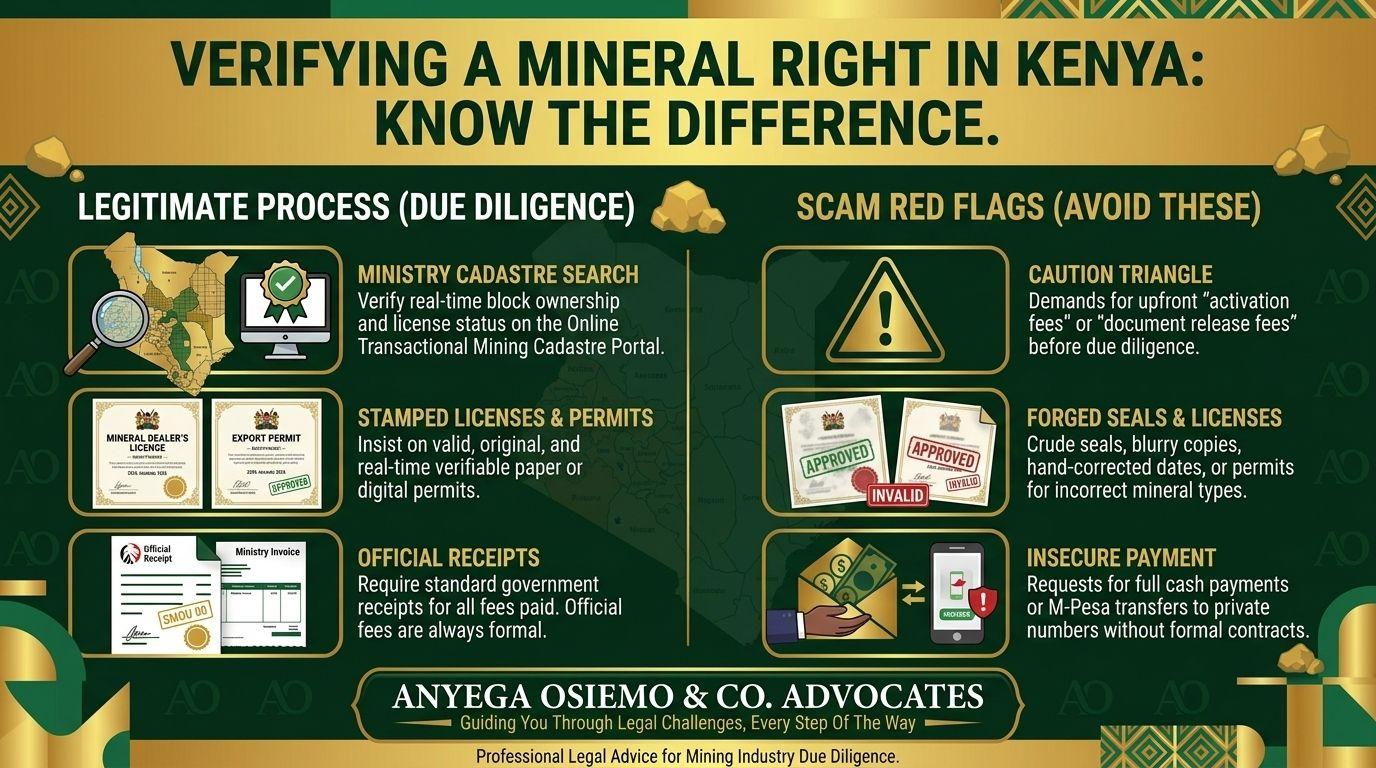
If your seller claims to mine or to source directly from miners under mineral rights, those rights must be recorded in the official cadaster. To verify that claim, search the Mining Cadaster Portal administered under the Ministry responsible for mining, currently within the State Department for Mining.
- 1.Search the Mining Cadaster Portal, administered by the Ministry responsible for mining, currently the State Department for Mining.
- 2.Run the claimed license or permit number directly. Every genuine mineral right in Kenya is registered with its holder, coordinates, commodity, and validity period.
- 3.Verify three facts to keep the claim consistent: first, the holder's name must match your seller's name or that of a company they can verifiably represent. Request and confirm any representation or offtake agreement. Second, the mineral right must be valid, not expired, suspended, or revoked. Third, the commodity and area must correspond to the seller's claims. For example, a limestone permit does not authorize gold mining, and a small artisanal claim cannot supply large quantities of refined gold bars.
- 4.Sanity-check location against the physical claims. Real Kenyan gold production is concentrated in the western counties of Migori, Kakamega, Siaya, and Vihiga, and flows through documented supply chains. A "mine visit" staged elsewhere is theatre.
The cadaster is the authoritative source for mineral rights. When claims such as 'our license is being processed,' 'the portal is not updated,' or 'you cannot search it' appear, treat them as false unless independently verified. In practice, such claims are never substantiated.
Layer 3: The Mineral Dealer's License and the Export Fiction
A separate license is required for dealing in minerals, distinct from mining rights. To verify that status, trading in minerals in Kenya requires a mineral dealer's license, which involves a license fee of KShs 20,000 and an annual permit fee of KShs 2,000. Verify this license through the Ministry's official channels, applying the same level of scrutiny as for the mineral right. A seller who does not mine but trades must hold a dealer's license. Any individual claiming to be a dealer without this license is not a legitimate dealer.
Exporting minerals from Kenya requires an export permit issued by the Ministry. To keep the payment process clear, all legitimate government fees must be paid directly to the government through official channels, never in advance to a company, an account that resembles a law firm, or an individual. Demands for fees such as 'export permit fee,' 'tax clearance,' 'anti-money-laundering certificate,' 'airport storage,' or 'release fee' after the purchase are characteristic of gold export scams. If the transaction requires payment of such fees to the seller, treat it as fraudulent.
Layer 4: Verify the Gold Itself
Documents prove nothing about metal. To move from paperwork to proof, only an independent assay does, and independence is the entire point:
- Choose the laboratory yourself, never one recommended or arranged by the seller. Use an established, government-recognized assayer; attend in person where possible.
- Demand a proper sample: drilled or cut from the bar, not a surface scrape. The sophisticated fakes circulating in East Africa are copper-zinc cores plated to defeat handheld XRF guns; surface-only testing is precisely what they are built to survive.
- Control the chain of custody: the sample passes from the seller's hands to the laboratories in front of you, sealed, labeled, receipted, with results delivered only to you.
- Regard any assay certificate provided by the seller as unproven until a laboratory of your choosing has independently verified it. Forged certificates, often copied from legitimate laboratories and altered with different names and serial numbers, are commonly used in fraudulent schemes. Contact the laboratory named on the certificate directly; it will often reveal such forgeries.
Layer 5: Structure the Transaction So Verification Actually Binds
Even a fully verified counterparty should be paid in a way that keeps verification operative through completion:
- Use escrow through an independent Kenyan law firm or bank, released only upon verified delivery and your own independent assay, never on the basis of 'documents' or 'clearances.'
- Stage payments against physical milestones you have personally inspected.
- Paper the deal properly: use a sale agreement reviewed by your own advocates, parties matching the verified company, Kenyan governing law, warranties on origin, licensing and purity, and a dispute clause with real teeth.
- Do not accept urgency. Artificial deadlines are imposed solely to prevent thorough verification.
The Five-Layer Verification in Practice: A Worked Due Diligence File
See how the layers operate together. A foreign buyer is offered '30kg of gold bars at 8% below spot, CIF to Dubai' by a polished Nairobi counterparty. The buyer's advisers run the file:
Layer one — entity. The eCitizen search shows an active company with filed returns. Still, its registered directors are two names that match no one the buyer has met, and the filings suggest a shelf company was recently reactivated. Finding: not disqualifying alone; the personable 'operations manager' controls nothing on paper.
Layer two — mineral rights. The claimed mining license number is genuine but belongs to a different company, in a different county, for a different mineral. The number was lifted from the public register. Finding: the 'our mine' story is false on its face.
Layer three — dealing and export. No dealer's license is verifiable. The export documentation pack routes "fees" to an account dressed as a law firm's client account, which an investigation shows belongs to an individual. Finding: textbook export-scam architecture.
Layer four — product. The supplied assay certificate carries a real laboratory's name; a direct call confirms the serial number belongs to a different client. Finding: forged.
Layer five — structure. Escrow is refused ("our lawyers don't allow it"), 40% advance is demanded "to secure the consignment," and shipping is proposed before final assay. Finding: every protection refused, every scam convention honored.
While an issue in a single verification layer may have an innocent explanation, multiple issues across layers are conclusive. In this scenario, the buyer withdraws after spending only a few days and a modest fee. If these facts were discovered after payment, they would form the basis of a fraud complaint, which would be slower, more expensive, and with uncertain prospects of recovery. This difference underscores the importance of verification.
Verifying Individuals: Directors, Agents, and "Officials"
Companies do not shake hands; people do, and people are the soft layer. Verify each person independently:
- Directors and signatories must match the registry record; meet them, or have your advocates meet them, and obtain certified identification.
- Intermediaries and "mandates": the broker who found you, the fixer arranging the mine visit are part of the counterparty, not neutral conduits. In documented cases of fraud, the intermediaries are often the principals' own people wearing different hats.
- The presence of individuals claiming to be government officials at meetings is intended to create an impression of legitimacy, but does not provide any. Genuine ministry officers do not participate in private commodity transactions. Their involvement in negotiations should be treated as a warning sign. Any legitimate regulatory questions should be addressed in writing through official channels by your own legal advisers.
- The person whose account receives the money is legally your counterparty, regardless of what the letterhead says. Verify that identity with particular care; borrowed and hired names are standard practice, and the account holder is often the most reachable defendant if everything else fails.
If You Are Buying at the Mine Gate or From an Artisanal Miner
Not all legitimate transactions are conducted through licensed dealers with formal offices. Much of Kenya's gold trade is driven by artisanal and small-scale mining in the western counties, where genuine buyers operate closer to the source. The principles of verification remain applicable, but must be adapted to the context. Verify the permit in the cadaster, as artisanal and small-scale permits are also registered. Conduct transactions in documented quantities with written receipts, and independently assay each purchase. Do not assume that proximity to a mine guarantees legal title to its output. Arrangements where the seller promises to refine and deliver later carry the same risks as larger export scams. For significant quantities, engage local advocates to structure the offtake with proper contracts, assay protocols, and payment only against verified metal.
The Red Flag Checklist: Stop If Any of These Appears
- The price is materially below the London spot price.
- 2.Cold approach over LinkedIn, WhatsApp or email.
- 3. Below-market discounts justified by "urgent cash needs" or "informal sourcing."
- 4. No fee is demanded before the delivery of export permits, taxes, clearances, storage, or insurance.
- 5. Resistance to escrow or to your own laboratory.
- 6. Documents that look perfect but cannot be verified in official registers.
- 7. Directors who never appear: "The boss is abroad."
- 8. A convincing small test deal proving nothing about the promised stockpile.
- 9. Government or political "connections" presented as a deal lubricant.
- 10. Pressure to exclude your own lawyer.
- 11. Receiving accounts in third parties' names.
- 12. Urgency about everything except verification.
What Verification Costs and What It Saves
The costs of an eCitizen search, cadaster checks, direct communication with laboratories, a day of an advocate's time, and properly structured escrow fees are minimal compared to the value of a genuine transaction. These modest expenses protect against outcomes ranging from a secure, enforceable purchase to substantial financial loss and protracted litigation. No legitimate seller will object to verification; only those engaged in fraud will resist. Verification is not an affront to the seller, but a necessary safeguard for the buyer.
What If Verification Already Failed and You Have Paid?
Verification and recovery are both essential components of a comprehensive strategy. If payment has already been made, it is critical to begin recovery efforts immediately. Preserve all evidence, instruct legal counsel, and consider seeking freezing orders before the perpetrators become aware of your intentions. Our companion guide on recovering funds from gold scams provides a detailed step-by-step process.
Frequently Asked Questions
Q1. How do I check if a gold dealer is licensed in Kenya?
A. Three independent official checks: the company on eCitizen (BRS search), any mineral right on the Mining Cadaster Portal, and the mineral dealer's license through the Ministry responsible for mining. All are cheap, fast, and disposable.
Q2. How much does a mineral dealer's license cost in Kenya?
A. The license fee is KShs 20,000, with a KShs 2,000 annual permit fee. A claimed license that does not verify in official records is not a license, regardless of what the paperwork shows.
Q3. Can foreigners legally buy gold in Kenya?
A. Yes. Kenya has a legitimate gold industry and a functioning legal framework for dealing in and exporting gold. The industry is real; the fraud hides behind it. Every step is verifiable through official channels.
Q4. Are "gold export permit fees" ever legitimate?
A. Legitimate export fees are paid to the government through official channels. Any advance fee paid to a company or individual to "release" or "export" purchased gold is a hallmark of an export scam.
Q5. What is the safest way to pay for gold in Kenya?
A. Escrow with an independent law firm or bank, released only after your own independent assay, in staged payments tied to inspected milestones. Everything else transfers the risk entirely to you.
Q6. How do I verify an assay certificate?
A. Ignore the seller's certificate until your own chosen laboratory has re-assayed the actual metal; call the named laboratory directly about serial numbers. Forged certificates copied from real labs are routine.
Q7. Can I verify a mining license online?
A. Yes, the Mining Cadaster Portal is the official register of mineral rights in Kenya. If a claimed right cannot be found there, it does not exist for your purposes.
Q8. What should I do if the seller refuses escrow?
A. Treat the refusal as a red flag of the first rank, and re-run the earlier layers with suspicion. Legitimate sellers accept independent escrow as a matter of course.
Q9. Is gold cheaper in Kenya than in the world market?
A. No. Genuine gold trades at or above world prices. A discount to a stranger is not a commercial opportunity; it is bait.
Q10. Who can run this verification for me?
A. Your own Kenyan advocates, acting only for you, never "verification consultants" introduced by the seller.
How We Can Help
At Anyega Osiemo & Company Advocates, we conduct pre-transaction due diligence on mineral dealers, mining rights, and counterparties for local and foreign buyers, structure escrow and sale documentation, and act for victims when verification comes too late. The cost of proper verification is trivial compared with the sums these transactions involve and with the cost of recovering money that verification would have kept safe.
Before you pay anyone for gold connected to Kenya, contact us for a verification review.
This article provides general information about Kenyan mining law and due diligence and does not constitute legal advice. Every transaction depends on its own facts. For advice on a specific transaction, contact Anyega Osiemo & Company, Advocates.
Disclaimer: This article is general legal information, not legal advice. For guidance on your specific situation, book a consultation with our advocates.