Real estate sits at the intersection of Islamic investment principles and the practical considerations faced by foreign buyers. The asset is tangible, the income comes from rent, and Kenya's expanding Islamic finance sector and property law modeled on the English system create a workable environment for well-prepared Muslim investors.
However, workable investment is not automatic. Financing must avoid interest; ownership must comply with constitutional restrictions on foreign landholding and Sharia partnership principles; and income must be appropriately screened. This guide addresses financing, structuring, and income purity while highlighting the Kenyan legal requirements that determine whether a real estate investment is truly halal.
Why Property Fits and Where the Traps Are
The classical instruments of Islamic finance exist precisely for assets like land and buildings:
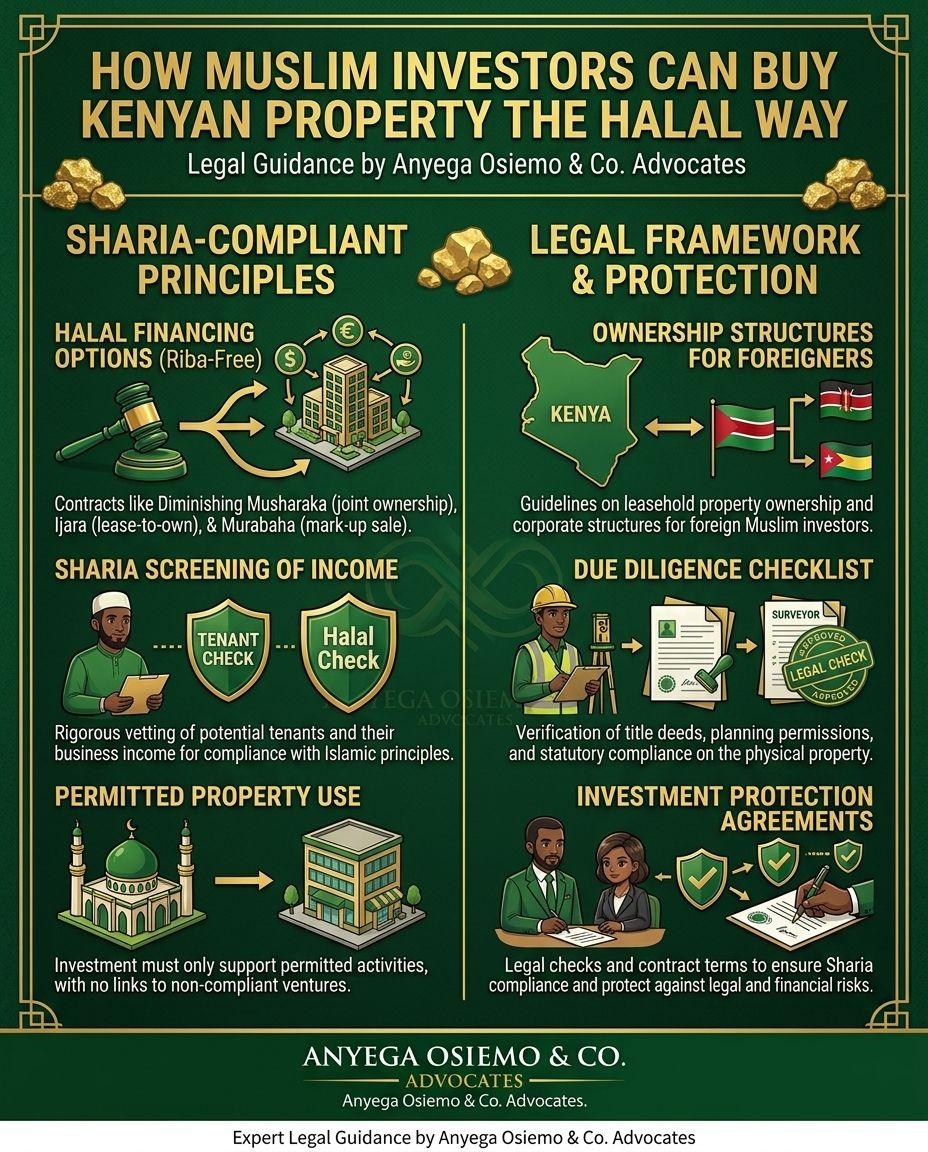
- Ijara leasing: the financier buys the property and leases it to you; rent, not interest, is the return. Lease-to-own variants end with the transfer of title upon the final payment.
- Diminishing musharaka, a declining partnership: you and the financier co-own the property in agreed proportions; you pay rent on the financier's share while buying units of their equity over time, until you own it outright. Each payment shifts ownership and reduces the rent. It is a common Islamic home finance structure available in Kenya through Islamic windows and banks operating in the country.
- Murabaha cost-plus sale: the financier buys the property and sells it to you at a disclosed mark-up, payable in installments. Ownership and risk pass to you at the sale; the mark-up is profit on a trade, not interest on a loan.
- Musharaka and mudaraba joint ventures and investment partnerships: natural structures for development and income projects with partners, with profit shares agreed in advance and losses borne in proportion to capital contributions.
The risks associated with these instruments correspond directly to their structure. For example, a so-called 'murabaha' in which the financier does not actually acquire ownership of the asset, does not bear its risk, and extends funds at a disguised interest rate constitutes riba in substance. Kenyan courts, when called upon to enforce such arrangements, will examine substance over form. Similarly, an ijara arrangement in which the 'rent' is calculated as interest on a declining balance, without genuine lease mechanics, will not withstand scrutiny. These structures are effective only when they reflect actual co-ownership, genuine transfer of risk, and real lease obligations, all of which must be properly documented.
Financing Without Riba: The Kenyan Landscape
Kenya's Islamic finance sector is real and regulated: full-fledged Islamic banks, Islamic windows of conventional banks, and Sharia-compliant products supervised within the Central Bank's licensing framework, with Sharia governance requirements alongside prudential ones. For property finance specifically, the practical routes for a buyer in Kenya are:
- Islamic bank home finance diminishing musharaka or ijara products from the Islamic banks and windows operating in Kenya, in shillings, against Kenyan property, under Kenyan security documentation.
- 2. Offshore Islamic financing: Gulf banks financing Kenyan acquisitions for their clients; workable but layered: the facility, the Kenyan security, and the exchange-control documentation must each be right.
- 3. Partnership with family or investors: a private musharaka: co-owners contribute capital, share rent pro rata, and document buy-out rights. Simple, flexible, and entirely halal when drafted properly. Regardless of the chosen financing route, the documentation must demonstrate compliance with both Sharia requirements and Kenyan law. This includes the financier's actual ownership of the property before any onward sale, charging rent solely on the portion of the property that is genuinely leased, allocation of risk in accordance with the transfer of title, and late-payment remedies that do not constitute disguised interest. The accepted practice is for penalties to direct penalties to charity. Any dispute over these arrangements should be addressed in the Kenyan courts with jurisdiction over the matter.
Structuring the Ownership: Foreigners, Leasehold and Partnership Rules
The foreign Muslim buyer faces the same land rules as every foreign buyer, solved in the same ways, with Sharia partnership principles sitting comfortably on top:
- Leasehold tenure, up to 99 years, is the foreigner's tenure under Article 65 and presents no Sharia issue; a long-registered lease is simply a contractually bound asset, and ijara logic fits it naturally.
- Agricultural land remains the difficult category, restricted for non-citizens under the Lands Control Act; investment exposure here runs through leases, joint ventures with citizen partners, or managed structures, each of which needs both land-law and Sharia review.
- The mechanics of co-ownership are particularly significant for Muslim investors, as partnership is the default form of organization under Sharia. Matters such as co-ownership shares, allocation of rent and expenses, exit and buy-out valuation, and dispute resolution must be clearly documented in a co-ownership agreement acceptable to both a Sharia scholar and a Kenyan court with jurisdiction.
- Corporate wrappers that hold the property through a Kenyan company are lawful and often convenient; the company's activities and financing must themselves be Sharia-compliant, which is a governance matter,r not an afterthought.
Our companion guide to foreign investment in Kenya covers the land-law layer in detail; this article's contribution is to ensure that the structure that satisfies the Lands Registry also satisfies the Sharia review.
Screening the Income: Tenants, Insurance, a nd the Purity Question
An income-producing property raises the screening questions that principal-protected investments do not:
- Tenant activities. The dominant scholarly approach permits leasing to tenants whose businesses include some non-compliant elements (supermarkets sell alcohol-adjacent products; offices house conventional banks), with stricter positions requiring avoidance or purification. Know your school's standards, disclose the tenant mix, and, where strictness is chosen, Nairobi's market is deep enough to find compliant tenants: clinics, logistics firms, professional firms, and halal-certified insurers. Conventional insurance is problematic for many scholars because of gharar and riba in its structure; takaful, the cooperative risk-sharing alternative, is available in Kenya's regulated insurance market and should be specified in the structure where the financier's own Sharia board requires it. board requires it.
- Mixed-income purification. Where income includes a non-compliant fraction, scholars advise purification by donating the offending portion to charity without expectation of reward. Keep the accounts clean enough to compute it.
- REITs and funds. Kenyan REITs and unit funds require screening of their own leverage levels, income sources, and underlying assets. Kenya's market has Sharia-labeled funds under the Capital Markets Authority’s supervision; for others, individual screening is required.
Off-Plan and Development: The Gharar Warning
The Kenyan development market, particularly for off-plan apartment projects with staged payments, presents a specific Sharia concern in addition to the usual legal risks. Contracts for assets that do not yet exist, with delivery scheduled years in the future, incomplete specifications, and a history of developer defaults, involve gharar, or prohibited uncertainty. The classical Sharia solution is istisna, or commissioned manufacture, which allows for this type of forward construction contract when properly structured. This requires defined specifications, clear delivery terms, specified remedies, staged payments linked to actual construction milestones, and the buyer's rights tied to real, registrable outcomes. Many off-plan sales documents do not meet these requirements. They are therefore problematic under both Kenyan law and Sharia, which explains the prevalence of off-plan disputes in Kenyan courts of competent jurisdiction. The prudent and halal approach is to purchase from reputable, well-financed developers, with stage payments held in escrow, registered documentation, and remedies that remain effective in the event of default.
A Worked Example: The Family Apartment in Kileleshwa
Consider the following example. A family from the Gulf seeks to acquire an apartment in Nairobi for use during business visits and to generate rental income at other times, with the intention of avoiding riba in the financing. The structure implemented involved a diminishing musharaka with an Islamic bank: the family contributed 30 percent of the capital, the bank 70 percent, with rent paid on the bank's declining share and the family's monthly acquisition of equity units. The title was registered with the bank's security interest documented as a co-ownership interest, rather than a conventional charge. A takaful policy was arranged for the structure. A co-ownership and family-use agreement addressed occupation periods, rental income sharing in proportion to equity, and buy-out valuation. The property was held under a 99-year leasehold title in the family's Kenyan company. Due diligence included registry searches, rates clearance, and review of the developer's track record, consistent with our standard foreign-buyer checklist. Every aspect of the transaction was reviewed by both the bank's Sharia board and Kenyan legal counsel. The family's subsequent question was not about compliance, but rather why their previous adviser had recommended a conventional mortgage.
Ten Mistakes Muslim Investors Make with Kenyan Property
- Accepting a conventional mortgage, even temporarily, does not resolve the issue of riba; intention alone does not cure the defect. The financing arrangement is the first aspect of the structure that must be addressed.
- 2. Murabaha arrangements in which the financier neither acquires ownership nor bears the risk of the asset will fail both Sharia and legal scrutiny.
- 3.Failure to document co-ownership arrangements poses a significant risk; a musharaka without a written partnership agreement is likely to lead to future disputes among family members.
- 4Neglectingng the land-law aspects of the transaction is a critical error; even Sharia-compliant structures will fail if the title is forged or interests are unregistered.
- 5.Entering into off-plan purchases without adherence to istisna principles exposes the investor to undefined assets and unsecured stage payments, both of which constitute gharar.
- 6. Failing to screen the tenant mix for compliance may result in income that does not meet Sharia requirements, even if the initial purchase was compliant.
- 7. Defaulting to conventional insurance is unnecessary, as takaful is available in Kenya. It should be specified in the transaction where required.
- 8. Assuming that the use of a corporate wrapper ensures compliance is incorrect; the company's financing and activities must be independently reviewed for Sharia compliance.
- 9. Failure to maintain proper records for income purification will result in unresolved compliance questions regarding mixed income.
- 10.Limiting the review to only one discipline is inadequate; both the Sharia adviser and Kenyan legal counsel must review the same set of documents. Discrepancies between their reviews are a common source of investment failure.
Frequently Asked Questions
Q1. Can a foreign Muslim buy property in Kenya without interest-based finance?
A. Yes. Diminishing musharaka and ijara products are available from Kenya's Islamic banks, and private partnership structures are always available; the property must be leasehold, as for any foreigner.
Q2. What is the difference between ijara and diminishing musharaka?
A. Ijara is a lease you rent, with or without a path to ownership. Diminishing musharaka is a form of co-ownership: you buy equity units over time while renting the financier's remaining share, culminating in full ownership.
Q3. Is murabaha just a disguised loan?
A. It can be when poorly structured. Genuine murabaha requires the financier to buy, own, and bear the risk in the asset before selling it to you at a disclosed mark-up; substance, not labels, determines both the Sharia ruling and the legal characterization
Q4. Can I rent my property to a non-halal business?
A. Positions differ among schools; many permit it with disclosure or purification; stricter views avoid it. Know the standard you follow and document the tenant mix accordingly.
Q5. Does Kenya have takaful?
A. Yes, takaful operators work within Kenya's regulated insurance market, and financiers' Sharia boards commonly require it for financed property.
Q6. Are Kenyan REITs halal?
A. Some are, after screening leverage and income; Sharia-labeled funds exist under CMA supervision. Screen individually or buy the llabeledproducts.
Q7. Is buying off-plan halal?
A. Potentially, under istisna principles, defined specifications, milestone-secured payments and real remedies. Most off-plan contracts as drafted fail both the gharar test and the prudence test.
Q8. How do I hold agricultural land as a halal investment?
A. Through leasehold structures, joint ventures with citizens, or managed arrangements, all lawful, all requiring dual review of land law and partnership terms
Q9. What documents should a Sharia review cover?
A. Everything the lawyer reviews: the facility agreement, co-ownership agreement, lease, security documents, insurance, and the company's governance documents where a corporate wrapper is used.
Q10. Who should review my structure?
A. Both your Sharia advisers and Kenyan counsel are reading the same. At Anyega Osiemo & Company Advocates, we provide comprehensive structuring of property investments in Kenya for Muslim clients. Our services include coordination with Sharia advisers and financiers, preparation of documentation for diminishing musharaka and co-ownership arrangements, conducting land-law due diligence, structuring of corporate wrappers, and handling of registration. Where disputes arise, we provide resolution services. We also assist Islamic banks and takaful operators with the documentation required for Sharia governance. We also work with Islamic banks and takaful operators on the documentation that their Sharia governance requires
Disclaimer: This article is general legal information, not legal advice. For guidance on your specific situation, book a consultation with our advocates.