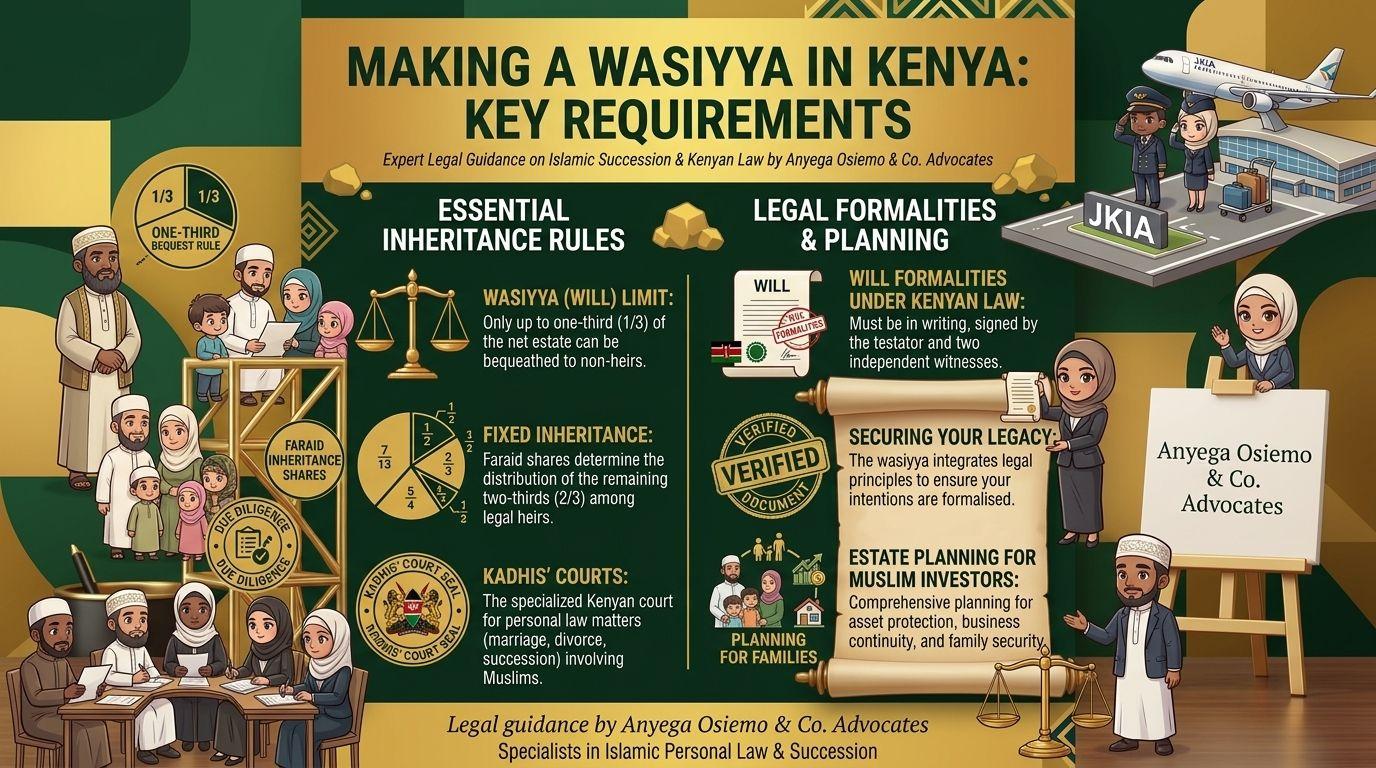
For members of Kenya's Muslim community, as well as Muslim investors from the Gulf and other regions who hold assets in Kenya, the wasiyya (Islamic will) determines the distribution of property upon death. When properly drafted, it complies with the fixed shares prescribed by the Quran, permits only bequests allowed by Islamic law, and facilitates transfer through Kenyan legal processes. If the wasiyya is not prepared in accordance with both Sharia and Kenyan legal requirements, disputes may arise. These disputes may lead to prolonged litigation before Kadhis' courts and succession courts, including disputes over contested shares, unlawful bequests exceeding the one-third limit, and property that cannot be transferred due to non-compliant documentation.
This guide sets out the operation of the wasiyya under Kenyan law, including the relevant Sharia principles, the Kenyan legal procedures that implement them, and the planning required to ensure compliance with both systems. The information provided is general in nature and does not constitute a religious ruling or legal advice for specific cases. Individuals should seek guidance from qualified Sharia scholars and Kenyan legal counsel regarding their particular circumstances.
The Foundation: What the Wasiyya Is and Is Not
Under Islamic law, a person's estate passes principally by the fixed shares of faraid, the Quranic inheritance scheme allotting defined portions to defined relatives: children at two-to-one by gender, a wife one-eighth where the deceased left children (one-quarter without them), a husband one-quarter with children (one-half without), parents their sixths where children exist, and so on through the table of relatives. The deceased's power to redirect this distribution is deliberately narrow, and this is where the wasiyya comes into play.
The core rules, consistent across the Sunni schools, with variations in detail:
- The one-third ceiling. No more than one-third of the estate may be bequeathed by wasiyya and, in the dominant classical position, bequests to legal heirs (those who take faraid shares) are invalid unless the other heirs consent after the death.
- Beyond the heirs. The wasiyya's proper field is non-heirs: charity, non-relative beneficiaries, causes and institutions dear to the testator.
- Debts first. Funeral expenses, debts and obligations are discharged before any distribution; the wasiyya and the faraid shares divide only what remains.
Accordingly, the wasiyya does not confer unrestricted testamentary freedom. It is a limited instrument that operates within a defined legal framework. Attempting to draft a wasiyya as a conventional will, for example, by purporting to leave the entire estate to a single beneficiary, does not alter the prescribed distribution. It results in an invalid bequest and is likely to generate disputes among the heirs.
How Kenyan Law Carries the Wasiyya
Kenya's legal system accommodates Muslim personal status law with unusual completeness:
- The Law of Succession Act does not govern Muslim estates. Muslims in Kenya are governed by Islamic law on marriage, divorce, and inheritance, an exclusion the Act itself recognises and that shapes every procedural question below.
- Kadhis' courts are constitutionally established courts with jurisdiction over matters of Muslim personal status, including inheritance disputes.
- They determine matters of marriage, divorce, and inheritance for Muslim parties, with the same status as Magistrates' Courts. Succession questions for Muslim estates are determined within this framework.
- Registries still need Kenyan paper. Land, vehicles, shares, and accounts are transferred through Kenyan registries and institutions, which operate on documents they recognise, such as succession certificates or grants, death certificates, and registration forms. The Kadhi's determination of the heirs and their shares must be recorded in the registries using the appropriate Kenyan instruments.
- The formal requirements for a valid wasiyya are drawn from the general law. Regardless of the forum, the wasiyya should be executed in writing, signed by the testator, and witnessed by two competent adults who are not beneficiaries. Compliance with the execution standards set out in Section 11 of the Law of Succession Act helps ensure that the wasiyya is recognized by all Kenyan institutions, irrespective of the religious context.
Where a Muslim estate involves non-Muslim co-owners, foreign assets, or family members of different faiths, the administration process requires coordination between the Kadhis' courts and the general succession courts. These complex matters require experienced legal counsel to ensure compliance with all applicable legal requirements.
The One-Third Rule in Practice: Getting the Arithmetic Right
Most defective wasiyyas fail because a bequest to an heir is invalid at execution and only becomes effective if, after the testator's death, the heirs who would otherwise be entitled to the share consent to the bequest. If the intention is to seek such consent, the wasiyya should be drafted to reflect this, and the consents should be documented carefully for administration after death.
- Valuation disputes follow every percentage. Real estate and business interests must be valued to apply the third; ambiguity about value is ambiguity about the bequest. Define the valuation approach or identify the asset specifically.
- In polygynous marriages, the spousal share under faraid is divided equally among the wives. Where there are two, three, or four wives, they collectively receive the one-eighth (or one-quarter) share and divide it equally among themselves. This rule is especially important in estate planning for polygynous families and may differ significantly from the rules in other jurisdictions.
Special Situations Muslim Testators Must Plan For
The non-Muslim spouse. The classical rule denies mutual inheritance between Muslim and non-Muslim spouses, and Kenyan courts applying Islamic law have wrestled with its application, including high-profile controversy over estates where a non-Muslim wife was excluded under faraid. The honest position: this area is contested, the outcomes are fact-sensitive, and the protection a surviving non-Muslim spouse will actually receive depends on planning done during the marriage, wasiyya within the third, inter vivos arrangements, and structures that do not depend on inheritance at all. No responsible adviser leaves this to chance; none should promise certainty either way.
Charitable bequests may be made through the wasiyya, provided they fall within the one-third limit. These may include gifts to mosques, schools, humanitarian causes, or the poor. Kenya's statutory framework for waqf (charitable endowments) is less developed than in some other jurisdictions. As a result, establishing durable charitable structures for Kenyan assets requires careful legal drafting. It may involve trusts or incorporated entities to preserve the charitable purpose under both Islamic and Kenyan law.
Foreign assets and foreign testators. A Muslim investor abroad holding Kenyan property needs documents that work in both directions: a wasiyya or will effective under the law of domicile for foreign assets, and Kenyan-compliant instruments for Kenyan land, accounts, and shares. Where a foreign grant of probate exists, Kenya's resealing machinery can carry it over to the Kenyan registries; where none exists, the Kenyan succession process applies to Kenyan assets.
Unpaid zakat constitutes a debt of the deceased and must be settled before any distribution of the estate. Executors and heirs often overlook this obligation until it arises during administration. It is advisable to include a record of the deceased's outstanding zakat obligations in the estate documentation.
The Process, Step by Step
- Take stock and take advice: assets and liabilities, family tree (including all wives and children), existing documents, and the scholars who will govern the religious questions.
- 2. Compute the framework: debts and funeral expenses; the one-third envelope; the faraid shares for the heirs as they stand; the shares are recalculated with every birth and death in the family.
- 3. Draft the wasiyya: ensure that bequests do not exceed the one-third limit, direct them to non-heirs or to heirs subject to post-death consent, and execute the document in compliance with Kenyan formalities, including writing, signature, and two independent witnesses.
- 4. Prepare the companion register. Review the wasiyya whenever there is a change in family circumstances, such as marriage, divorce, birth, death, or the acquisition of new assets. Each of these events may alter the distribution of shares, and an outdated wasiyya may result in an incorrect allocation of the estate. For example, birth, death, or acquisition each recalculates the shares, and a wasiyya drafted for last year's family misdirects this year's estate.
- 5. On death: the heirs proceed through the appropriate forum, the Kadhis' court, for Muslim personal-status determination, coordinated with the registries' documentation requirements. Consider the following example: A Muslim investor from the Gulf, married to two wives, owns an apartment in Nairobi, holds shares in a Kenyan company, and maintains accounts in both Nairobi and Dubai. His objectives are to make a charitable bequest to a school, provide for both wives in accordance with the law, and prevent disputes between the two households. Nairobi and Dubai. He wishes to benefit a charitable school, clearly provide for both wives, and avoid any dispute between the households.
On legal advice, the estate plan is structured as follows: the majority of the estate is distributed according to faraid, with both wives sharing the one-eighth spousal share and the children receiving the remainder in the prescribed proportions. A wasiyya within the one-third limit provides a specified cash sum to the charitable school, with the value clearly defined to prevent disputes. The Kenyan apartment and company shares are listed in an asset register, and the wasiyya is executed in accordance with Kenyan legal formalities. The Dubai assets are addressed in a separate instrument compliant with UAE law, with Kenyan counsel ensuring there is no inconsistency between the documents. Upon the testator's death, the administration proceeds efficiently: the Kadhi's court determination is consistent with the documented plan, no consents are required as the bequest is to a non-heir, and the registries accept the necessary instruments. The estate is administered without unnecessary conflict.
Ten Mistakes in Muslim Estate Planning in Kenya
- Bequeathing more than a third invalidates the bequest beyond the ceiling, and the excess invites exactly the litigation the wasiyya was meant to prevent.
- 2. Bequeathing to heirs without planning for consent, the bequest fails unless heirs consent post-death; draft for that reality or avoid the field.
- 3. Ignoring Kenyan formalities, a wasiyya that Kenyan registries cannot process is a religious document with no legal transport.
- 4.Forgetting the debts-first order, zakat, loans, and obligations rank before the third and the shares alike.
- 5.No valuation discipline: percentage bequests over undefined assets are disputes in waiting.
- 6. Overlooking the recalculation problem, every family change rewrites the faraid table; undated wasiyyas misdirect estates.
- 7. Leaving the non-Muslim spouse unplanned contested law, fact-sensitive outcomes, and the protection must be built during the marriage.
- 8.Assuming the Kadhis' court finishes the job, the religious determination still requires registry documentation to transfer property.
- 9.Charitable intentions without durable structures: a bequest to a cause needs a receiving structure that survives in Kenyan law.
- 10.One document for two jurisdictions: foreign assets and Kenyan assets need instruments each system will carry; coordination is the craft.
Frequently Asked Questions
Q1. Can I leave everything to my wife in a wasiyya?
A. No. The wife's share is fixed by faraid (one-eighth with children, one-quarter without), and bequests beyond one-third to anyone are invalid. Provision beyond the fixed shares requires lifetime arrangements rather than the wasiyya.
Q2. What happens if I die without a wasiyya?
A. Faraid governs the entire estate; the fixed shares apply automatically through the succession process. The wasiyya's role is the charitable third and specific non-heir bequests; without one, that flexibility is lost.
Q3. Do I need a Kadhi’s court for a Muslim estate in Kenya?
A. Muslim personal-status succession is determined within the Kadhis' court framework; the resulting determination is then carried into land, vehicle and account registries through the correct instruments. Mixed estates coordinate with the general succession courts.
Q4. Can I name an executor?
A. Yes, and you should. The wasiyya can nominate an administrator or executor, subject to the court's appointment; a trusted, competent nominee is worth more than any clause.
Q5. What about my non-Muslim wife and children?
A. The classical rule and its Kenyan application are contested and fact-sensitive; planning during the lifetime within the third, and through structures that do not depend on inheritance, is the only reliable protection. Take specific advice from both your scholars and Kenyan counsel.
Q6. Are my four wives each entitled to a full spousal share?
A. They share the wife's quota one-eighth (with children) or one-quarter (without) divided equally among them under the classical rules applied in Kenya.
Q7. Can my heirs agree to divide the estate differently after my death?
A. Yes, heirs may consent to redistribution among themselves, and heir-directed bequests can be validated by post-death consent. Such arrangements must be documented with the same care as the wasiyya itself.
Q8. Does a wasiyya avoid Kenyan probate?
A. No. The estate still passes through the succession and registration machinery; the wasiyya directs the religious distribution, and the Kenyan process carries it out.
Q9. Can I benefit a charity or build a waqf?
A. Within the one-third, yes, and it is among the wasiyya's most honored uses. Durable charitable structures for Kenyan assets need specific drafting to survive in Kenyan law.
Q10. Where do Sharia rulings end and Kenyan law begin?
A. The scholars govern the religious validity; Kenyan courts and registries govern the legal transport. Both authorities must be satisfied, and the planning that serves one while ignoring the other fails at death, when both arrive together.
How We Can Help
At Anyega Osiemo & Company Advocates, we prepare wasiyyas and Muslim estate plans that function as both religious instruments and Kenyan legal documents: working with our clients' Sharia advisers on the distribution framework, executing to full Kenyan formalities, preparing asset registers, coordinating Kadhis' court determinations with registry transfers, planning for polygynous and mixed-faith families, and administering estates when the time comes in coordination with counsel abroad where assets span jurisdictions
Disclaimer: This article is general legal information, not legal advice. For guidance on your specific situation, book a consultation with our advocates.