Islamic finance in Kenya has transitioned from a marginal activity to a regulated part of the financial sector. Islamic banks are licensed by the Central Bank, Sharia-compliant funds are supervised by the Capital Markets Authority, and takaful operates within the established insurance framework. However, the underlying instruments—murabaha, mudaraba, musharaka, and ijara—are not well understood by many market participants. Their enforceability is frequently doubted, often without proper legal analysis.
A careful legal analysis demonstrates that, when properly structured, Islamic finance contracts are enforceable in Kenya as the legal forms they represent, namely sale, partnership, lease, and agency agreements, governed by the general law of contract. These agreements must have genuine commercial substance, which Kenyan courts are competent to assess and enforce. If the contracts are not properly structured, they fail both as valid Sharia instruments and as enforceable legal agreements. This guide sets out the principal types of Islamic finance contracts, the legal and Sharia conditions each must meet, and the drafting considerations necessary for enforceability. It is intended as general information and should be supplemented by advice from qualified Sharia scholars regarding religious compliance in specific cases.
The Enforceability Question, Answered First
Kenya has no statute conferring or denying special status on Islamic finance contracts, and none is needed. They are contracts: formed under the Law of Contract Act and common-law principles, enforceable by the ordinary courts, subject to the same doctrines of capacity, consideration, certainty, and legality as any other agreement. What distinguishes them is commercial architecture: they route returns through trade, partnership, and lease mechanics rather than interest. The enforceability risks, therefore, arise not from any hostility to Islamic finance but from poor architecture: agreements that say "murabaha" that function as disguised loans, partnerships without partnership terms, and leases without lease mechanics. Courts enforce substance. The drafting task is to make the substance worthy of the name.
The Principal Instruments and Their Conditions
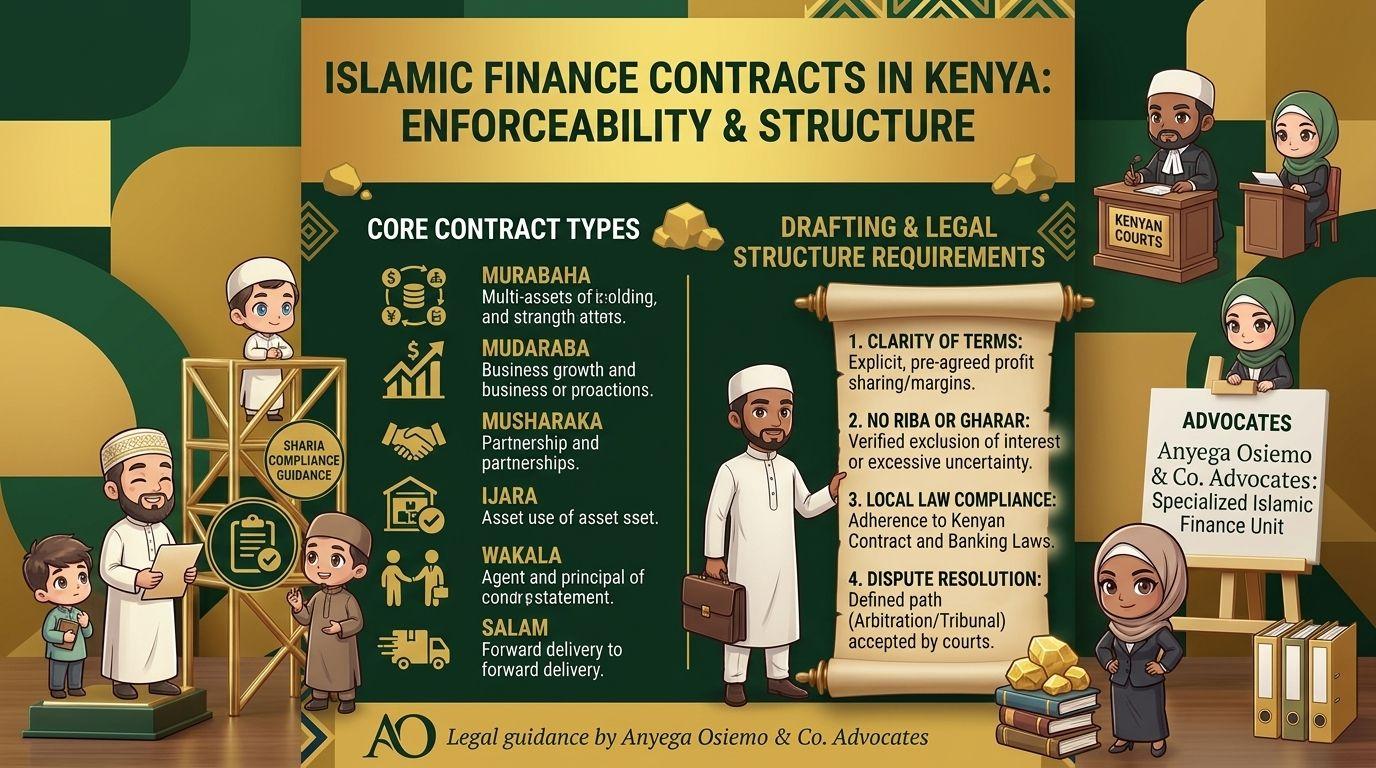
Murabaha: the cost-plus sale. The financier purchases an asset the client wants, then sells it to the client at a disclosed mark-up, payable immediately or in deferred installments. The non-negotiable conditions: the financier must actually buy and own the asset before reselling; must bear its risk at least momentarily; must disclose cost and mark-up; and may not charge the mark-up as time-based interest on a loan balance. Late-payment penalties, where agreed, cannot accrue to the financier as income; the accepted device routes them to charity. Murabaha dominates Islamic trade finance globally: a Dubai–Nairobi commodity flow financed on murabaha is standard practice, and Kenyan courts will enforce the sale documents as sales,s provided the purchase and sale are real.
Mudaraba: the investment partnership. One party contributes capital (rabb al-mal); the other contributes effort and expertise (mudarib). Profits are shared according to an agreed-upon need ratio, with any financial loss borne solely by the capital provider, unless the mudarib was negligent or breached the mandate. The structure is the classical answer to "I have capital, you have expertise," and its drafting must reflect what it is: agency-like duties, reporting obligations, investment parameters, and no guarantee of principal. A mudaraba promising fixed returns or capital protection has reinvented the deposit it claims not to be.
Musharaka: the equity partnership. All partners contribute capital (and may contribute effort); profits follow agreed ratios; losses follow capital contributions. For Kenyan ventures in property development, trading businesses, and agri-processing, musharaka is the natural Islamic joint-venture form, and its documentation is ordinary partnership documentation with Sharia-specific sensitivities: no guaranteed returns, no partner extracting a fixed "priority" profit disconnected from performance, and exit and valuation mechanics that track equity rather than debt.
Ijara: the lease. The financier owns an asset and leases it for rent; ownership obligations (major maintenance, insurance, loss) stay with the lessor; a lease-to-own variant (ijara muntahia bittamleek) transfers title at the end of the term against the final payment. The conditions that keep it real: rent is charged only on the asset actually leased, ownership risk genuinely remains with the lessor during the term, and the "rent" is not secretly calculated as interest on a notional loan.
Wakala: the agency. Appointing an agent to act for a fee is the backbone of Islamic treasury, custody, and payment services, as well as the safekeeping arrangements for assets such as allocated gold. The agent owes fiduciary duties; the fee must be for real service.
Salam and istisna: the forward contracts. Salam: full prepayment now for defined goods delivered later, the classical forward sale, used in commodity flows. Istisna: commissioned the manufacture of the framework for construction and off-plan property, tying payments to defined milestones. Both are permissible precisely because the classical law built uncertainty-controls around them: defined specifications, defined delivery, defined remedies. Contracts that abandon those controls inherit both the gharar problem and, frequently, the disputes.
What Kenyan Courts Will Look At
When an Islamic finance dispute reaches a Kenyan court, and some do, the analysis tracks ordinary commercial law:
- Substance over labels. An agreement reciting "murabaha" in which the financier never owned the asset will be analysed as what it was in practice: a loan, with all that implies for the treatment of the mark-up.
- Certainty of terms. Profit shares, rent, delivery obligations and valuation mechanics must be ascertainable; musharaka buy-outs "at fair value to be agreed" are invitations to litigation.
- The partnership terms. Mudaraba and musharaka disputes turn on the same questions as any partnership dispute: what was contributed, what was authorized, what was reported, what was lost, and why.
- Security and recovery. Kenyan security law (charges, guarantees) ordinarily attaches to these structures; the financier's remedies on default are contractual and possessory, and the absence of interest does not weaken them where the structure is real.
The practical requirement for those drafting these contracts is to assemble documentation that allows a judge unfamiliar with Islamic finance to understand the transaction. This includes purchase invoices that demonstrate the financier's ownership, lease registers, and partnership accounts. Both religious validity and legal enforceability depend on the same evidentiary record.
Drafting for Dual Validity: The Checklist
For each instrument, the file should contain what the Sharia reviewer needs and what the court will ask for:
- For murabaha: evidence of the financier's purchase (invoice, transfer), disclosure of cost and mark-up, the sale contract, the payment schedule, and the charity-routing clause for late penalties.
- For mudaraba: evidence of capital contributions, the mandate and investment parameters, reporting and audit rights, the loss-allocation clause; and the prohibition on principal guarantees.
- For musharaka: capital accounts, profit ratios, loss ratios tied to capital, management roles, exit and valuation mechanics, and dispute resolution.
- For ijara: the asset schedule, the lease terms, maintenance and insurance allocations, and the title-transfer mechanics in lease-to-own variants.
- For all of them: governing law and forum clauses (Kenyan law, Kenyan courts, or arbitration under the New York Convention, with arbitral awards enforced), and, where a Sharia board or advisor is named, a governance clause specifying whose standards govern compliance.
The Dispute Resolution Layer
Islamic finance disputes in Kenya are contested in ordinary forums, the commercial courts or arbitration, where the contract provides for it. Two drafting decisions shape that future: the forum clause (Kenyan courts are competent and improving; arbitration, seated in Nairobi under the NCIA or another institution, offers privacy and enforceability abroad under the New York Convention), and the Sharia-compliance clause (whether non-compliance is a breach, a voiding event, or a matter for expert determination, a question that should be answered in the contract, not discovered in the dispute). For cross-border structures, the Gulf capital and the Kenyan asset arbitration under the New York Convention are usually the professional choices.
A Worked Example: Financing the Import Cycle
Consider the following example. A Nairobi trading company imports electronics from Dubai on sixty-day supplier terms. Its financier provides working capital using a murabaha structure: the financier purchases specific consignments from the supplier, as evidenced by invoices and bills of lading in the financier's name, and then sells the goods to the trading company at a disclosed mark-up, payable over ninety days. For each transaction cycle, the documentation includes the supplier invoice, proof of the financier's ownership, the murabaha sale agreement with the mark-up stated as a lump sum, the payment schedule, and a clause directing late payment penalties to charity. If, for instance, the trading company defaults on the ninth of twelve cycles, the financier's claim is a straightforward seller's action for the price of goods sold and delivered. The supporting documents—purchase invoices, title evidence, and sale contracts—are sufficient for enforcement, without the need to explain Islamic finance principles to the court. The clarity of the transaction's substance is what ensures its enforceability.
Ten Mistakes in Structuring Islamic Finance in Kenya
- Murabaha without ownership: the financier who never buys the asset has written a loan with extra steps.
- 2. Mudaraba with guaranteed principal: the guarantee converts the partnership into a deposit, destroying the structure's logic.
- 3. Musharaka with fixed-priority return: equity partners share performance, not a disguised coupon.
- 4. Ijara rent on a phantom balance: rent must attach to the asset actually leased.
- 5.Late penalties accruing to the financier: the accepted device routes them to charity; income-ifying them re-creates riba.
- 6. Gharar in forward contracts: salam and istisna work because their controls work; strip the controls and inherit both sin and litigation.
- 7. No evidence file: courts enforce what they can see; purchase invoices and title documents are evidence of enforceability.
- 8. Vague valuation and exit mechanics: partnership disputes are won on pre-agreed numbers.
- 9.Silent Sharia-compliance clauses: whether non-compliance voids, breaches,s or requires expert determination must be written down.
- 10. One-sided review: a contract that satisfies only the Sharia board or only the lawyer satisfies neither when tested.
Frequently Asked Questions
Q1. Are Islamic finance contracts enforceable in Kenyan courts?
A. Yes. They are enforceable as contracts under Kenyan law; the courts analyze the substance, so structures that are commercially real and genuine, such as partnerships or lease arrangements, are ordinarily enforced.
Q2. Is murabaha interest with extra paperwork?
A. A defective murabaha can be. A genuine one requires the financier to buy, own, and risk the asset before reselling at a disclosed mark-up; the distinction is substantive, and both Sharia reviewers and courts look for it.
Q3. What happens if a mudaraba investment loses money?
A. The capital provider bears financial loss, unless the manager was negligent or breached the mandate; the agreed ratios share profits. Any promised capital protection contradicts the structure.
Q4. Can late payment be penalized?
A. Yes, but penalties should not accrue as income to the financier; the standard device routes them to charity, preserving deterrence without riba.
Q5. Which disputes decide these cases?
A. Evidence of ownership and contribution, certainty of terms, and the partnership records are the same materials that decide ordinary commercial disputes.
Q6. Should these contracts provide for arbitration?
A. For cross-border structures, usually a Nairobi-seated arbitration with New York Convention reach is private and internationally enforceable; for purely domestic deals, Kenyan courts are competent.
Q7. Who certifies Sharia compliance in Kenya?
A. Institutions use internal Sharia advisory boards or external Sharia advisors; for private structures, an independent scholar's review documented in the file is the professional standard.
Q8. Do these structures work for foreign investors?
A. Gulf and other investors widely use them in Kenya; the structure, security, and forum questions carry an extra cross-border layer.
Q9. What is the role of AAOIFI standards?
A. They are the reference standards most Sharia boards apply; a contract stating that AAOIFI standards govern compliance gives the reviewer and the court a fixed benchmark.
Q10. Where do I start with a proposed transaction?
A. With both reviews commissioned on the same documents, a Sharia advisor and Kenyan counsel should review before anything is signed.
How We Can Help
At Anyega Osiemo & Company Advocates, we draft and review Islamic finance documentation for institutions and investors: murabaha and trade-finance files, mudaraba and musharaka partnerships, ijara and lease-to-own structures, wakala agency arrangements, and the security and dispute-resolution architecture around them, working alongside Sharia advisors so the documents carry both signatures' worth of validity. We also act in disputes when structures are tested
Disclaimer: This article is general legal information, not legal advice. For guidance on your specific situation, book a consultation with our advocates.