Each week, experienced professionals, including businesspeople, engineers, traders, doctors, and investors, transfer substantial sums to gold operations in Nairobi that are established solely to receive such payments. When these schemes inevitably collapse, victims often question how they became involved. The reality is that the process is deliberately structured and refined to systematically create trust, urgency, and commitment. Recognising and understanding this process is essential, as each stage is characterised by identifiable participants and indicators.
This article provides a detailed analysis of the operation, outlining its stages, participants' roles, the psychological mechanisms employed, and warning signs that can be identified before any financial loss occurs. The analysis is based on documented patterns observed in prosecutions, investigations, and recovery proceedings involving fraudulent gold operations.
The Operation at a Glance: Cast and Stages
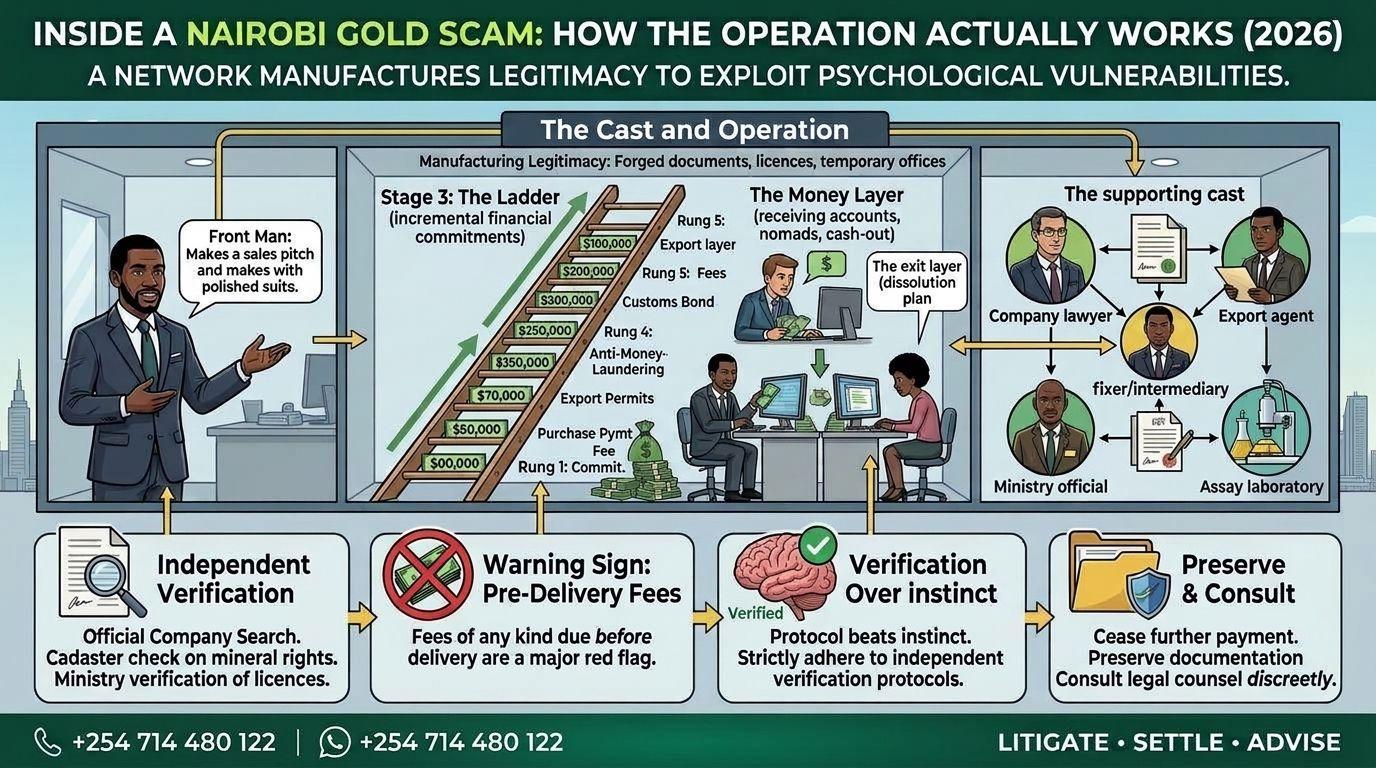
A professional gold export fraud is structured as a network comprising individuals with defined roles, rather than a single individual acting alone.
- The front man, polished, articulate, often with genuine industry vocabulary; the face of the operation.
- The fixer or intermediary, the connector who found you, vouched for the operation, and is often secretly the operation's own employee.
- The supporting cast: the "company lawyer," the "export agent," the "ministry official," the "assay laboratory", some hired actors, some complicit professionals, some entirely fabricated.
- The money layer: receiving accounts, nominees, cash-out channels.
- The exit layer: the dissolution plan that activates the moment heat arrives.
The following stages describe how participants in the operation engage with the victim.
Stage 1: The Bait Discount Gold Does Not Exist
The initial approach typically involves an offer to purchase gold at a price significantly below the prevailing London spot price, often justified by claims of urgent liquidity needs, informal sourcing, direct access to mines, or the avoidance of intermediaries. Such a discount is not a legitimate commercial opportunity but rather a mechanism to identify individuals willing to rationalise an implausible offer. Established buyers, refiners, and financial institutions do not engage with such proposals, allowing the operation to focus exclusively on susceptible targets. Any unsolicited offer of gold at a price materially below market value should be regarded as a clear indicator of fraud. In legitimate transactions, gold is not sold at a discount to unknown parties.
Stage 2: The Showroom Manufacturing Legitimacy
Victims who proceed are introduced to an environment designed to create an appearance of legitimacy. This may include registered companies (as incorporation is inexpensive), professionally presented offices (often short-term rentals), displayed licences (which may be forged or improperly obtained), professional websites, courteous staff, and branded documentation. Some schemes may even arrange visits to purported mining sites or offices. The objective is to provide the impression that due diligence has been conducted. However, these demonstrations are superficial and do not constitute genuine verification. Company registration merely confirms existence, not business activity; office premises may be temporary; and licence numbers may not correspond to the actual rights claimed. Proper verification must be conducted independently, through official registries and laboratories selected by the prospective buyer.
Stage 3: The Ladder Small Commitments Climbing to Large Ones
The operation is structured to request incremental financial commitments from the victim, rather than demanding the full amount at the outset.
- A modest "reservation" or "commitment fee" small enough to rationalise.
- A purchase payment: now you are invested, financially and psychologically.
- Subsequently, a series of additional fees is introduced, including charges for export permits, anti-money-laundering clearance, taxes, customs bonds, storage, insurance, and airport release. Each fee is accompanied by documentation, which is typically forged, and is presented as the final requirement until another is introduced. The perpetrators' financial gain derives exclusively from these fees, as no gold is ever delivered.
- Optional rungs: "test shipments" of real small quantities to prime larger wires; "urgent problems" requiring emergency payments; new "opportunities" to recover prior payments (recovery fraud's first cousin).
This incremental approach exploits a well-documented psychological bias: individuals who have already made financial commitments are more likely to continue investing to recoup prior expenditures. The operation relies on this tendency to secure additional payments. The most effective means of prevention is to cease participation at any stage, regardless of prior investment, despite the difficulty.
Stage 4: The Pressure Playbook Urgency as a Weapon
At each stage, the operation imposes artificial deadlines, such as claims of imminent buyers, fluctuating prices, expiring export windows, or waiting officials, to create a sense of urgency. This urgency is intended to discourage independent verification and to prompt emotional rather than rational decision-making. It is notable that legitimate gold transactions can withstand extended periods of due diligence and verification, whereas fraudulent schemes cannot. Any transaction that penalises patience or discourages verification should be treated with suspicion.
Why Smart, Cautious People Fall
Victims of these schemes are not lacking in intelligence or experience. The operations exploit common psychological and procedural vulnerabilities, including the appearance of authority, the presence of official documents, social validation, artificially created scarcity and urgency, and the incremental escalation of commitments. The most effective safeguard is the implementation of a strict protocol of independent verification, which must be adhered to regardless of external pressure or deadlines. Such protocols are essential, as fraudulent operations cannot withstand thorough and independent scrutiny.
The Red-Flag Master List
The presence of any single warning sign should prompt immediate reconsideration of the transaction. The occurrence of multiple indicators should result in termination of the engagement.
· Below-spot pricing, from any source, for any stated reason
· Cold approaches over LinkedIn, WhatsApp, email
· Fees of any kind due before delivery permits, taxes, clearances, storage
· Refusal of independent escrow or of your own laboratory
· Documents that cannot be verified in official registers you search yourself
· Directors who never appear; authority that lives in stories
· Urgency at every stage; deadlines that punish verification
· Receiving accounts in third parties' names
· Test deals engineered to prove little about the promised volume
· "Government connections" presented as deal lubricant
· Resistance to your own lawyer's involvement
· Pressure to keep the transaction "confidential"
If You're Inside One Right Now
If you identify the described pattern within your own transaction, it is advisable to cease further engagement immediately. It is important not to disclose your suspicions or confront the parties involved. Instead, preserve all documentation, export all correspondence, maintain a record of all payments, and consult legal counsel before the operation becomes aware of your actions. Once suspicion is detected, the perpetrators typically act swiftly to conceal evidence and move funds. Further guidance on verification procedures and recovery processes, including freezing orders, asset tracing, and civil recovery, is available in our companion materials. Timeliness is critical in maximising the prospects of recovery.
A Worked Example: The Investor Who Stopped at Rung Two
Consider the following composite example: A European commodity trader receives an offer to purchase 30 kilograms of gold at 8% below the spot price, with delivery terms to Dubai. The offer is presented through an intermediary, with supporting documentation and an impressive office setting. The trader, having previously encountered a similar situation, adheres to a strict protocol: conducting an independent company search (revealing directors unknown to him), verifying the claimed licence through the cadastre (the number is genuine but registered to a different entity), directly contacting the laboratory listed on the assay certificate (the serial number is assigned to another client), and insisting on escrow arrangements through his own legal representatives and laboratory, with staged delivery. The operation refuses these conditions, citing deadlines and offended partners. The trader withdraws without confrontation, retaining all documentation. Subsequently, he learns that the same operation has been implicated in multiple cases across several countries, resulting in arrests. The trader's adherence to protocol, rather than reliance on instinct, prevented financial loss.
Ten Mistakes That Feed the Operation
1. Rationalising below-market pricing as opportunity instead of bait.
2. Conducting due diligence within the operation by examining its offices, reviewing its documents, and assessing the legitimacy of its representatives.
3. Making an initial payment without adequate verification, in the hope of progressing the transaction.
4. Accepting advance fees as a standard business expense, rather than recognizing them as a hallmark of fraudulent activity.
5. Allowing previous financial commitments to prevent withdrawal from the transaction at later stages.
6. Complying with artificial deadlines set by parties who have not yet delivered on their obligations.
7. Mistaking the presence of registration documents, physical premises, and paperwork for evidence of actual gold holdings.
8. Relying on intermediaries without full disclosure of their interests or involvement in the transaction.
9. Maintaining confidentiality of the transaction as directed by the other party, which serves to isolate the victim rather than protect legitimate interests.
10. Confronting the perpetrators directly, rather than discreetly preserving evidence, can compromise the possibility of recovery.
Frequently Asked Questions
Q1. How do gold export scams actually work?
A. A network manufactures legitimacy (offices, documents, officials), hooks victims with below-market pricing. It monetises through a ladder of advance fees, purchase payments, export permits, taxes, and clearances, with no gold ever existing. Urgency suppresses verification at every stage.
Q2. Why do the fees never end?
A. Because the fees are the business. With no metal to sell, every shilling of profit must arrive as a pre-delivery payment, each explained as the last.
Q3. Are the mining licences and assays ever real?
A. The documents are usually forged or composed from genuine records: a real licence number belonging to a stranger's operation, an assay certificate copied from a real laboratory. Direct verification through official channels detonates them.
Q4. Do real test shipments prove anything?
A. Nothing about the promised volume. A few genuine grams or small bars seed large wires; the stockpile they represent does not exist.
Q5. Why do smart people fall for this?
A. Because the process exploits universal psychological machinery: authority, urgency, sunk costs, not gullibility. Protocol beats instinct: independent verification before any payment ensures every documented operation survives.
Q6. What is the single biggest red flag?
A. Fees due before delivery, full stop. Below-spot pricing is the bait; pre-delivery fees are the business model.
Q7. Can the money be recovered after payment?
A. Sometimes through freezing orders, tracing and civil recovery, most reliably when started fast and before the operation knows. Our recovery guide covers the process; speed is the variable you control.
Q8. How do I independently verify a gold dealer?
A. Official company search, cadaster check on claimed mineral rights, dealer's licence through the Ministry, your own chosen laboratory for assay, escrow through your own advocates each run through channels the seller does not control.
Q9. What should I do if I suspect I'm in the middle of a scam?
You should immediately cease making further payments, avoid direct confrontation, preserve all relevant documentation, and consult legal counsel without delay before any response from the perpetrators.
Q10. Where can I report gold fraud in Kenya?
The Directorate of Criminal Investigations, through counsel where possible, with your evidence indexed, the criminal complaint is for pressure and restraint, while the civil action is for recovery.
Disclaimer: This article is general legal information, not legal advice. For guidance on your specific situation, book a consultation with our advocates.