In January 2026, Kenya enacted the Mineral Royalty Sharing Regulations, published as Legal Notice 3 of 2026, which fundamentally altered the allocation of mining royalties. Previously, host communities were entitled to only 2% of royalties. The new formula provides as follows:· 70% goes to the national government· 20% goes to the county government where mining occurs· 10% goes to the host community, up from the previous 2%This change has already been implemented in practice. In August 2026, the government commenced the disbursement of approximately KSh 2.9 billion in royalties that had remained unclaimed since 2016, allocating these funds to 32 counties. Kwale County received the largest allocation, approximately KSh 1.38 billion, attributable to sustained production by Base Titanium. Notably, host communities have indicated that the 10% allocation remains insufficient and are actively challenging the current distribution.The revised formula changes the legal position of all stakeholders, including licence holders, county governments, community organisations, and investors. The following analysis shows what these changes mean in practice.
What the New Formula Actually Does
Royalties constitute the state's entitlement to a portion of the value derived from mineral production. The 2026 regulations reallocate this entitlement among the national government, county governments, and host communities. Importantly, the regulations also address the procedural mechanisms for the distribution of royalties, following a prolonged period during which significant sums remained undistributed due to ambiguity and contestation regarding the sharing framework.Three things follow immediately:1. The community share has increased fivefold, from 2% to 10%. This adjustment significantly alters the financial dynamics of community relations for large-scale mining operations. Projects previously structured around minimal community expenditure must now recognise a statutory entitlement that carries substantial legal and political significance.
2. County governments are now direct stakeholders. With a 20% allocation, county governments acquire a tangible financial interest in mining activities within their jurisdictions, thereby altering their incentives to both support viable projects and exercise oversight over non-performing operations.
3. Disputes regarding the allocation are ongoing. Communities seeking a greater share than the prescribed 10% are likely to pursue their claims through litigation, legislative advocacy, and negotiation. Stakeholders should anticipate continued contestation under the new framework.2. County governments are now direct stakeholders. With a 20% allocation, county governments acquire a tangible financial interest in mining activities within their jurisdictions, thereby altering their incentives to both support viable projects and exercise oversight over non-performing operations.3. Disputes regarding the allocation are ongoing. Communities seeking a greater share than the prescribed 10% are likely to pursue their claims through litigation, legislative advocacy, and negotiation. Stakeholders should anticipate continued contestation under the new framework.
What Licence Holders Should Do Now
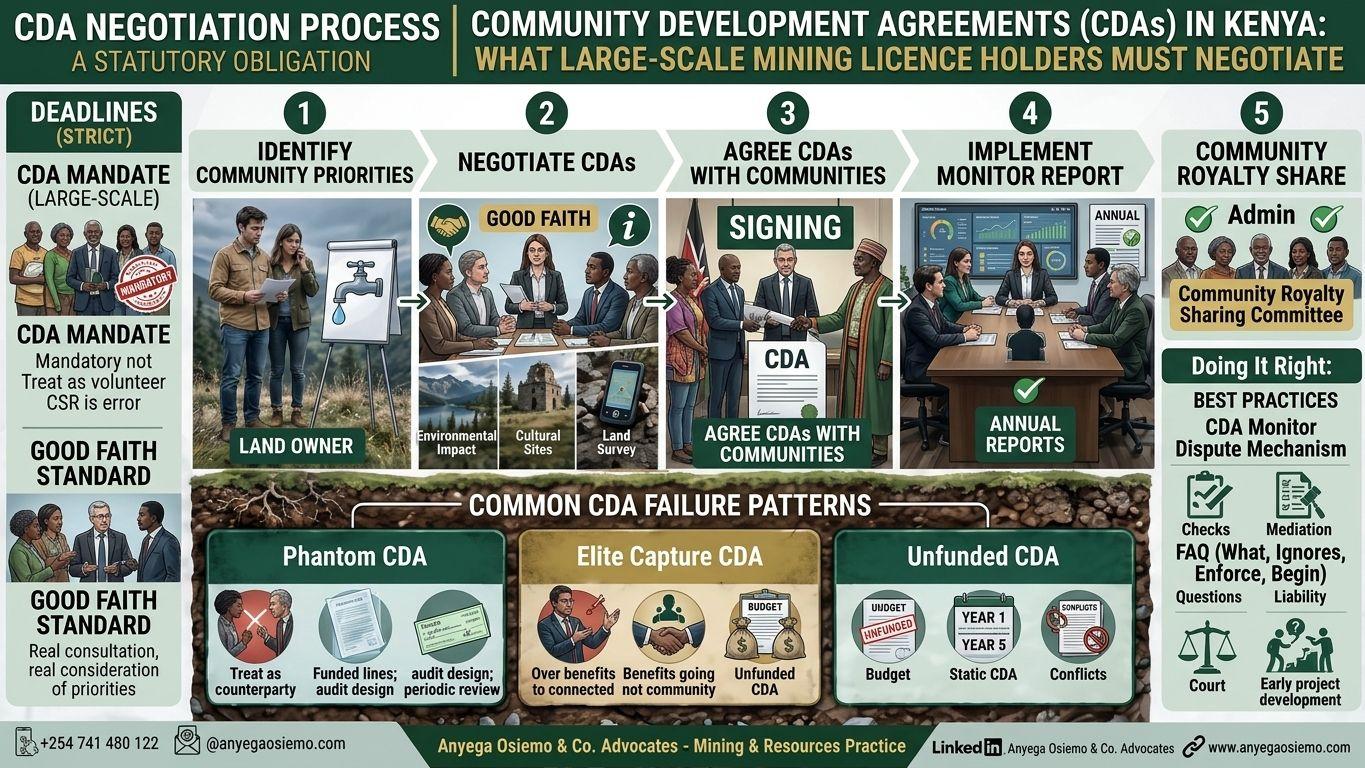
- Review existing community agreements now. Where Community Development Agreements or related arrangements were premised on a 2% community royalty, the applicable baseline has changed. Reassess agreements, budgets, and stakeholder expectations proactively to ensure compliance with the revised statutory entitlement.
- Ascertain royalty obligations with precision. Royalties constitute a statutory cost of production, payable irrespective of profitability. Under-declaration or delayed payment now attracts heightened scrutiny, as both county governments and host communities are entitled to transparency regarding their respective shares.
- Watch the implementing machinery. Who administers the 10% community share, through what structure, and with what accountability, will be worked out in practice and in further regulation. The Community Royalty Sharing Committees proposed under the 2026 minerals policy suggest the government intends formal local administration. Being inside that process as it forms is far better than reacting to it after.
- Maintain comprehensive records of community expenditures. Invest in excess of the statutory share only where the contributions are properly documented, verifiable, and communicated to relevant stakeholders. Entities able to substantiate their contributions are better positioned in any discussions regarding royalty allocations.
What Counties and Communities Should Know
- Monitor royalty entitlements actively. The August 2026 disbursement demonstrates that royalty shares may accumulate for extended periods without being transferred to counties or communities due to unresolved allocation frameworks. Accordingly, entitlements must be actively monitored and pursued. Determine the amounts received by the county, the relevant periods covered, and any outstanding balances.
- Build robust governance for the 10% community share. Absent transparent local administration, there is a risk of misappropriation by local elites, a challenge observed in numerous resource-rich regions. Communities should advocate for and participate in the design of governance structures to manage their share, including decision-making, auditing, and reporting mechanisms.
- Use the legal path where disputes arise. Where communities believe the formula or its administration is unlawful, litigation and legislative engagement are available. Several communities have already signalled their intention to pursue a larger share.
What Investors Should Watch
Treat royalty-sharing formulas as political variables, not fixed costs. Kenya has now moved its community share from 2% to 10% in one step, with public debate openly discussing more. Structure investment models for Kenyan mining to:· treat royalty and community-sharing assumptions as scenarios, not constants· stress-test project economics at higher community shares· value operators with mature community relations as lower-risk than those without
Frequently Asked Questions
Q1. Who decides how the community's 10% is spent?
A. The framework provides for the community share to be administered for community benefit; the precise governance structures are still being developed, with formal Community Royalty Sharing Committees proposed. Communities should engage now in designing those structures.
Q2. Can the formula change again?
A. Yes. Royalty-sharing frameworks are set by regulation and legislation, both of which can be amended, and the political momentum toward larger community shares suggests further change is possible. Treat today’s formula as a floor, not a ceiling.
Q3. Do the new regulations apply to existing licences?
A. Royalties on production are payable under the current framework when minerals are produced and sold. Obtain specific advice on how the new sharing formula applies to the operations and payment cycles.
Q4. What happened to the royalties held since 2016?
A. The government released approximately KSh 2.9 billion in accumulated royalties to 32 counties in August 2026, with Kwale receiving the largest allocation. Counties and communities should verify allocations against production records and pursue any shortfalls.
Disclaimer: This article is general legal information, not legal advice. For guidance on your specific situation, book a consultation with our advocates.