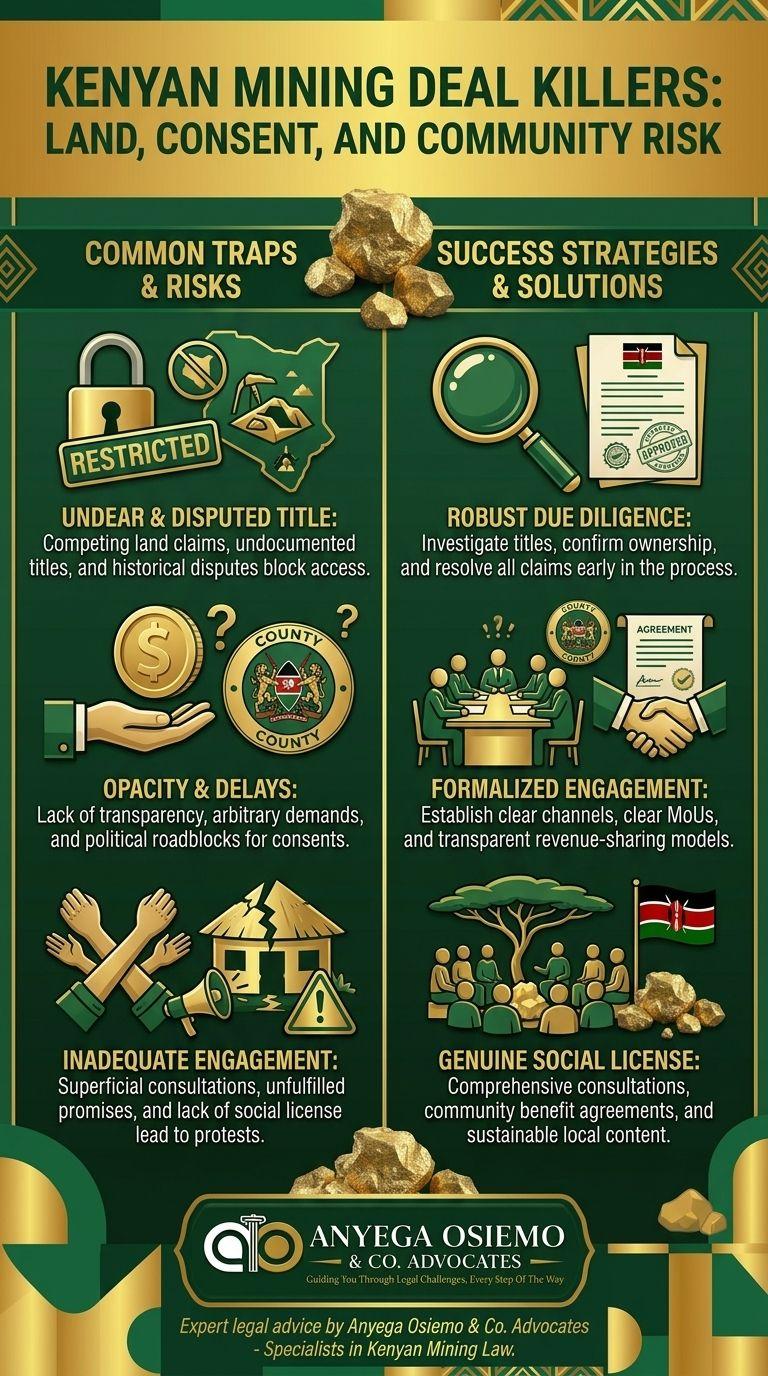
Investors spend months, and millions, verifying orebodies, modeling grades, and negotiating prices, only to lose their investments to a dispute with the family whose ancestral land sits atop the deposit. In Kenyan mining, the geology is rarely the problem. The ground the mine sits on usually is.
Understanding three legal layers land access, county consent, and community relations is the difference between a project that operates and a project that litigates.
Layer 1: A Mineral Right Is Not Land Ownership
The single most common misunderstanding in Kenyan mining investment is the belief that a mining license or permit includes the land above the minerals. It does not. A mineral right authorizes the extraction of minerals; it does not convey the surface. Accessing and using that surface requires separate, lawful arrangements with whoever holds or occupies it.
This means every mining venture must solve two legal problems, not one:
1. The right to the minerals: the mineral right itself
2. The right to be on the land: ownership, lease, license, consent, or negotiated access
A project with a perfect mining license and no lawful land access cannot physically operate. Conversely, surface arrangements without a mineral right are just expensive farming.
Layer 2: County Consent and the County Dimension
Kenya's devolved governance gives county governments a meaningful role in the mining landscape. The licensing framework contemplates county-level consent, and counties matter in practical ways that no register records: local administration, infrastructure, and the area's political economy all run through the county government.
What this means for investors:
- Consent is a process, not a signature. Properly obtained county consent reflects actual engagement. A stamped letter that no one at the county can remember issuing will not protect you when the politics shift.
- Counties have their own priorities. Employment, revenue, local benefits, and projects that ignore them create adversaries with real leverage.
- Due diligence must include the county conversation. Not just "does a consent document exist?" but "what is the actual state of this project's relationship with this county government?"
Layer 3: Community Relations: The Quiet Deal-Breaker
The most dangerous project risk in Kenyan mining rarely appears in any document. It lives in the community around the deposit: expectations about jobs and benefits, grievances about land, historical grievances that predate your project by decades, and the gap between what was promised and what was delivered.
The legal exposure takes familiar forms:
- Disputes over compensation for land access, crop loss, or disturbance often reignited by new operators long after the original arrangements
- Protests and blockades that halt operations regardless of who is legally right
- Boundary and ownership conflicts within the community itself, which your project inherits the moment it picks a side
- Artisanal miners on or adjacent to the license area are a particularly acute issue in the gold counties, where informal workings long predate modern licensing, and whose livelihoods cannot simply be legislated away
The mining license can solve none of these issues. All of them can stop the mine.
What Good Looks Like
Projects that survive these risks tend to share a pattern:
Documented, lawful access: Every hectare of surface access rests on written arrangements with identified parties with authority to grant the,m verified, current, and registered where registration is required.
Genuine county engagement: Relationships built before they are needed, maintained after the license is granted, and reflected in real agreements rather than ceremonial correspondence.
Early, honest community engagement: Disclosure of what the project will and will not deliver; grievance mechanisms that work; benefit-sharing arrangements that are modest, specific, and kept. Communities that trust the process give disputes the benefit of the project; communities that do not do so do not.
A defensible position on artisanal miners. Whether through formalization, cooperation zones, or negotiated transition, the question of existing informal workings is answered deliberately, not discovered at the first site visit.
Due diligence that asks the human questions. Who lives there? Who claims what? Who was here before the license? Who is angry, and at whom? These questions do not appear in registers, nor do they answer themselves.
The Acquisition Angle
For buyers of existing mining assets, these layers are where value hides, and value dies. A project priced on its resource can be worthless if land access rests on verbal agreements, county consent is a fiction, and the community regards the operator as an occupying force. These defects do not show in assay reports. They show up in legal and social due diligence, which is why that work must be done before the price is agreed, not after.
Frequently Asked Questions
Q1. Does a mining license give me the right to enter the land?
No. Surface access requires separate lawful arrangements with the landholder or occupier and, in Kenya's framework, involves county and landowner consent requirements. The mineral right and land access must both be secured.
Q2. What happens if artisanal miners are working inside my license area?
This is one of the most sensitive issues in Kenyan mining and has no one-size answer. Options range from formalization to negotiated relocation, but force without lawful basis creates legal exposure and practical chaos. Specialist advice, early, is essential.
Q3. Can a county government block a mining project?
Counties have real powers and real influence over projects on their territory. A project in genuine conflict with its county government faces a difficult future regardless of its federal permits.
Disclaimer: This article is general legal information, not legal advice. For guidance on your specific situation, book a consultation with our advocates.