When a person dies intestate, their estate does not automatically devolve to their family, regardless of the closeness of the relationship. No individual may lawfully access bank accounts, transfer property, claim insurance proceeds, or transact on behalf of the estate until the court appoints an administrator. This appointment, known as the grant of letters of administration, is often the family's initial formal engagement with the legal system, typically arising at a time of bereavement.
This guide provides a comprehensive overview of the process for obtaining letters of administration in Kenya. It addresses the circumstances in which letters of administration are required, identifies the persons eligible to apply, outlines the necessary documentation, explains the applicable timelines and costs, highlights potential challenges, and sets out the legal duties imposed on administrators following the issuance of the grant.
Probate vs Letters of Administration: Know Which You Need
Both instruments confer legal authority to manage a deceased person's estate, but they arise in distinct legal contexts.
· Grant of probate: issued to the executor named in a valid will. The deceased chose the person; the court largely confirms the choice.
· Letters of administration: issued by the court on application, where there is no will, or where no executor named in a will is able or willing to act. The court selects the administrator from the statutory pool, and it does so in the family's full view.
The following discussion addresses the second scenario, in which the deceased left no will and the family is required to make decisions that were not previously documented.
When Are Letters of Administration Required and When Are They Not?
The grant of letters of administration constitutes the legal authority required to administer the estate. It is essential for accessing bank and M-Pesa accounts, transferring land and vehicles, dealing with share registrars, making insurance claims, managing business interests, and, in current practice, administering digital assets such as cryptocurrency. Limited exceptions exist, for example, where banks may release funds for funeral expenses upon minimal documentation, or where assets pass by survivorship or nomination. Nevertheless, any transaction that requires formal proof of authority will necessitate the grant. Attempting to distribute the estate informally, without the grant, exposes the family to legal disputes, tax liabilities, and personal responsibility for any irregularities.
Who May Apply: The Statutory Priority Order
The Law of Succession Act ranks applicants: the surviving spouse first, then children, then parents, then progressively more remote classes of relatives. In practice:
· The surviving spouse is the natural applicant, frequently joined by an adult child as co-administrator; registries and banks often prefer two administrators, and co-administration protects everyone.
· Persons in the same class four adult children, say apply jointly, or formally consent to one or two of their number, or renounce.
· Lower-priority applicants need the court's leave and face heavier scrutiny, often including sureties.
It is essential that the question of who will apply be resolved within the family before filing. Where the court is presented with a single, uncontested application, the process proceeds efficiently. Where multiple, competing applications are filed by different family members, the court is required to schedule hearings to resolve the dispute, resulting in significant delays.
The Documents: The Complete File
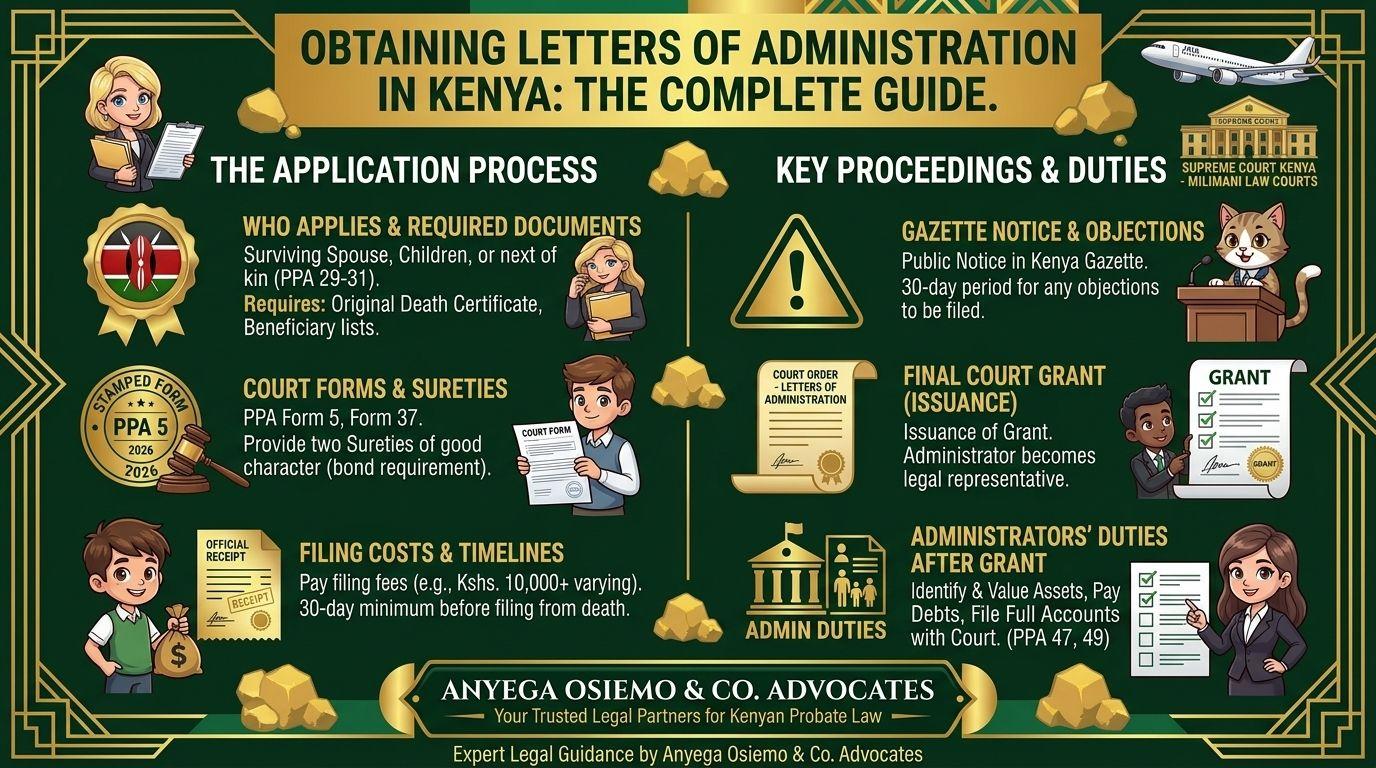
Requirements vary somewhat by registry and estate, but a complete standard file contains:
· Death certificate — certified original; photocopies are rejected.
· Petition for letters of administration in the prescribed form: the deceased, the family, the estate, the proposed administrator.
· Affidavit of means — the sworn inventory of assets and liabilities, valued in Kenya Shillings: land, bank and M-Pesa accounts, vehicles, shares, business interests, chattels, digital assets, and debts owed to and by the estate. Vagueness invites queries; overvaluation creates tax and fee consequences; both delay the file.
· Affidavit of the proposed administrator — relationship, the genuine search for a will, and the undertaking to administer lawfully.
· Consents and renunciations of same-class persons not applying.
· Sureties, where required, typically an insurance-company bond.
· Supporting civil documents — national IDs, marriage and birth certificates to establish the family tree, and land titles or official searches. Failure to include a required document does not merely delay the process; in practice, particularly in busy registries, such omissions can result in delays of several months.onths.
The Process, Step by Step
1. Confirm the absence of a will. Carefully examine the deceased's documents and make enquiries with any advocates who may have acted for the deceased. Filing for administration when a valid will exists is a serious procedural error that may result in wasted costs and delay. The family must also resolve, at this stage, who will apply, who will consent, and who will renounce.
2. Assemble the file: petition, affidavits, consents, death certificate, identity and family documents, inventory and valuations.
3. Lodge the application in the court of competent jurisdiction: Magistrates' Courts for estates within their statutory limits, and the High Court for larger or more complex estates, including those with foreign or digital assets.
4. Public notice. The application must be advertised in accordance with statutory requirements. The grant cannot be issued until the statutory notice period—at minimum, thirty days—has elapsed, thereby providing an opportunity for interested parties to file objections.
5. Objections, if any. Caveats or objections suspend the grant pending resolution. Many estates stall here for reasons unrelated to paperwork.
6. Upon issuance of the grant, the administrator acquires legal authority to act on behalf of the estate and assumes the corresponding legal obligations.
7. Administer the estate: collect and secure all assets, pay funeral expenses, settle debts and taxes, provide for dependants as required, and maintain accurate accounts.
8. Propose and confirm the mode of distribution in accordance with the rules of intestacy. The court will consider the interests of dependants before confirming the grant. Only after confirmation is distribution to beneficiaries lawful.
Sureties and the Administration Bond
Where the applicant is not the surviving spouse or the court otherwise considers security prudent, the Act requires sureties guaranteeing faithful administration, commonly an insurance bond with a premium tied to the estate's value. Expect the requirement to apply when non-priority relatives apply, when minors are involved, or when family harmony is doubtful. Budget the premium and the time to arrange it; discovering the requirement after filing adds months.
Objections, Disputes and Delays
Objections are commonly based on allegations that a will exists, that the proposed administrator is unfit or dishonest, that certain family members have been concealed, that the inventory omits assets, or that there is disagreement within the family regarding administration. Some objections are legitimate, while others are raised for strategic advantage. In either case, substantive objections suspend the grant, and contested succession proceedings can extend for years. Early negotiation, guided by legal advice, is almost always less costly than protracted litigation, which ultimately depletes the estate assets intended for the beneficiaries.
The Administrator's Job After the Grant
The grant is authority and obligation in one instrument:
· The administrator should promptly secure all estate assets by notifying banks, protecting property titles, preparing inventories of valuables, and engaging with exchange and platform accounts in accordance with their estate procedures. Failure to secure assets increases the risk. Pay expenses in the statutory order: funeral and administration expenses first, followed by debts and taxes, then maintenance for dependants, and only thereafter distribution to beneficiaries. An administrator who pays heirs before settling creditors acts in breach of duty. The administrator must act impartially among beneficiaries, maintain accurate accounts, and distribute assets only after confirmation of the grant. Early or informal distribution frequently results in litigation and personal liability.
· Deal with defendants’ claims openly; the court can order reasonable provision for defendants not adequately provided for; anticipate and disclose these interests rather than be ambushed by them.
· Handle special assets properly; land sales need proper valuation and process; business interests need continuity decisions; digital assets need custody, documentation and platform compliance.
Estate Accounts: The Court's Expectations
Estate administration is fundamentally an accounting process with legal implications. The accounts must detail all assets held at death with their values, all collections with dates, every payment categorized and supported by receipts, and the remaining assets with their intended distribution. Vague entries such as 'general expenses' may prompt queries, and unsupported payments may result in personal liability for the administrator. For volatile assets, such as cryptocurrency, each transaction and valuation at relevant dates must be recorded, as these are often subject to scrutiny by beneficiaries. Properly maintained accounts are essential for the administrator's protection and must be available to all beneficiaries.
Small Estates: The Streamlined Route
Small estates may be administered through simplified procedures, typically in the Magistrates' Court, with reduced documentation and less complex requirements. Whether an estate qualifies as 'small' is determined by the value and nature of the assets, not by the family's subjective assessment. It is essential to ensure that all assets are accurately listed and valued before selecting the appropriate process. Legal advice should be sought to avoid procedural errors.
Timeline and Costs
For an uncontested estate with complete documentation, the realistic timeframe from filing to grant is typically six to twelve months or longer, with the statutory thirty-day notice period representing the minimum and registry workloads accounting for additional delay. Contested estates may take years to resolve. Costs include court fees, which scale with the value of the estate, advocate fees agreed in writing at the outset, the surety bond premium where required, valuation fees for land and significant assets, and publication charges. Written professional-fee agreements protect both the family and the law firm; fee disputes during periods of bereavement are corrosive and entirely avoidable. Not every person invited to act as administrator should accept the role. Renunciation—the formal refusal to apply—is appropriate where the proposed administrator resides abroad and cannot manage the process, where family relationships are likely to result in conflict, where the estate's liabilities exceed its assets, or where the individual does not wish to assume fiduciary responsibility. Renunciation should be made early and in the prescribed form. Partial or ineffective administration followed by later renunciation is more detrimental to the estate than an initial refusal. Courts hold administrators to their duties regardless of their willingness to accept the role.
Ten Mistakes That Stall or Poison the Process
1. Applying while a will exists or before a serious search for one.
2. A divided family filing competing applications.
3. Inventories that omit assets later discovered; such omissions undermine the credibility of the administration.
4. Missing consents or renunciations from the same class.
5. Filing in the wrong court jurisdiction; such errors can result in delays of several months.
6. Treating the statutory thirty-day notice period as a mere formality and attempting to expedite it.
7. Distributing assets before confirmation of the grant; this is a common source of personal liability for administrators.
8. Failing to plan for surety requirements and only discovering the need for a bond after filing.
9. Ignoring debts and dependants until they arise during administration.
10. Proceeding without a written fee agreement with professionals.
Frequently Asked Questions
Q1. How long do letters of administration take in Kenya?
A. Uncontested with complete papers: commonly six to twelve months or more from filing to grant, plus administration and confirmation. The thirty-day public-notice period is a statutory floor. Contested matters take years.
Q2. Who should apply for letters of administration?
A. The statutory priority order is spouse, then children, then parents, then more remote relatives subject to consents or renunciations within each class and the court's discretion.
Q3. Do I need sureties?
Often, yes when the applicant is not the spouse, when minors are involved, or when the court requires security. In practice, this means an insurance bond; your advocates arrange it.
Q4. Can the grant be challenged after it issues?
A. Yes, through revocation where it was obtained by fraud, concealment or mistake. Speed matters; delay legitimizes the administration and protects third parties who relied on it.
Q5. What does it cost?
A. Court fees scaling with estate value, advocate fees agreed in writing, bond premium, valuation and publication costs. Proportionate fees exist for smaller estates; ask before engaging.
Q6. Can an administrator sell estate property?
A. Yes to pay debts, taxes and expenses, and as part of distribution with the grant's authority, proper valuation, accounting to beneficiaries, and in line with the confirmed mode of distribution. Undervalued sales to insiders are a classic ground for revocation and personal liability.
Q7. What if we find more assets after the grant?
A. Supplement the inventory and accounts, and account for the new assets within the administration. Concealment cuts both ways; administrators who hide discoveries face the same consequences as heirs who do.
Q8. How are minors' shares handled?
A. Through guardianship and, more robustly, trusts with the court's oversight where required. Assets held for minors under informal family arrangements have a way of evaporating before majority.
Q9. What about digital assets like Bitcoin?
A. They are estate assets like any other: listed in the affidavit of means, secured by the administrator, and released by platforms against the grant. Our companion guides cover the crypto-specific mechanics.
Q10. Do we need a lawyer for letters of administration?
A. Strictly, not always; practically, almost always. The procedural pitfalls above priority, consents, sureties, inventory, confirmation are where self-managed files stall, and the cost of advice is small against the value at stake.
How We Can Help
At Anyega Osiemo & Company Advocates, we guide families through letters of administration from the first difficult week to the final distribution: family and priority assessments, petition and affidavit preparation, surety arrangements, objections and disputes, administration and accounting, confirmation of the grant, and estates involving businesses, land and digital assets. While a will would have made all of this simpler, we also prepare one for you so your family never has to read this guide about you.
If you are facing an intestate estate, contact us; the sooner the file is right, the sooner the family can heal.
This article provides general information about Kenyan succession law and does not constitute legal advice. Registry practice and court requirements vary, and every estate depends on its own facts. For advice on your specific situation, contact Anyega Osiemo & Company, Advocates.
Disclaimer: This article is general legal information, not legal advice. For guidance on your specific situation, book a consultation with our advocates.