A lockout by a business partner often manifests through sudden loss of access to company email, bank accounts, and premises, typically without prior notice, meeting, or formal resolution. Such actions are executed unilaterally, without adherence to the required corporate procedures.
It is essential to distinguish between loss of access and loss of ownership or rights. Being excluded from company operations does not equate to forfeiture of your shares or your legal rights as a shareholder or director under the Companies Act, 2015. The actions taken in the immediate aftermath are critical in determining the outcome of the dispute.
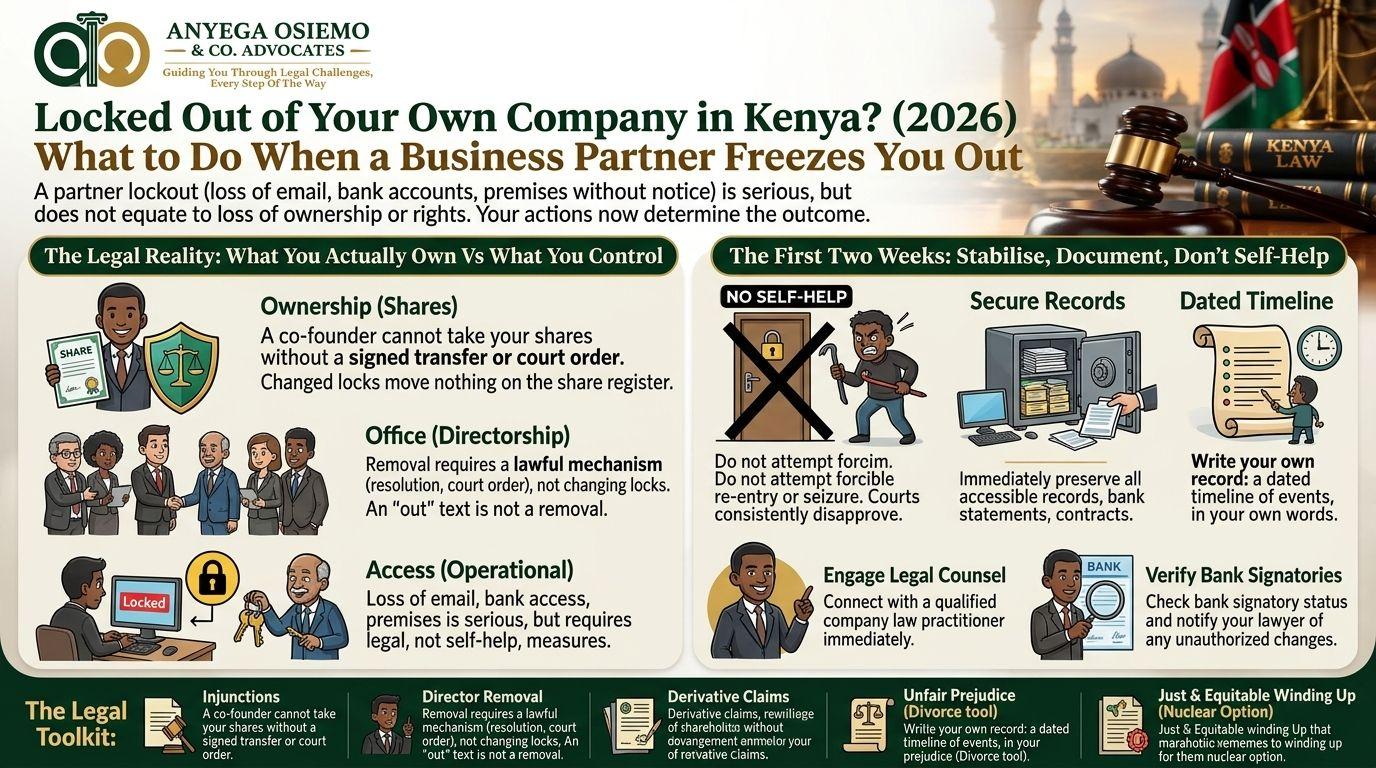
The Legal Reality: What You Actually Own Versus What You Control
It is necessary to distinguish between three separate legal concepts that are often conflated during a lockout:
- Ownership: your shares. A co-founder cannot take your shares without a signed transfer or a court order. Changed locks move nothing on the share register.
- Office: directorship. Directors manage the company, and a director can sometimes be removed, but only through lawful mechanisms (a shareholders' resolution, resignation, disqualification, or court order), not by changing the locks. An "out" delivered by text message is not a removal.
- ·Access: bank mandates, records, email. These are operational, and the law treats their obstruction seriously, but restoring them requires either negotiation or court intervention, not self-help.
A common and serious error is to respond to a loss of access with self-help measures, such as forcibly re-entering the premises or seizing company assets. Courts consistently disapprove of such conduct, regardless of the other party's initial wrongdoing.
The First Two Weeks: Stabilise, Document, Don't Self-Help
1. Secure and preserve all available company records, including financial statements, bank records, contracts, correspondence, share registers, and board minutes. Immediate action is required to retain any accessible information.
2. Write your own record: a dated timeline of events, in your own words, with witnesses noted.
3. Do not attempt to regain access through unlawful means, such as breaking into premises, seizing assets, or redirecting client payments. Such actions are likely to be used as evidence against you.
4. Engage a qualified company law practitioner without delay. Prompt legal advice is essential, as the opposing party may be taking steps to consolidate their position.
5. Verify any changes to bank signatory status and instruct your legal counsel to notify the bank if such changes were effected without proper authority.
The Legal Toolkit
Kenyan company law gives a locked-out shareholder real instruments, roughly in order of escalation:
- Inspection and information rights. Shareholders have statutory rights to company records. A formal records demand, often the first letter, puts the company on notice that obstruction will be litigated.
- Injunctions. Where assets are being dissipated, contracts diverted to side entities, or the business run to your exclusion, courts grant injunctions fast: restraining the partner from dealing with company assets, from removing you, from diverting business and restoring the *status quo* while the dispute is heard.
- Director removal. Directors can be removed by an ordinary resolution of shareholders with the statutory notice period; the reverse sword cuts both ways, and if you hold, or can assemble, the votes, the removal of the rogue partner from the board is a legitimate objective.
- Derivative claims. Where the wrong is to the company stolen funds, diverted contracts the Companies Act permits shareholders to bring claims in the company's name against the wrongdoing directors, with court permission. The recovery goes to the company, which is exactly where you want it.
- Unfair prejudice. The Act's unfair-prejudice remedy is the classic "business divorce" tool: when the company's affairs are conducted in a manner prejudicial to your interests as a shareholder, the court can order buyouts, regulate conduct, or grant other relief. Most lockout disputes end here with a buyout at a court-imposed price.
- Just and equitable winding up. For deadlocked or fundamentally broken ventures, the Insolvency Act's just-and-equitable ground lets a shareholder ask the court to dissolve the company and distribute its assets. It is the nuclear option and precisely because it is nuclear, it re-prices every negotiation beneath it.
Negotiated Exit Versus Litigation
In most cases, the appropriate approach to a lockout dispute is to treat it as a matter for negotiated exit rather than protracted litigation. A typical settlement involves an independent business valuation, a structured buyout arrangement, non-compete and non-solicitation covenants, mutual releases, and clear procedures for the transfer of interests. Litigation serves to protect the business and facilitate a fair settlement, rather than to perpetuate conflict. Clients who follow this structured approach generally incur significantly lower costs than those who pursue litigation solely on principle.
A Worked Example: The Friday Lockout
A composite case. Two founders, 60/40, run a logistics company. The majority founder, suspecting the minority of courting a competitor, has the locks changed, the minority's email disabled, and KShs 8 million moved to a "holding account" over a single Friday. The minority founder's response, on advice, is not a raid on Monday morning: it is a documented records demand, an urgent application restraining further movements of company funds and the removal of the minority director, and a derivative claim threatened over the KShs 8 million. Faced with a preserved business, a frozen escape route for funds, and a partner who will demonstrably litigate, the majority settles in weeks: the minority exits at an independently valued price, KShs 8 million is returned with accounts, and the non-compete protects the company in both directions. The company survives; one founder exits richer and unembarrassed; the other keeps a business worth keeping. Litigation shaped the settlement; it never needed to be the settlement.
Mistakes Locked-Out Shareholders Make
- Self-help re-entry seizing assets or forcing access converts the wronged into the wrongdoer.
- Assuming the lockout was legal locks are not resolutions; directorships end by law, not by locksmith.
- Delaying counsel while the other side consolidates accounts, clients and records.
- Destroying evidence in anger: deleted emails and smashed laptops become their exhibits.
- Suing for everything instead of sequencing: preserve first, recover second, exit third.
- Ignoring the bank: signatory changes made without authority should be challenged immediately.
- Valuation naivety: accepting a partner's "the business is worth nothing now" price without an independent valuation.
- Fighting for the job instead of the value: courts buy people out; they rarely force partnerships back together.
- No non-compete in the settlement and the departing partner rebuilds next door with your client list.
- No shareholder agreement before the dispute: the single cheapest instrument for preventing everything above.
Frequently Asked Questions
Q1. Can my partner legally lock me out of the company?
A. No, not by changing locks or cutting access. Removing a director or diluting a shareholder requires lawful corporate action; obstruction is challengeable, often urgently.
Q2. I own 49%. Do I have any power?
A. Yes, minority shareholders hold statutory inspection rights, derivative claims, the unfair-prejudice remedy, and, in broken ventures, winding-up rights. Votes matter less than these instruments.
Q3. How do I stop money leaving the company?
A. Urgently, through the court: injunctions restraining transactions, bank notification where signatory changes were improper, and preservation orders over disputed funds.
Q4. What is unfair prejudice?
A. A statutory remedy where the company's affairs are run prejudicially to a shareholder's interests: exclusion from management, diversion of business, oppressive conduct remedied by buy-outs and conduct orders.
Q5. How long does a company dispute take?
A. Interim protection: weeks. Full determination: a year or more. Which is why interim orders and negotiated exits are most common in these cases.
Q6. Can I force my partner to buy me out?
A. Through the unfair-prejudice route, a court can order a buy-out at a fair value, and the credible threat of that order drives most voluntary settlements.
Q7. What is the company worth?
A. An independent valuation should be conducted on an asset-based, earnings-based, or blended approach, rather than being influenced by the subjective views of either partner. In the event of a valuation dispute, the parties may negotiate the method of resolution, with mechanisms such as expert determination providing a cost-effective means of settling such disagreements.
Q8. Should I report this to the police?
A. Where the conduct in question amounts to criminal offences such as theft, forgery, or fraud, it is appropriate to consider making a criminal complaint. Such complaints may be pursued alongside civil proceedings. However, it is important to understand that criminal proceedings serve primarily to apply pressure rather than to secure recovery, and should be coordinated with legal counsel.
Q9. Can we dissolve the company?
A. If the company is genuinely deadlocked and no longer able to function, an application for winding up on just and equitable grounds may be made to the court. This process enables the dissolution and distribution of the company's assets. It is a significant remedy and should be used with careful consideration.
Q10. How do I prevent this ever happening?
A. A comprehensive shareholder agreement should address reserved matters, mechanisms for resolving deadlock, exit provisions, valuation clauses, and rules for the removal of directors. Such a document is essential for preventing disputes and potential lockouts, and its cost is typically far less than the expense of resolving them after they arise.
Disclaimer: This article is general legal information, not legal advice. For guidance on your specific situation, book a consultation with our advocates.