Ask a mining company owner whether their licenses are compliant, and you will almost always hear yes. Ask for the filing history that proves it, and the room goes quiet. In our experience advising on mining acquisitions in Kenya, the royalty and returns file is where the gap between "compliant and actually compliant" reveals itself and where acquirers discover, too late, that they have bought a compliance backlog along with the gold.
This article explains what Kenyan mineral right holders are required to file and pay, how to verify it, and what the findings mean for your transaction.
What Holders Must File and Pay
Under Kenya's mining framework, mineral right holders carry recurring obligations that fall broadly into three buckets:
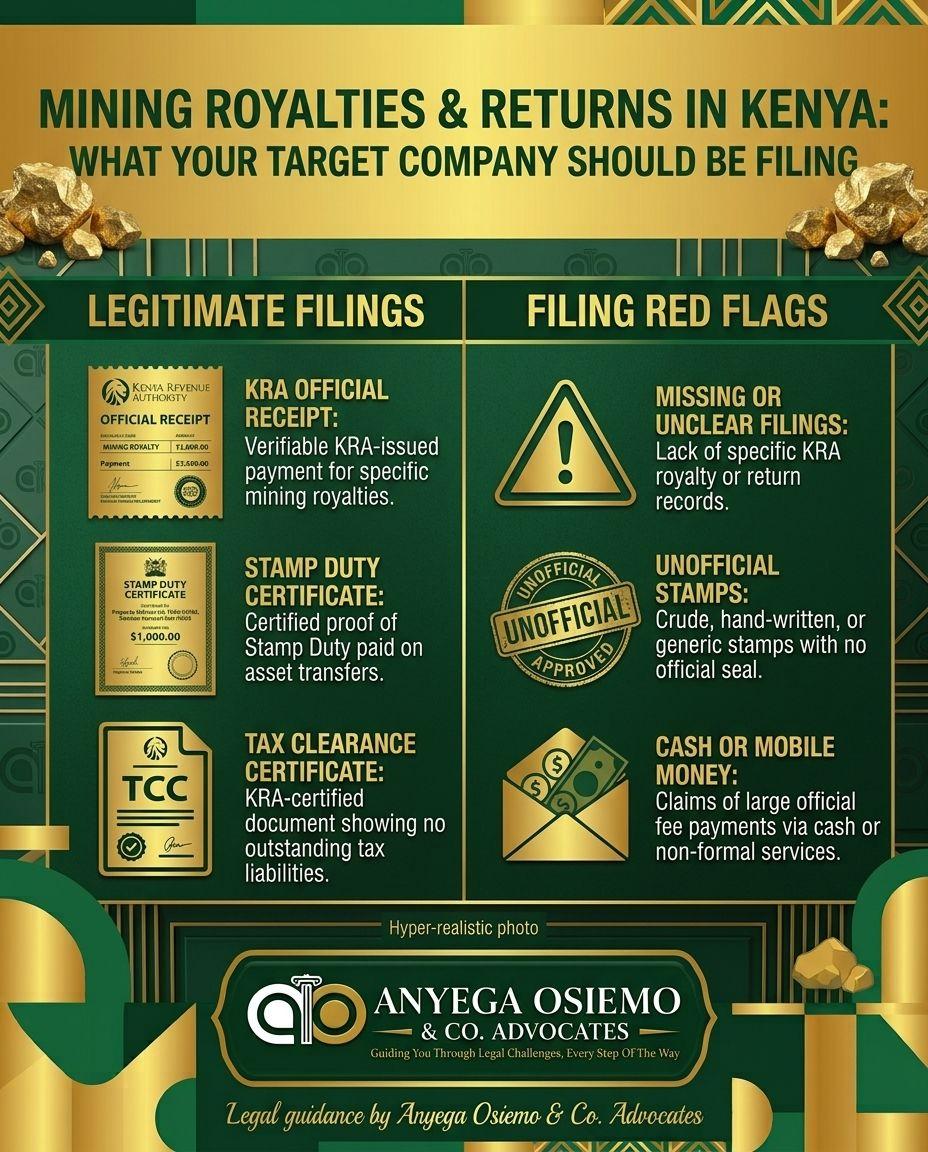
1. Financial obligations. Royalties on minerals produced, payable to the state, together with annual rent on the right itself. Both are continuing obligations; they do not pause when production pauses, and they do not forgive when cash is short.
2. Periodic returns. Holders must file prescribed returns for their operations, including production and royalty-related returns, as well as other statutory reports required by the Act and regulations. These returns are the state's window into the operation and the holder's paper trail of legitimacy.
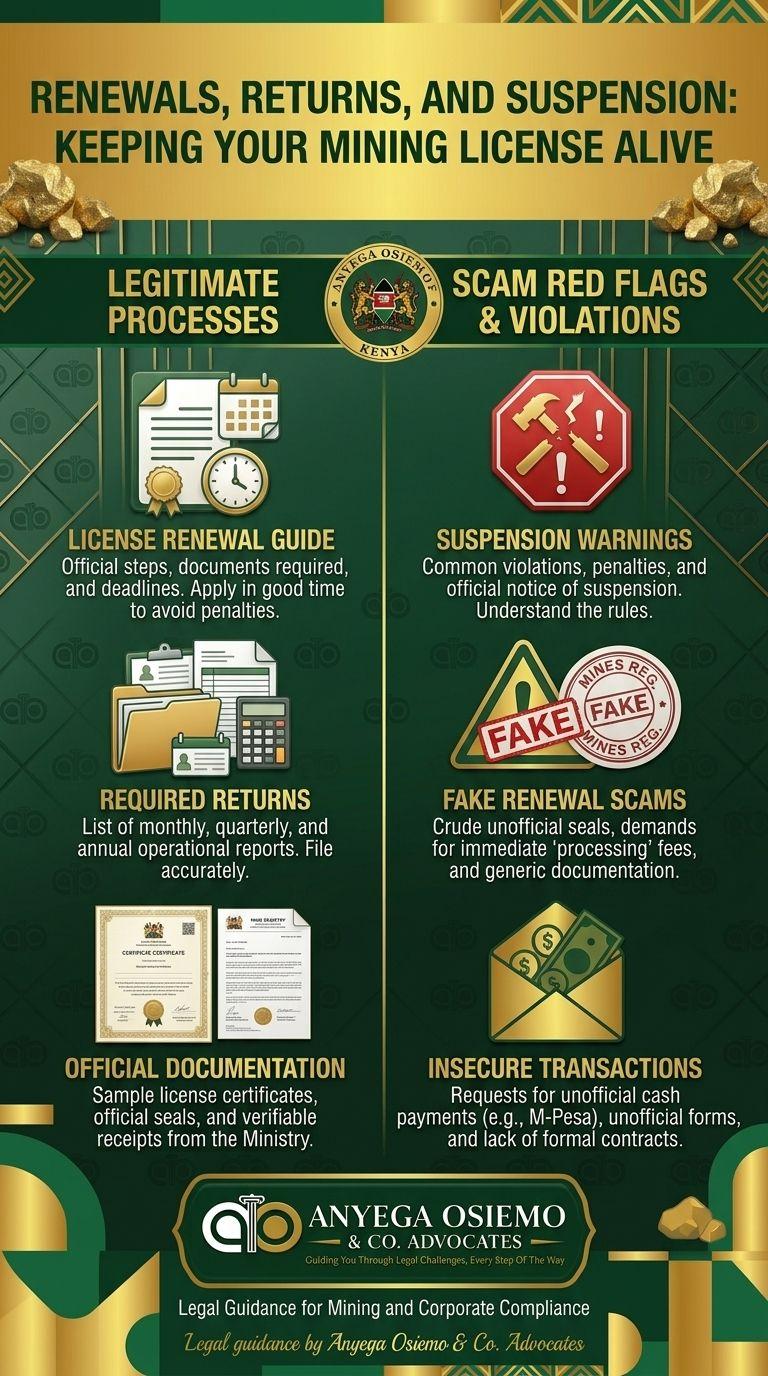
3. Annual rent and renewal-related obligations. Rent falls due annually; renewals must be applied for before expiry; work programs approved at grant must be performed and reported.
The Act and current regulations set the specific rates, forms, and deadlines, which are subject to change. What does not change is the principle: the obligation is continuous, and the paper trail either exists or it does not.
Where the Bodies Are Buried
In acquisition due diligence, royalty and return records reliably surface four problems:
Non-filing. Returns never made. Sometimes the holder never understood the requirement; sometimes the operation was informal longer than anyone admits. Either way, statutory non-filing exposes the right to enforcement and the company to penalties.
Under-declaration. Production reported below reality is a serious matter that shades into revenue offenses. A target that has been selling more than it declares has tax and royalty exposure that will not stay behind after closing.
Unpaid royalties and rent. Arrears attach to the right. Buy the company, buy the arrears; buy the right, and you still must regularize before the Ministry will smile on your transfer or renewal.
A shadow operation. Sometimes the filings are complete and clean and contradict everything else. Ore moved off site without invoices; buyers with no contracts; export volumes nobody declared. When the paper trail is cleaner than the physical reality, the paper trail is the fiction.
How to Verify: Documents and Cross-Checks
Start with the target's own records: returns filed, receipts, royalty computations, ledgers. Then cross-check, because records provided by the counterparty are claims, not proof:
- Ministry records. Confirm filings and payment status directly with the relevant authorities, through your advocates.
- KRA position. Tax compliance certificates and filings reveal whether the revenue side matches the production story.
- Bank and sales records. Do the receipts match declared production? Material divergence is a finding that changes the deal.
- Physical indicators. Plant throughput, stockpiles, and site activity production that visibly exceeds declared volumes are red flags no document review should miss.
What Findings Mean for the Deal
Not every gap is a deal-breaker: every gap is a pricing or structuring event:
- Curable arrears can be settled at or before closing with the price adjusted to make the seller pay for their own history
- Systemic under-declaration changes the risk calculus entirely: exposure may exceed what any indemnity can realistically cover
- Warranty and indemnity packages should specifically address royalty, return, and tax compliance, drafted tightly enough to survive closing
- Holdbacks and escrows tied to compliance regularization align the seller's interest with the truth of their disclosures
- In serious cases, the right answer is to walk. A bargain priced on undeclared production is not a bargain; it is a transfer of liability to someone with deeper pockets than yours
The Operator's View: Why Compliance Is Also Defense
For operators, the same obligations frame the discipline: file on time, pay on time, keep the paper trail immaculate. The compliance file is not bureaucracy; it is what the right is worth. Licenses with clean histories transfer at premiums; licenses with messy histories transfer at discounts or not at all. Every skipped return is a discount you will one day pay, with interest, to a buyer who did their homework.
Frequently Asked Questions
Q1. What royalties apply to gold mining in Kenya?
Royalties on minerals are prescribed under the mining framework and current regulations and can change over time. For any transaction or operation, confirm the current applicable rates and bases with the authorities or your advisers rather than relying on figures quoted from memory or old documents.
Q2. Do these obligations apply to small-scale permit holders too?
Yes, obligations scale with the right, but they do not disappear at small scale. Rent, returns, and royalties apply across the licensing tiers, and small-scale operations are a frequent focus of regularization efforts.
Q3. How far back should compliance due diligence go?
At a minimum, cover the period during which the seller has held the right, with attention to the renewal history and any gaps in ownership. Historic non-compliance by a prior holder can still complicate transfers and renewals today.
Disclaimer: This article is general legal information, not legal advice. For guidance on your specific situation, book a consultation with our advocates.