The central feature of most gold scams linked to Kenya is the creation of fictitious fees. Typically, the purported buyer has already paid for the gold, which is then claimed to be held in a warehouse, refinery, or at the airport. The fraudsters then demand an additional payment, such as an export permit fee, tax clearance, or anti-money laundering certificate, as a precondition for release.
Victims often pay these fees because they appear official, are accompanied by forged documentation, and because the alternative is to acknowledge the loss of substantial sums already paid.
This article identifies the common fictitious fees encountered in such scams, outlines the legitimate official processes that are imitated, and provides guidance on distinguishing genuine charges from fraudulent demands.
The Fake Fee Catalog
Across the gold fraud cases documented by Kenyan law enforcement and reported in the press, the same invented fees appear again and again:
1. The export permit fee. The scammer claims the gold cannot leave Kenya without an export permit and that the fee must be paid to them, or to a "facilitator," before release. Payment demands of tens of thousands of dollars are typical.
2. The tax clearance fee. The story: the seller owes withholding tax or capital gains tax on the transaction, which must be settled before the gold is released. Sometimes the scammer even offers to "share" this cost.
3. The AML / anti-money laundering certificate. The fraudsters claim Kenyan regulations require an AML compliance certificate for the transaction, and that they have "arranged" one for a fee.
4. Customs and storage charges. Daily "storage fees" for gold stored in a warehouse or at an airport, escalating the longer the victim delays.
5. Insurance and security fees. Special transport insurance, armed escort charges, "diplomatic clearance."
6. Refining or assay "processing" fees. Charges to "certify" the gold before export, imitating legitimate assay costs.
7. The "government connection" fee. Payment to a claimed official who can expedite the paperwork.
Each of these fictitious fees is loosely based on an element of the legitimate process, which is what enables the fraud to succeed.
What the Official Process Actually Looks Like
Kenya does regulate gold export. But the official process looks nothing like what the scammers describe:
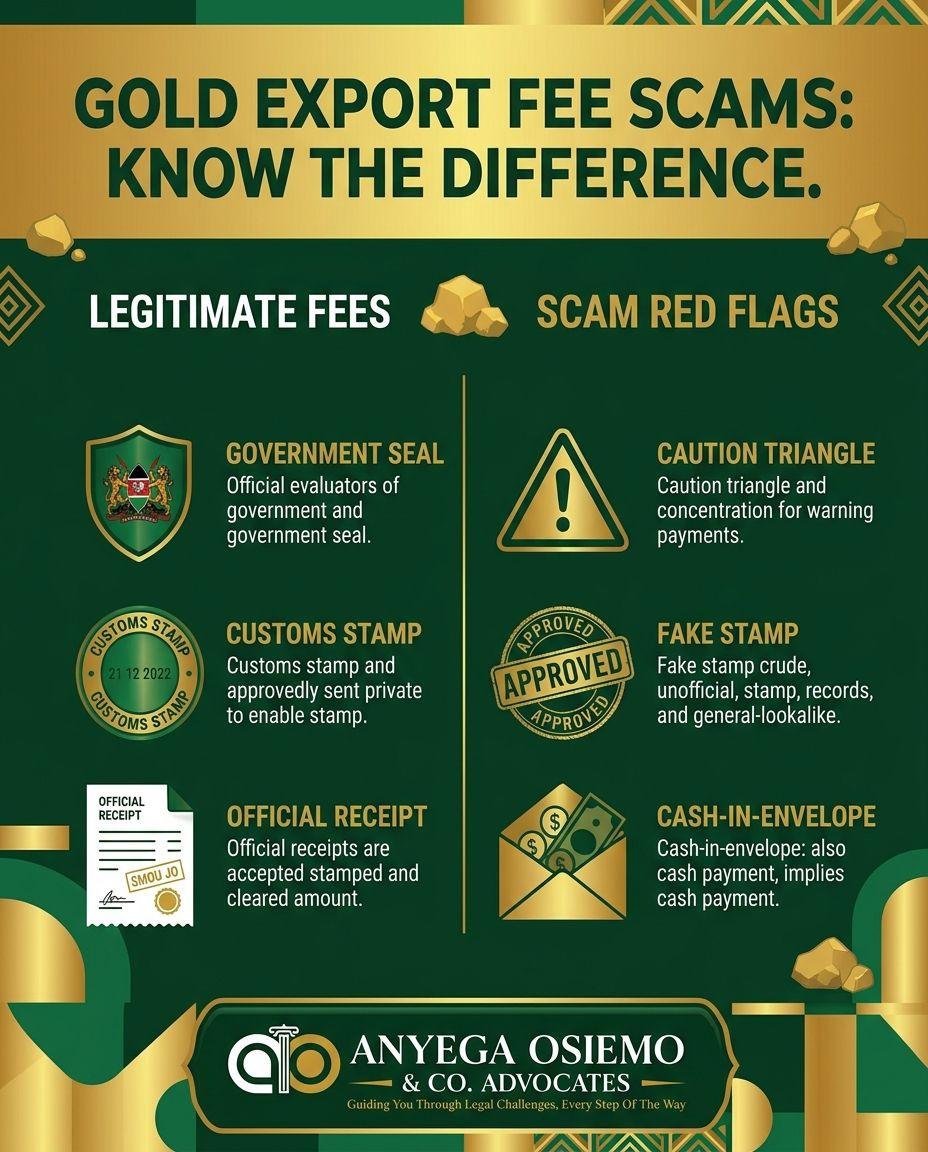
- Mineral export permits are issued by the Ministry responsible for mining through official channels applied for through formal processes and paid to government revenue accounts, not to companies, individuals, or "facilitators."
- Taxes on legitimate transactions are declared and paid through the Kenya Revenue Authority's official systems, typically as part of a documented commercial transaction with contracts and invoices.
- There is no AML certificate that a private buyer must purchase from a third party to receive gold.
- Government fees are never paid in cash to an individual, via personal bank accounts, through mobile money to a private number, or into foreign accounts held by "agents."
The most reliable principle is that in any legitimate transaction, all government charges are paid directly to the relevant government agency through traceable official channels and against official receipts. Any request for payment to a company, individual, or intermediary, rather than directly to the government, should be treated as a warning sign.
Why Victims Keep Paying
The persistence of invented fees can be attributed to several factors:
1. Sunk costs. After making substantial payments, victims may consider making further payments as a rational means of recovering their investment. Fraudsters exploit this by presenting each new fee as the final requirement.
2. Imitation of legitimacy. Fraudsters use forged receipts, counterfeit official letterheads, and impersonation of officials to create the appearance of a legitimate bureaucratic process.
3. Plausibility. Kenya does require export documentation for minerals. Victims who verify this requirement may incorrectly assume that the fees demanded by fraudsters are genuine.
The Verification Test to Identify Fraudulent Fees
Before making any payment in connection with a gold transaction in Kenya, determine whether the fee can be paid directly to the issuing authority, through official payment channels, and with an official receipt.
- If yes, pay it that way, and only that way.
- If payment is requested to be made to the seller, their lawyer, or any facilitator on behalf of the authority, the transaction should be treated as fraudulent.
Secondary checks: verify the permit or certificate's serial number with the issuing agency; confirm any claimed government office through official directories (not the numbers provided by the seller); and have your own Kenyan lawyer confirm what the transaction is, legally. Legitimate transactions can be structured to mitigate risk by using escrow arrangements through an independent law firm, with funds released only upon verified delivery and assay. This ensures that no payments are made for non-existent gold.es" are paid for gold that does not exist.
What - Cease all further payments. Additional payments increase the financial loss and perpetuate the fraudulent scheme.- Cease all further payments. Additional payments deepen the loss and fund the fraud.
- Preserve all documentation, including receipts, invoices, transfer records, correspondence, names, phone numbers, and details of recipient bank accounts.
- Report the matter to the Directorate of Criminal Investigations or the police, identifying the recipient bank accounts as evidence. Recent cases demonstrate that arrests can result from such reports.
- Seek legal advice promptly regarding civil recovery and freezing orders. The recipient accounts may still contain traceable funds, but timely action is essential.
Frequently Asked Questions
Q1. Are gold export permit fees real in Kenya?
Export permits themselves are real and legally required. But they are obtained through the Ministry's official process, and fees are paid to official government accounts, never to a seller, agent, or "facilitator" in advance of a private deal.
Q2. How can I verify an export permit is genuine?
Verify directly with the Ministry responsible for mining, using contact details from official government sources, never details supplied by the seller. Your own lawyer can do this verification for you.
Q3. I paid a "release fee," and the gold still hasn't arrived. What now?
Treat it as fraud, stop all payments, preserve evidence, report it to the police, and seek legal advice on recovery options immediately.
Disclaimer: This article is general legal information, not legal advice. For guidance on your specific situation, book a consultation with our advocates.