Ask anyone who has shepherded a mining application through the Kenyan system where the time goes, and you will hear one answer above all: the EIA. The Environmental Impact Assessment, administered by the National Environmental Management Authority (NEMA), is a hard prerequisite for mining operations, and it is the stage where timelines slip from months into years.
The frustrating part is that most of the delay is avoidable. This article explains how the process works, why applications stall, and how to prepare so that your EIA moves at the speed of the process rather than the speed of your surprises.
Why the EIA Matters So Much
Mining is a classified high-impact activity under Kenya's environmental law. You cannot lawfully commence a mining operation without an approved EIA and the associated license. Because the mining license framework requires it, the EIA sits squarely on the critical path: no EIA, no license, whatever the 90-day statute says.
This is by design. An EIA is not a box-tick; it is a study that predicts how your operation will affect water, land, air, biodiversity, and the communities around it, and commits you to managing those impacts. Regulators, financiers, and increasingly buyers all read it. A weak EIA haunts a project for its entire life.
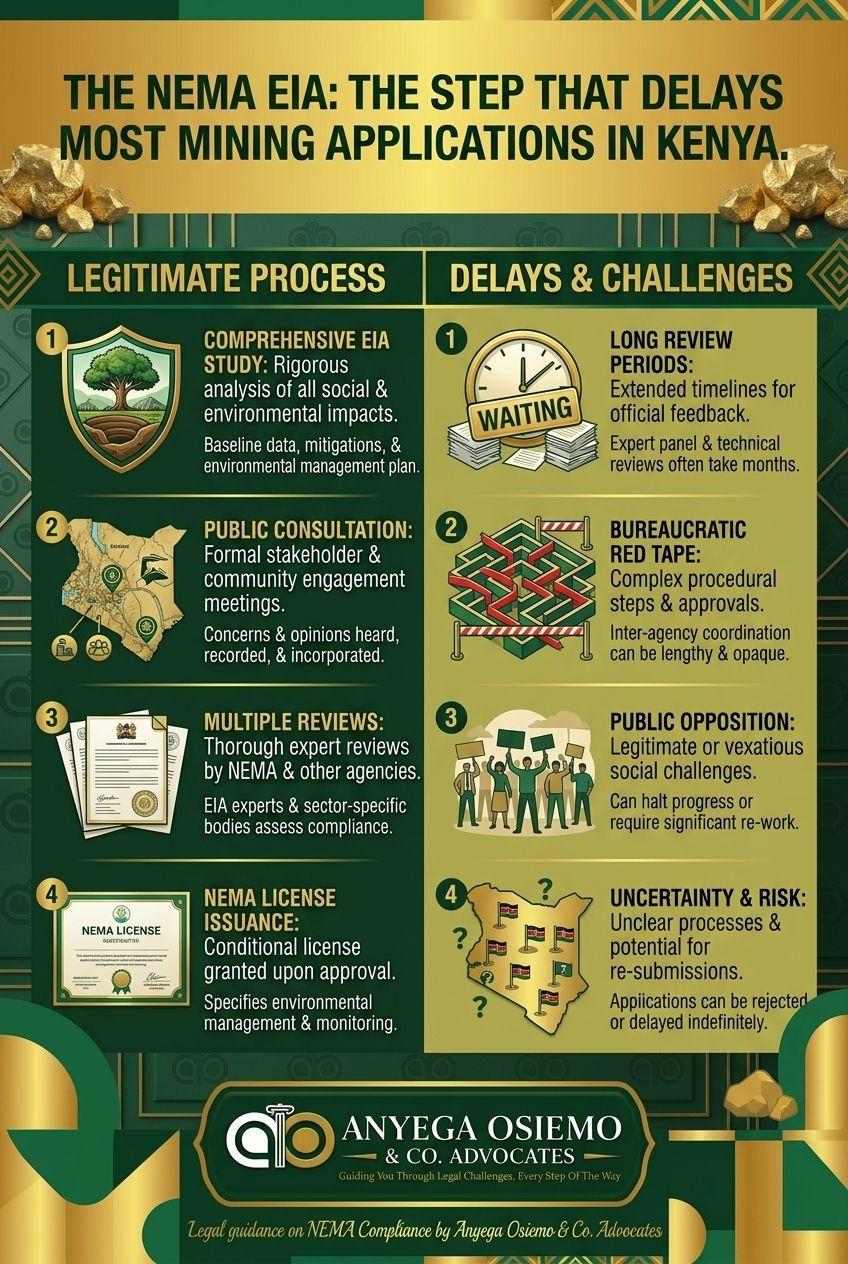
How the Process Works, in Outline
While every project differs, the EIA sequence follows a recognizable shape:
1. Screening and project registration. The project is registered with NEMA, its category has been confirmed, and the scope of assessment has been agreed.
2. Terms of reference (ToR). The baseline studies the EIA must cover water, soils, flora and fauna, socio-economic conditions, and cultural heritage are defined. A thorough ToR agreed upfront prevents catastrophic scope disputes later.
3. Baseline studies. Fieldwork across seasons where relevant. This is the technically demanding, calendar-driven stage and the one most underestimated at project planning.
4. EIA report preparation. A licensed environmental consultant compiles findings, impact predictions, mitigation measures, and an environmental management plan.
5. Public participation. Kenyan law requires affected communities and stakeholders to be consulted, with their input recorded. This stage is non-negotiable, and attempts to rush it or stage-manage it reliably backfire.
6. Review and approval. NEMA reviews the report, seeks input from relevant agencies and the public record, and decides. Approval attaches conditions the environmental management plan the operation must then live by.
Where Applications Actually Stall
Underestimating the baseline. Studies scoped too narrowly get rejected or returned for more work. Water studies that miss a season; biodiversity surveys that skip the migration; socio-economic baselines that interview the wrong people each add months.
Consultant problems. Cheap, overloaded, or inexperienced consultants produce reports that reviewers return, repeatedly. The consultant is not a place to save money.
Public participation done as theatre. Consultations held where the affected communities cannot attend, held once where the law and the situation require ongoing engagement, or findings ignored in the final report all generate objections, and objections generate delay.
Community conflict surfacing at review. The EIA process is often the first formal forum where land grievances, tensions over artisanal mining, or benefit expectations receive a hearing. Projects that have done no early community work meet these issues here, at the worst possible time.
Politics and timing. Review timelines can, in practice, stretch beyond the notional ones. Applications that arrive complete, credible, and uncontroversial move faster because reviewers have fewer reasons to slow them.
How to Prepare So the EIA Does Not Eat Your Timeline
Start the EIA before you need it. The single most effective tactic: begin baseline work while the mining application is being prepared, not after. The 90-day mining license clock means nothing if your EIA has a year of fieldwork ahead of it.
Choose the consultant carefully. Track record of mining EIAs in Kenya, capacity to conduct fieldwork properly, and willingness to defend the report during review. Ask for their approval history.
Do the community work first. Genuine engagement before the formal consultation makes the formal consultation what it should be: a confirmation, not an ambush.
Budget realistically. Proper baseline studies across multiple seasons, quality reporting, and legitimate public participation cost real money. Under-budgeted EIAs are the most expensive kind.
Treat conditions as design inputs. The environmental management plan you commit to becomes your operating constraints. Negotiate it with an understanding of what compliance will actually require, on-site, not as a document to be filed and forgotten.
The Strategic View
Savvy developers treat the EIA as an asset, not an obstacle. A well-executed EIA with genuine community engagement is the foundation of a project's social license; it is the document financiers and acquirer’s price; and it is what separates the projects that operate from the projects that litigate. The delay caused by the EIA is temporary. The problems it prevents are permanent.
Frequently Asked Questions
Q1. How long does a mining EIA take in Kenya?
A. Realistically, many months to over a year depending on project scale, baseline complexity, and public participation. Timelines vary widely; the planning mistake is assuming the fast case.
Q2. Can I start mining with an application pending?
A. No. Commencing operations without the required environmental approval is an offense and exposes the operation to enforcement regardless of mining license status.
Q3. Who prepares the EIA?
A. A firm licensed to conduct EIAs under Kenyan law. Your legal team coordinates the consultant, the mining application, and the regulatory interface so the pieces move together
Disclaimer: This article is general legal information, not legal advice. For guidance on your specific situation, book a consultation with our advocates.