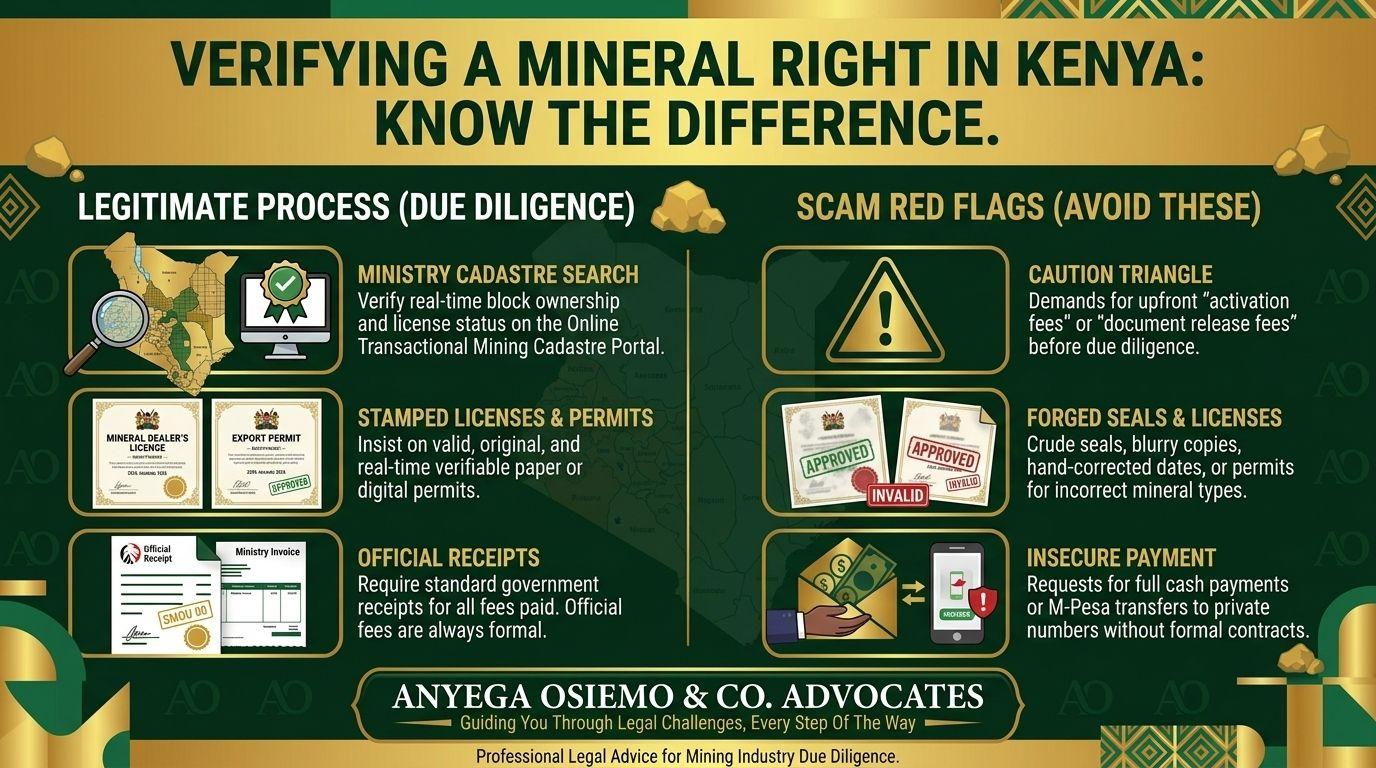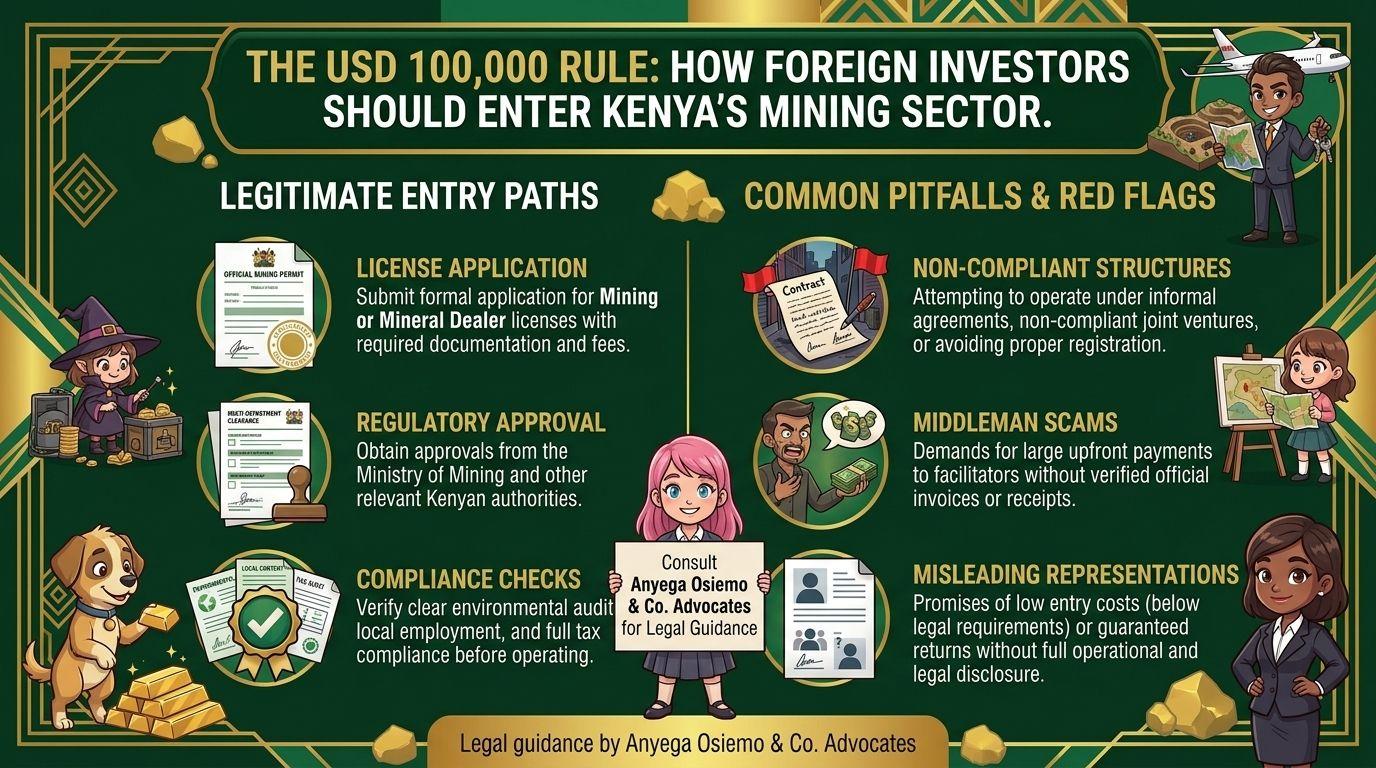
Kenya's mining sector attracts significant international interest: its gold, its gemstones, its position in East Africa's mineral economy. But foreign investors arrive with a critical misconception: that Kenyan mineral rights are open to anyone who applies. They are not. The Mining Act imposes a threshold that filters out tourists and tests the seriousness of genuine entrants: foreign applicants must demonstrate a minimum investment of USD 100,000.
This article explains what the rule actually requires, how to structure your entry to satisfy it, and the sequence of steps that gets foreign investors from interest to lawful operation.
What the Rule Actually Means
The USD 100,000 threshold is a qualification requirement, not a fee. It exists to ensure that foreign entrants bring real capital, real commitment, and real capacity, not speculative applications over ground they will never develop.
In practice, demonstrating the threshold involves:
- Evidence of funds: bank statements, audited accounts, or equivalent proof from credible institutions, showing the capital available for the investment
- A credible use of funds: the investment must connect to the proposed operation- exploration work, equipment, development, infrastructure not merely sit in an account
- Proper structure: the applicant entity, its ownership, and its funding must be documented and lawful
The threshold is best understood as the floor of a seriousness test. An application backed by exactly USD 100,000, with a credible plan, will outrank one backed by more money but with no plan.
How to Structure Your Entry
Foreign investors typically enter through one of three structures:
Sole foreign applicant. A foreign company applies in its own name. Clean and direct, but it means the foreign entity holds all obligations directly: compliance, tax registration, local presence requirements.
Kenyan subsidiary. Incorporating a Kenyan company (fully or majority foreign-owned) to hold the right. This is the most common serious-entrant structure: it localizes the compliance burden, satisfies local-presence expectations, simplifies banking and taxation, and creates the vehicle through which local partners, employees, and operations run naturally.
Joint venture with a Kenyan holder. Partnering with an existing right-holder contributing capital and expertise to a licensed asset. Faster entry and local knowledge built in, but demanding of due diligence: the partner's right must be verified, the JV's governance must be airtight, and the capital must be protected against the classic failure modes of local partnerships.
The right structure depends on your strategy: explorers building from scratch lean on a subsidiary; acquirers of existing assets weigh share purchase against fresh application; venture investors structure around the partner's reality.
1. Strategy before structure. Decide what you are actually doing: exploring for new ground, acquiring an existing right, or partnering into an operation. Each path has different approval mechanics, timelines, and risks.
2. Incorporate and register. Establish your Kenyan presence: company registration, tax registration with KRA, bank accounts, and the administrative spine of a compliant operation.
3. Prepare the evidence of investment. Compile the financial documentation that meets the threshold, properly sourced and properly documented, in a form accepted by Kenyan authorities. This is where early legal advice pays: evidence assembled carelessly gets applications rejected slowly.
4. Choose your ground. Cadaster searches to identify available, uncontested areas or, for acquisitions, to conduct full due diligence on an existing right.
5. Assemble the application. Complete documentation: the forms, the work program, the evidence of financial and technical capacity, the environmental pathway, landowner and county consents, the whole file, prepared before lodgment rather than assembled in response to queries.
6. Lodge and manage. Application through the Mining Cadaster Portal, engagement through the review process, and the patience to let the 90-day framework work while keeping the file responsive.
7. Build the compliance system. From day one of holding: calendar, records, filings, rent, returns. Foreign holders fail disproportionately at this stage; the obligations continue whether or not anyone is watching from abroad.
The Mistakes Foreign Entrants Make
Treating the threshold as the strategy. USD 100,000 qualifies you to apply; it does not fund a mining operation. Serious exploration and development budgets are multiples of the threshold, and authorities know it.
Skipping the local presence. Rights held by absentee foreigners with no Kenyan substance attract scrutiny and complicate everything from banking to enforcement. A real local presence company, people, advisers is not optional in practice.
Buying into someone else's problem. The fastest entry is buying an existing right, and the fastest way to inherit arrears, disputes, and revocation risk is buying without due diligence. The foreign premium for "turnkey" opportunities is usually a discount on trouble.
Structuring around the rules. Nominee arrangements, disguised ownership, and threshold-evasion schemes occasionally appear in this sector. They collapse, and when they collapse, they take the investment, the right, and sometimes the investors' liberty with them.
The Bigger Picture
Kenya welcomes serious mining investment; the framework is modern, the cadaster is functional, and the country needs the capital. What the framework resists deliberately is speculative, absentee, or cosmetic entry. Foreign investors who arrive with real capital, real plans, real local structure, and real compliance discipline find a workable system. The rule exists to separate them from the rest; satisfying it properly is how you join the right category.
Frequently Asked Questions
Q1. Does the USD 100,000 apply to all foreign applicants?
A. The threshold applies to foreign investment in mineral rights under the mining framework. The specifics of how it is evidenced and applied should be confirmed for your particular structure and application requirements, and applied to the facts.
Q2. Can I apply for a mineral right remotely, without visiting Kenya?
A. Much of the process can be managed through local representation, advocates, agents, and your local company. But serious entrants plan real presence; operations cannot be run from abroad, and the framework expects substance.
Q3. How long does the whole entry process take?
A. From incorporation to granted right, realistically, several months to over a year, depending on the path, application quality, and the environmental timeline. Budget the long case and treat the short case as a bonus.
Q4. Is joint venturing with a local holder safer than applying fresh?
A. Safer in some ways, riskier in others; it depends entirely on the partner and the asset. Verification and structure are everything in JVs; enthusiasm is not a substitute for due diligence.
Disclaimer: This article is general legal information, not legal advice. For guidance on your specific situation, book a consultation with our advocates.